New tool converts classic PlayStation 2 games to PC and eliminates cumbersome emulators
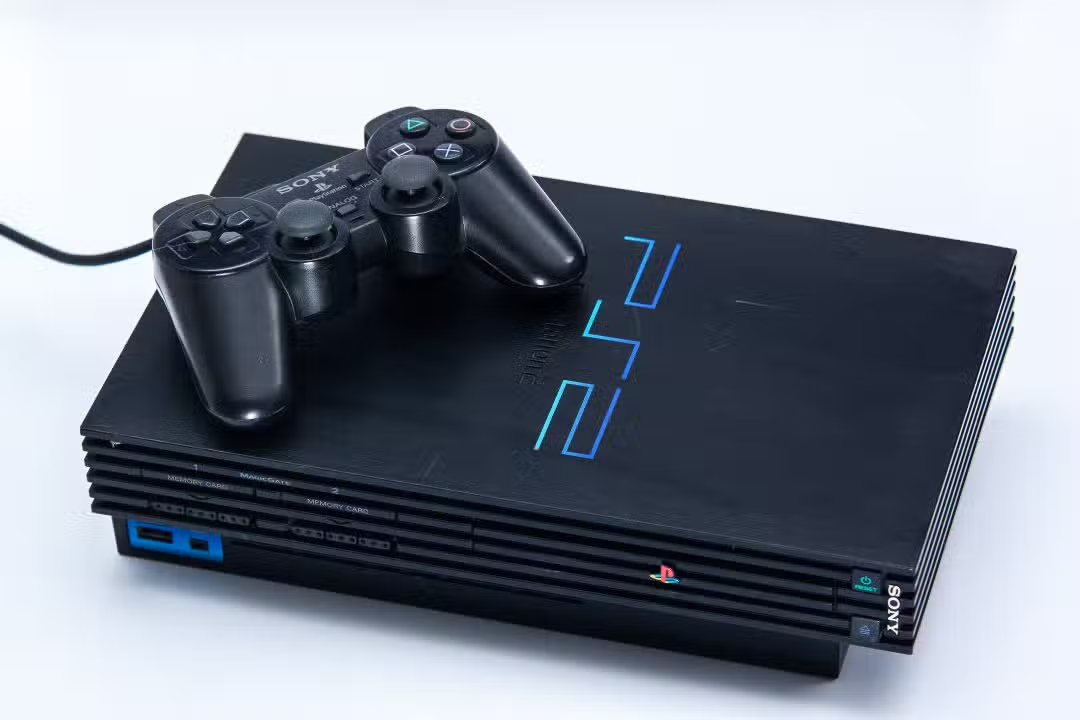
A significant innovation in the digital game preservation scenario recently emerged through the work of a Brazilian programmer. The project, called PS2Recomp, proposes a distinct technical approach to running titles from the best-selling console in history on modern computers. Diferente from traditional methods that simulate old hardware, this new solution recompiles the original game binaries directly into the C++ language, creating native executables for systems like Windows and Linux.
The initiative led by developer Ranieri Alfas aims to eliminate performance barriers often associated with emulation. By transforming the game code to an architecture compatible with current processors, the software removes the need for real-time translation of console instructions. The source code has been made publicly available on GitHub, allowing other enthusiasts and software engineers to collaborate on compatibility improvements and expansions.
PS2 GAMES RUNNING NATIVELY ON PC WITHOUT EMULATION!
PS2Recomp, a project created by a Brazilian, which uses static recompilation to convert PS2 binaries into C++ code, allowing native versions of games on PC.
PROJECT IS NOT READY, but the work has started!pic.twitter.com/LblIGHIGHg
— Senhor Linguica (@SenhorLinguica)January 26, 2026
Preliminary demonstrations indicate that the tool can already process and run commercial games with stability. The technique used, known as static recompilation, promises not only greater fluidity on powerful machines, but also makes gameplay viable on devices with limited resources, which would normally choke when trying to simulate the complex architecture of the PlayStation 2.
The technical recompilation process
The operation of PS2Recomp is based on translating instructions from the Emotion Engine processor, the heart of the Sony console, into instructions understandable by modern x86 or ARM CPUs. The software analyzes the original executable files (ELF format) and generates new code in C++. Este resulting code is then compiled, generating a program that runs natively on the user’s operating system, without the middle layer of a conventional emulator.
This conversion encompasses not only the main processor, but also the vector coprocessors and floating point units that gave the console its characteristic power. A runtime system accompanies the generated executable to manage system calls and hardware-specific functions that cannot be translated directly, ensuring that game logic remains intact.
The complexity of the MIPS R5900 architecture used in the original console has always been a challenge for reverse engineering. However, the static recompilation approach allows for optimizations that occur before the game even starts. Isso results in drastically lower CPU usage during gameplay, freeing up system resources for other tasks or graphical enhancements.
Advantages over traditional emulation
Classic emulators, like the popular PCSX2, work by interpreting the console’s code in real time. Although this approach has achieved a high degree of compatibility over the years, it requires considerable processing power to maintain the original synchronization and speed. The recompilation method eliminates this overhead because the computer executes native instructions, resulting in faster load times and lower command latency.



In addition to the pure performance gain, native execution makes it easier to implement modern improvements. Desenvolvedores and modders can integrate support for ultra-wide resolutions, unlocked frame rates, and high-definition textures much more easily than would be possible by injecting code into an emulator. The project structure allows specific fixes for game bugs to be applied directly to the recompiled code.
Legacy preservation and compatibility
The PlayStation 2 has a vast library, with thousands of titles that marked generations and defined genres. The preservation of these games is a constant concern, especially for works that have never received official re-releases or remasters. The tool offers new hope for these classics to remain accessible regardless of changes to future hardware platforms.
Among the titles that can benefit from this technology are great critical and public successes. Running native may fix persistent graphics issues in games that utilized Sony-specific hardware tricks. The list of potential beneficiaries includes:
- Action and adventure classics that require precision in commands and suffer from input lag in emulators.
- Extensive RPGs that can gain quick save and instant loading features.
- Racing games that demand stable frame rates for a satisfying experience.
- Obscure titles that experience rendering failures in traditional emulation due to complex architectures.
Conversion to native executables also resolves the dependency on proprietary BIOS files, which often represent a legal gray area in emulation. By focusing on translating the game’s software, the project moves away from the need to replicate the console’s operating system, focusing on preserving the interactive work itself.
Potential for portability and mobile
One of the most promising prospects for PS2Recomp is the ease of portability to architectures other than Windows. Como the end result is C++ code, it can be compiled to run on Linux environments and, crucially, on Android devices. Isso opens the door for smartphones and tablets to run PS2 games with much greater energy efficiency than current emulators.
Portable gaming devices and PC-based handheld consoles would also benefit immensely. The reduction in CPU consumption directly translates into longer battery life and less heat generation, critical factors for the mobile experience. The project already demonstrates technical feasibility for these adaptations, depending only on adjustments to the graphic and interface libraries.
Community engagement and future
The open development model adopted by Ranieri Alfas has attracted the attention of programmers around the world. The project repository records constant activity, with contributors helping to map unknown instructions and refine support for audio and video libraries. Essa Collective collaboration is essential to cover the wide range of programming variations found in the console’s library.
Inspired by similar projects carried out for the Nintendo 64, PS2Recomp seeks to achieve a level of automation that allows any user to convert their legally acquired games with a few clicks. Embora Still in the experimental phase, the rapid progress demonstrates the interest and demand for more robust and efficient preservation solutions.
The future of the tool depends on the continuity of these community efforts. As more games are tested and validated, the compatibility database grows, transforming the project into a fundamental piece in the history of video games. The ability to play classics with modern software performance ensures that the PlayStation 2 legacy lives on for new audiences.
Veja Tambem em News (EN)

Research reveals that parents are unaware of how their children use artificial intelligence

Samsung releases new system update with new features for Galaxy Watch 4 users

Digital retail reduces the value of the Galaxy S25 5G smartphone with bank bonuses and device exchange
Amazon’s wireless CarPlay adapter has a 50% discount and high approval ratings from drivers

Zach Cregger’s new Resident Evil ignores games and focuses on an unprecedented story with new characters

Rumor suggests that Nintendo is preparing a special edition of the Switch 2 with a remake of Ocarina of Time

Apple accelerates production of the iPhone 17e and develops new Air model with dual camera system

Epic Games platform releases twelve high-budget games at no permanent cost for PC users

PlayStation 5 Pro price drop accelerates digital retail sales and eliminates global stocks

New Galaxy Watch 9 firmware appears on server and confirms progress in software development

Apple’s commemorative project tests cell phone with 1.1 millimeter edge and curved screen for 2027