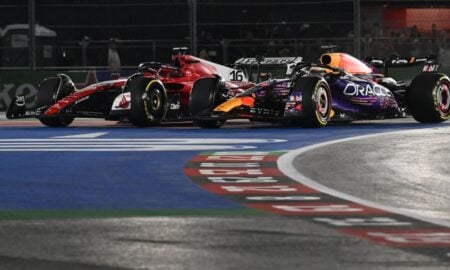
Red Bull imposes a strong pace at the opening of the tests and Verstappen surpasses McLaren in Bahrain


The Circuito Internacional of Sakhir was the stage for the official start of track activities for the new season of Durante the morning session of the first day of pre-season testing, the Red Bull Racing demonstrated that it maintains its dominant form, with the current world champion setting the speed benchmark for the rest of the grid. The initial performance suggests that the Austrian team has managed to further refine its technical package, sending a clear message to its rivals in the first hours of open timing.
It didn’t take long for Max Utilizando medium compound tires, the Dutchman showed consistency and aggressiveness, indicating that the team’s new model preserved the qualities of its predecessors while correcting any weaknesses. The ease with which the time was achieved, without the apparent need to push the equipment to its maximum, left the paddock alert about the car’s real potential for the upcoming championship.

Tight competition at the top of the timesheets
Despite Red Bull’s leadership, the session was not a complete monologue. McLaren, confirming the evolution shown in the final stretch of last season, positioned itself as the closest challenger. Oscar Piastri drove the British team’s car with precision, ending the morning with a deficit of just 0.169 seconds over the leader. The young Australian’s performance reinforces the thesis that McLaren can be a constant force in the fight for podiums, presenting a balanced and fast car right out of the pits.
The proximity between the times of Verstappen and Piastri, both using similar tire compounds for their fast laps, suggests that qualifying in the first stages may be closer than anticipated. Analistas noted that although the Red Bull has a theoretical advantage in race pace, the McLaren’s pure speed in a single lap is a promising indication of the show’s competitiveness. The Woking team appears to have resolved aerodynamic efficiency issues that limited its performance on certain types of tracks.
Focus on reliability at Mercedes and Ferrari
While Red Bull and McLaren grabbed the headlines for their lap times, Mercedes and Ferrari took different approaches, prioritizing data collection and systems verification over pure speed. George Russell, driving Mercedes, completed an extensive program focused on mileage, finishing the session with the third fastest time. The German team seeks to validate the correlations between the wind tunnel and the track, ensuring that the new concept car does not suffer from the rear instability issues that have plagued previous models.
Carlos Sainz, driving for Ferrari, followed a similar route, recording the fourth best mark of the day. The Italian Scuderia focused its efforts on long runs to understand tire behavior and engine thermal management. The lack of attempts at low-fuel fast laps by these two teams indicates that they are playing a long game, preferring to build a solid base of success before unleashing the full power of their power units. Reliability was the highlight for both, who completed their programs without serious mechanical complications.
Technical difficulties and interruptions on the track
Not all teams have had a problem-free start to the preseason. Williams faced its first significant setback of the year with Alexander Albon. The Thai driver was forced to stop the car on the track due to a technical fault, which triggered the yellow flag and temporarily halted the session. The incident, later identified as a problem with the fuel pump and transmission system, cost the Grove team valuable development time.
Albon’s car was stopped in an escape area, requiring the intervention of inspectors for safe removal. Esse type of failure, although common in pre-season testing where parts are pushed to the limit for the first time, puts pressure on Williams mechanics and engineers. Cada minute lost in the pits represents less data for understanding the new aerodynamic package, something critical for a team looking to move up in the midfield. The team worked frantically to diagnose the fault and return the car to the track as quickly as possible.
The importance of aerodynamic sensors
A striking visual aspect of this first morning was the extensive use of aerodynamic sensor grids, known as “aero rakes”, installed in several cars, including the Ferrari. Esses devices, which resemble large metal antennas mounted on the sides or rear of vehicles, are essential for measuring air flow in real conditions. Teams use this data to confirm that the turbulence generated by the tires and the flow directed towards the diffuser match computer simulations.
For the engineers in Maranello and Brackley, correctly correlating this data is more valuable than any lap time recorded on day one. If sensors indicate that the air is behaving as predicted, teams can proceed with development and upgrades. Caso Otherwise, weeks of work may be required to correct fundamental flaws in the project. The massive presence of these instruments indicates that the current technical regulations still allow room for different aerodynamic interpretations between constructors.
Perspectives for the sequence of tests
With the end of the morning session, attention turns to the afternoon, when track temperatures tend to drop, approaching the conditions that will be found in qualifying and the race of the Grande Prêmio of the Bahrein. Pilotos as Lando Norris, taking over the McLaren cockpit, and Charles Leclerc, as Ferrari, are scheduled to continue their respective teams’ programs. The expectation is that lap times will drop as the track gains grip and teams begin to carry out qualifying simulations.
The Red Bull, with confidence renewed by the performance of the Verstappen, should focus on refining the car’s balance with different fuel loads. Para the rivals, the afternoon will be crucial to try to reduce the apparent disadvantage and find answers to the pace imposed by the current champions. The start of pre-season confirmed some expectations, but also made it clear that the battle for development during the year will be intense, with reliability playing as decisive a role as pure speed.