
Remnants of the planet Theia in the Earth’s mantle reinforce the theory of the giant impact that created the Moon 4.5 billion years ago

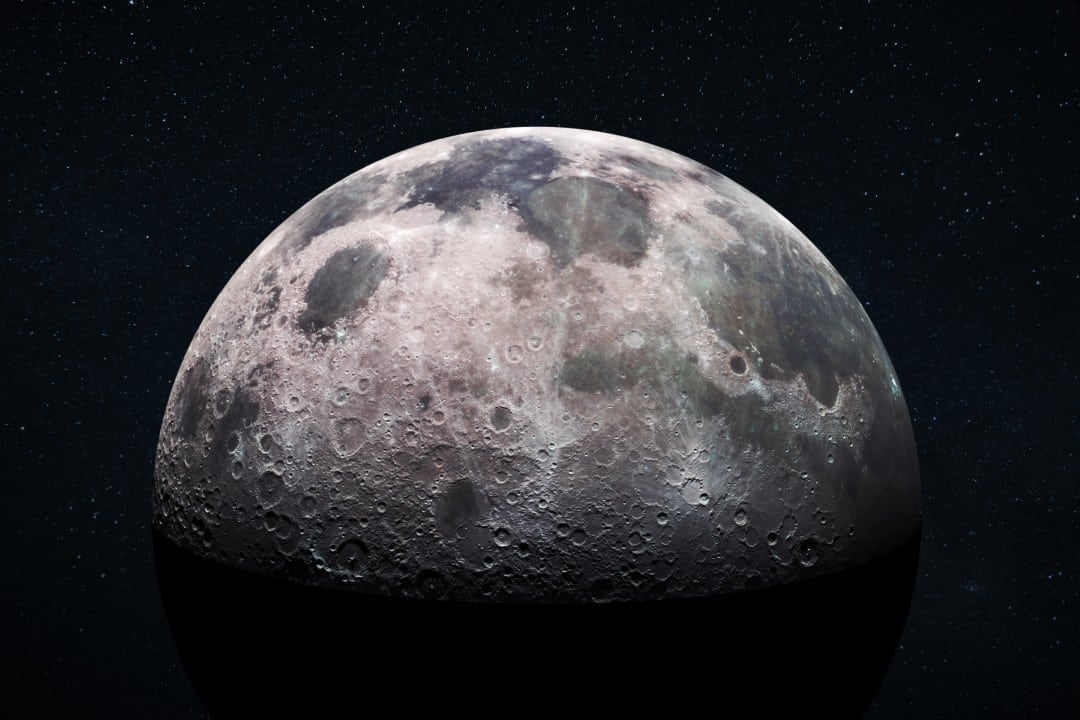
The giant impact hypothesis continues to be the most accepted model by the scientific community to explain the formation of Lua. A protoplanet called Theia, similar in size to Marte, collided with the primitive Terra approximately 4.5 billion years ago. Esse event ejected a large amount of material that coalesced and formed the natural satellite.
Recent studies have identified anomalous structures in the Earth’s mantle that may be direct remnants of this protoplanet. Essas formations, known as low seismic velocity provinces, have a distinct composition and occupy deep regions of the planet. Pesquisas published in specialized magazines indicate that they represent portions of the mantle of Theia incorporated into Terra after the collision.
The chemical similarity between terrestrial and lunar rocks reinforces this explanation based on analyzes of samples collected on the Apollo missions. Modelos computational models simulate the process and demonstrate how the impact generated the conditions currently observed.
Giant impact hypothesis consolidates as main explanation
The theory emerged in the 1970s and 1980s as a response to the limitations of previous models about the origin of Lua. Cientistas proposed that a high-energy collision would better explain the features observed in the Terra-Moon system. Initial Simulações showed that a body the size of Marte could eject enough material to form a debris disk around Terra.
This disk later coalesced and gave rise to Lua in a relatively quick process. The hypothesis gained strength with data from the Apollo missions, which brought lunar samples with an isotopic composition very close to that of Earth. Outras theories, such as capture or coformation, were gradually discarded as they did not explain these similarities.
Chemical and isotopic evidence from lunar rocks
Analysis of rocks collected on the Apollo missions revealed high similarity in the ratio of oxygen isotopes between Terra and Lua. The Esse pattern indicates that both bodies formed from material originating in the same region as the Sistema Solar. The lunar samples also show signs of exposure to extreme temperatures, consistent with a violent impact event.
Researchers identified depletion of volatile elements in the rocks of Lua, which occurs in high-energy collisions. Estudos comparisons with meteorites and terrestrial samples reinforce that Lua could not have originated by fission or independent capture. Essas evidence accumulated over the decades and consolidated the impact model.
Anomalous structures in the Earth’s mantle
Two large provinces of low seismic velocity, known as LLVPs, are located at the base of the Earth’s mantle, one under África and the other under Pacífico. Essas regions have higher density and propagate seismic waves more slowly than the surrounding material. Modelos geophysicists indicate that they occupy a volume equivalent to several continents combined.
Research carried out in 2023 suggests that these structures correspond to fragments of the mantle of Theia preserved after the collision. Simulations show that the densest material on the protoplanet gradually sank to the edge of the core. Essa embedding explains seismic anomalies detected by global station networks.
Advanced computational modeling
High-resolution simulations reproduce the impact between the primitive Terra and Theia in increasingly greater detail. The models consider parameters such as collision angle, speed and composition of the bodies involved. Resultados indicate that much of Theia’s mantle mixed with that of Terra, while the protoplanet’s core sank deeper.
These computations also demonstrate the rapid formation of a debris disk that evolved into Lua within hours or days. Recent Avanços incorporate terrestrial seismic data to validate the presence of exogenous material in the mantle. The simulations continue to be refined with greater processing power.
Implications for terrestrial stabilization
The presence of Lua exerts a gravitational influence that stabilizes the axis of rotation of Terra. Essa stability maintains climate variations within limits favorable to the development of life. Sem the satellite, the planet would show extreme oscillations in its axial tilt.
The impact with Theia also contributed to the internal differentiation of Terra and the beginning of plate tectonics. The energy released heated the mantle and facilitated convection processes that drive continental movement. Esses effects have shaped the planet’s geological evolution over billions of years.
Alternative theories and their abandonment
- The fission hypothesis proposed that Lua broke away from Terra by rapid rotation, but it did not explain the similar chemical composition nor the current orbit;
- The capture model suggested that Lua was gravitationally attracted, but it did not justify the absence of highly elliptical orbits expected in this process;
- Coformation indicated simultaneous formation of Terra and Lua as a dual system, but failed to explain the iron deficit in Lua;
- All of these proposals were discarded as isotopic and dynamical evidence accumulated.
Advances in recent space missions
Missions like the Chinese one Chang’e brought samples from regions not previously explored on Lua. Esses materials expand the database for chemical comparisons with terrestrial rocks. Programas and Artemis plan collections at the lunar south pole to obtain additional information.
These initiatives allow for more accurate analyzes of isotopes and trace elements. The results help refine models about the original composition of Theia. Novas samples contribute to better understanding the post-impact mixing process.
Contributions from international institutions
Researchers from Instituto Max Planck, NASA and American universities are leading studies on the topic. International Colaborações integrate global seismic data to map LLVPs with greater accuracy. Equipes use supercomputers to run complex simulations.
These multidisciplinary works combine geophysics, geochemistry and astrophysics. Publicações in magazines such as Nature and Science publish advances periodically. Cooperation accelerates understanding of the primordial events of Sistema Solar.
Future research perspectives
New seismic imaging technologies promise greater resolution of Terra’s deep structures. Missões planned lunar rovers will collect samples from ancient craters for detailed analysis. Modelos computing systems will continue to evolve with greater processing capacity.
These developments will allow us to test hypotheses about the extent of mixing between terrestrial and Theia materials. Pesquisas also investigate possible influences on the formation of the Earth’s core. The topic remains active in the international scientific community.



