
Trajectory analysis confirms safe passage of new interstellar visitor through the solar system

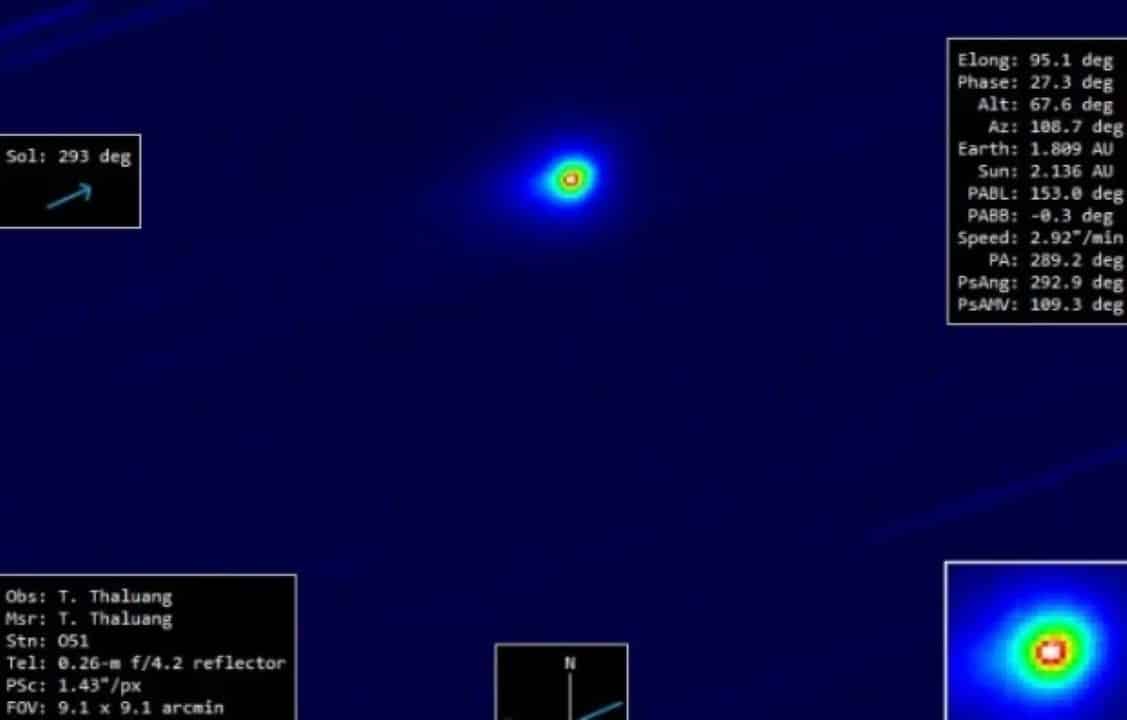
The recent validation of orbital data by the international scientific community confirmed the passage of a third celestial body of external origin to our solar system. Monitoramentos conducted by leading space agencies, including NASA, guarantee that the object’s transit through the inner regions of our cosmic neighborhood will occur within absolute safety margins, eliminating any risk of impact with the Earth’s surface.
Initially identified by automated systems dedicated to asteroid tracking, the celestial body early demonstrated speed and inclination characteristics that differentiate it from native space rocks orbiting Sol. Confirmation of their interstellar nature represents a significant milestone in human ability to detect and analyze visitors traveling between the stars, enabling in-depth study without the need for distant intercept missions.

Experts in orbital dynamics observed that the object’s approach curve does not correspond to the closed ellipses typical of local comets and asteroids. The excessive speed relative to Sol indicates an origin far beyond the heliosphere, proving that this visitor was ejected from another star system before crossing our path.
Monitoring details and safe route
The celestial body follows a strictly hyperbolic path, which indicates that it has enough kinetic energy to escape solar gravity and return to deep space after its brief visit. Cálculos advanced celestial mechanics indicate that its maximum approach to the central star occurs in the middle of the year, remaining at a safe distance of tens of millions of kilometers from Terra.
Contrary to unfounded speculation that circulated on social media suggesting an imminent danger, official data is categorical regarding the safety of the event. Equipes of planetary defense analyzed the trajectory exhaustively and ruled out any collision scenario, taking advantage of the unique opportunity only for scientific data collection and detailed astronomical observation.
Parallels with previous visitors
The arrival of this new traveler offers a rare opportunity for comparative studies with its famous predecessors, ‘Oumuamua and Comet 2I/Borisov. Enquanto the first presented an elongated shape and enigmatic physical behavior, and the second behaved chemically like a typical comet, the new object brings its own chemical and physical signatures that intrigue astronomers.
Preliminary observations, combined with high-performance computational modeling, allowed researchers to draw important parallels about the composition of these objects and what they reveal about other planetary systems:
– The detected presence of volatile elements suggests that the object releases gases as it heats up, forming a visible coma characteristic of comets.
– Análises spectral tests are being conducted to identify primordial molecules, such as carbon and cyanogen, in their internal structure.
– The entry speed into the system exceeds 30 km/s, a figure that mathematically confirms its origin from outside the gravitational influence of the Sol.
– Sua detection helps refine statistical models about how often these bodies actually cross our system, suggesting that interstellar traffic is more common than previously thought.
Advances for modern science
For researchers, each interstellar visitor functions as a fundamental piece of a vast galactic puzzle, bringing samples of materials formed in other stellar systems directly to our “doorstep.” Analysis of the reflected light and gases emitted by the object makes it possible to deduce the chemical conditions of its birthplace, something that would be impossible to do with current space missions due to the unreachable distances of other stars.
The continuous refinement of ground-based and space-based telescopes, combined with more powerful tracking software, promises that discoveries like this will become increasingly frequent in the coming years. The detailed study of these bodies not only satisfies human curiosity about the neighboring universe, but also improves the planetary defense technologies necessary to monitor objects that, in the future, may actually present risks, validating global security protocols.



