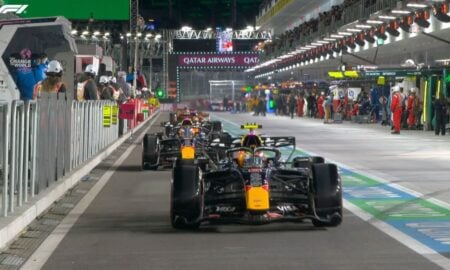
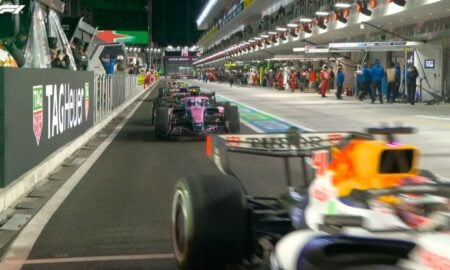
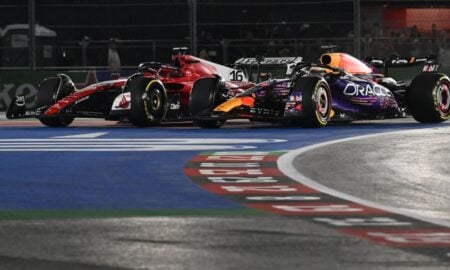
Verstappen overtakes rivals and sets fastest lap at the start of the Formula 1 pre-season in Bahrain


The Circuito Internacional of the Bahrein was the scene of the first official movements of the new Fórmula 1 cars, marking the beginning of a crucial six-day testing period. Max Verstappen, current world champion, reaffirmed the strength of Red Bull Racing by recording the fastest time of the inaugural session. The Dutchman’s solid performance signals that the Austrian team maintains robust technical development, focusing on optimizing aerodynamics and the efficiency of power units.
During track activities, teams prioritized understanding the new machines, testing limits and collecting vital data for fine-tuning ahead of the first race of the year. The session was marked by different strategies between the teams, with significant variations in the choice of tire compounds and fuel load, which makes direct time comparisons a complex task at this early stage.

McLaren’s Oscar Mercedes also showed service with George Russell, who secured the third fastest time, indicating consistent progress in the development of the German team’s car.
- Max
- Oscar Piastri was just 0.169 seconds behind the leader, but needed soft tires to achieve such performance, suggesting a technical advantage for the
- George Russell completed the top 3, consolidating Mercedes’s presence among the leaders and raising expectations for the championship’s competitiveness.
- The session served to validate wind tunnel data and simulations, with the teams focusing on aerodynamic correlation.
Adaptation from Hamilton to Ferrari and initial challenges
The attention of the public and the specialized media also focused on the Ferrari garage, where Lewis Hamilton held one of its first official sessions wearing the Italian team’s overalls. The seven-time world champion ended the day with the fourth fastest time, demonstrating a progressive adaptation to the new equipment. Ferrari showed a promising pace, but the session was not free from small technical incidents.
At a certain point, Hamilton locked the front left wheels, generating smoke and indicating that the adjustment of the braking system and the balance of the car still require refinements. Apesar In addition, the Maranello team’s data collection was extensive, focusing on tire durability and chassis behavior in high-speed corners, critical points for performance throughout the season.
Technical difficulties at Williams and new talents
While the top teams were accumulating mileage, Williams faced a troubled start to the pre-season. The team dealt with significant delays that kept the car in the pits for long periods, limiting the track time needed for initial evaluations. Carlos Sainz, driving for the British team, managed to record the seventh best time when it finally took to the track, but the lack of running time represents an obstacle in the development schedule.
Making up for this lost time will be essential so that Williams does not start the championship at a technical disadvantage. The reliability of the new components is the immediate priority, and engineers are working around the clock to ensure the car can complete the racing simulation programs in the remaining days of testing at Bahrein.
Another highlight of the session was the presence of young promises on the grid. Arvid Lindblad, just 18 years old, took over the cockpit of Racing Bulls, attracting attention as a potential future talent for the Red Bull program. The inclusion of rookies in official sessions demonstrates the teams’ strategy to prepare the next generation of drivers by assessing their ability to provide accurate technical feedback in a high-pressure environment.
Aerodynamic evolution and energy management
The current Fórmula 1 technical regulations continue to require teams to strike a delicate balance between aerodynamic efficiency and hybrid power management. The updates seen on the Bahrein suggest that the teams have invested heavily in new solutions for the floor and wings, seeking to reduce drag without compromising the downforce required for the circuit’s technical curves.
Airflow sensors, visible in several cars during the first laps, collected terabytes of information that will be analyzed in factories. Power unit management was also a central focus, with drivers testing different energy recovery modes to maximize the power available in qualifying laps and ensure efficiency during long racing stints.