
Astrophysicist’s new theory compares black holes to waterfalls to explain quasar glow

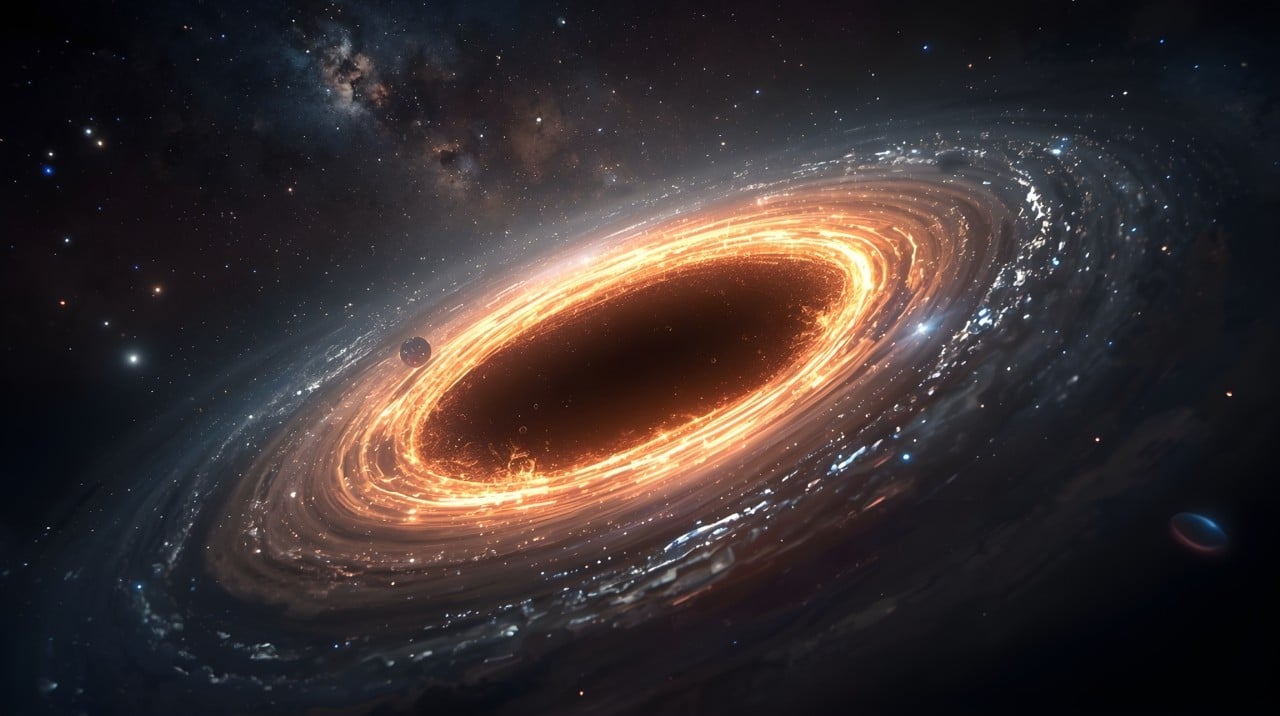
A new scientific perspective proposed by astrophysicist Avi Loeb suggests that the dynamics of matter around black holes can be understood through an analogy with terrestrial waterfalls. The recent essay details how extreme gravity in these environments bends space-time, creating a cliff-like effect where gas is accelerated to speeds approaching that of light. Esse process results in an intense luminosity, characteristic of quasars, which often outshines the brightness of entire galaxies.
Physical analysis indicates that the surrounding matter, as it falls toward the event horizon, undergoes extreme heating due to friction. Essa active phase of radiation emission can last millions of years and is fundamental to understanding the evolution of these massive objects. The phenomenon highlights a cosmic paradox where the darkest structures in the universe are responsible for generating the brightest light sources ever detected.
Observations carried out by Telescópio Espacial James Webb have provided crucial data corroborating these theories, identifying supermassive black holes in very early stages of the cosmos. The presence of these objects when the universe was less than a billion years old challenges traditional formation models and suggests much faster growth mechanisms than previously assumed.
Gravitational dynamics and particle acceleration
The Relatividade Geral of Albert Einstein describes gravity not as a conventional force, but as the curvature of the fabric of space-time. Nas close to a black hole, this curvature forms deep gravitational wells. Matter that approaches this region is accelerated drastically, behaving like water flowing towards a waterfall, gaining kinetic and thermal energy in the process.
A practical example of this dynamic was observed in the quasar CAPERS-LRD-z9, detected by the sensitive instruments of James Webb. With a redshift of 9.288, this object has an estimated mass of 40 million times that of Sol and existed just 500 million years after Big Bang. The existence of such a structure at such a remote time reinforces the idea that the continuous “fall” of gas allowed an accelerated accumulation of mass.
The radiation emitted during this acceleration process spans multiple wavelengths, making quasars visible at extreme cosmological distances. The galactic gas, as it plummets into this gravitational abyss, reaches temperatures that generate enough brightness to be captured by telescopes in Terra and in space, serving as beacons that illuminate the ancient history of the universe.
Feedback and regulation mechanisms
The growth of black holes does not occur indefinitely, being regulated by a mechanism known as feedback. Durante the quasar phase, which can persist between 10 and 100 million years, the intense luminosity and radiation generated end up heating the surrounding gas. Esse heating causes matter to be expelled from the gravity well, cutting off the black hole’s “fuel” supply.
This cycle of feeding and starvation creates a remarkable balance between the mass of the central black hole and the mass of its host galaxy. Observations indicate that the expulsion of gas interrupts continuous accretion, functioning as a safety valve that prevents the object from consuming all the matter available in the galaxy.
Recent data indicate that solitary quasars in the early universe have reduced gas reservoirs, which is consistent with this regulation theory. The dynamics suggest that, after a period of exponential growth facilitated by the dense conditions of the young universe, the black hole’s own power limits its final expansion.
The evidence collected shows that powerful winds emanate from these ancient objects, directly influencing the formation of new stars in neighboring galaxies and shaping the structure of the cosmos as we know it today.
Stellar collapse and high energy phenomena
In addition to supermassive giants, the study also addresses the formation of stellar-mass black holes, originating from the collapse of massive stars that have exhausted their nuclear fuel. An emblematic case was recorded in the Andrômeda galaxy, where a star disappeared without leaving the visual signature of a supernova explosion, indicating a direct collapse into a black hole.
In these extreme events, the process can consume the equivalent of a solar mass per second. The formation of opposing jets channels matter into collimated streams, and internal collisions in these jets generate long-lasting gamma-ray bursts. Esses high-energy flashes are detectable by observers aligned with the jet axis, serving as further evidence of the “cosmic waterfall” in action.
Intersection between science and art
To illustrate such abstract and complex concepts, Loeb’s essay inspired a series of watercolors by artist Greg Wyatt. The works visually depict “celestial waterfalls”, combining the rigidity of astrophysical data with the fluidity of artistic expression. Essas representations help visualize how gravity shapes the fate of matter and light.
Interdisciplinary collaboration reinforces how visual analogies are powerful tools for human understanding of phenomena occurring at unattainable scales. By comparing relentless gravitational pull to a familiar force of nature like a waterfall, science becomes more accessible, allowing a better appreciation of the processes that have governed the universe since its beginnings.



