
Comet 3I/ATLAS may harbor life forms, suggests Avi Loeb in analysis of gaseous plumes


Astronomer Avi Loeb, professor at Universidade of Harvard, published an article suggesting that the interstellar comet 3I/ATLAS may harbor life forms. The hypothesis is based on detections of organic molecules and anomalous methane production observed by space telescopes. The object, discovered in July 2025, passed through Sistema Solar with a hyperbolic trajectory and gas plumes rich in compounds consumable by terrestrial organisms.
The third confirmed interstellar object exhibits characteristics that differ from ordinary comets. Imagens captured between December 2025 reveals an elongated shape with an anti-tail pointed towards Sol. Dados from the James Webb telescope and the SPHEREx mission identified water, carbon dioxide, carbon monoxide and methane in the composition.
The discussion reignites debates about panspermia, the process of transferring life between stellar systems. Loeb argues that anomalies in the object deserve detailed investigation to rule out or confirm biological origins.
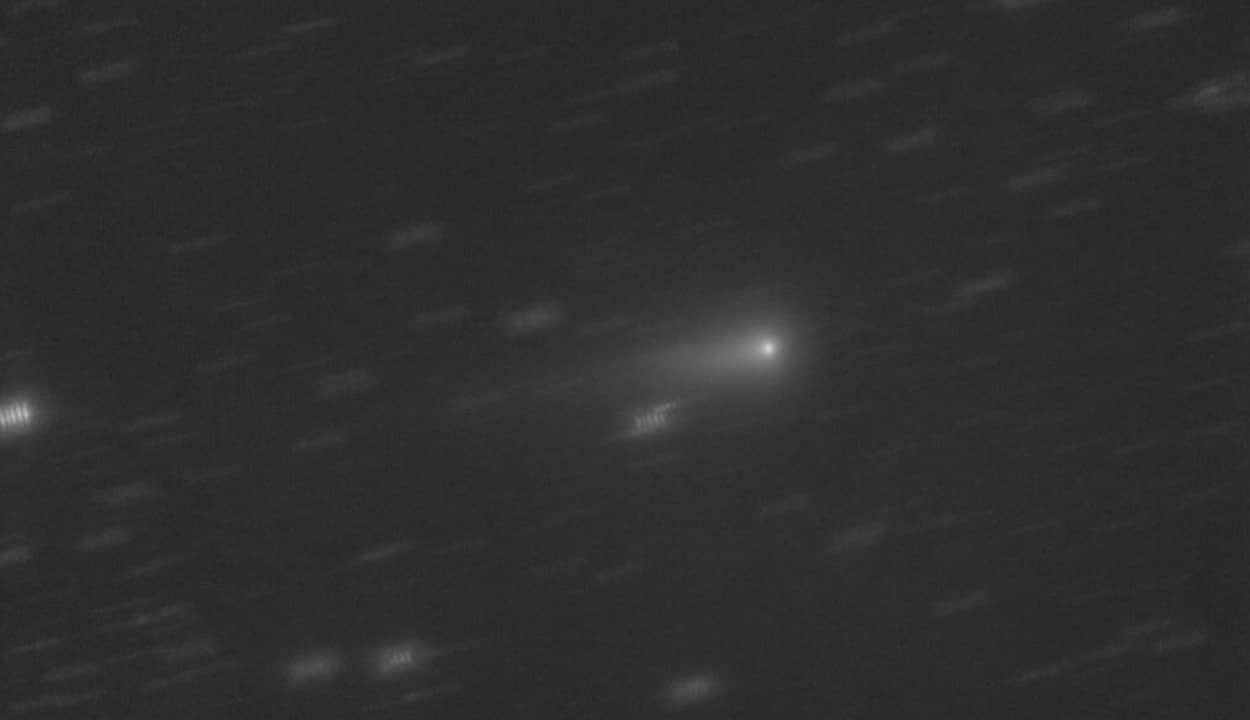
Characteristics of the 3I/ATLAS object
Comet 3I/ATLAS follows an unbound trajectory with a speed of about 60 km/s. Sua passage near Sol exposed internal layers that released gases and dust in extensive plumes.
Observations show a pear-shaped brightness map with antitail elongation. Cada image covers an area of 300 thousand kilometers, similar to the Terra-Moon distance.
The composition includes organic production at a rate equivalent to 14% of the detected water. Moléculas such as methanol, formaldehyde and ethane appear in significant quantities.
Organic molecule detections
Telescopes identified robust presence of water (H₂O), carbon dioxide (CO₂) and carbon monoxide (CO). Methane (CH₄) emerged only after perihelion, despite its volatility.
Absence of methane in August 2025 spectroscopy indicates depletion in the outer layers. Late release suggests exposure of internal material near Sol.
- H₂O: main component of plumes
- CO₂ and CO: common gases in comets
- CH₄: anomalous post-perihelion detection
- Organic: CH₃OH, H₂CO and C₂H₆ in high proportions
These compounds are consumable by known life forms on Terra. The combination raises questions about natural or biological processes.
Anomaly in methane production
Methane has a lower sublimation temperature than carbon dioxide. Normalmente, should evaporate before in traditional comets.
In 3I/ATLAS, carbon monoxide came out first, contrary to expectations. Late detection of methane implies continued production or protected origin.
Scientists compare the behavior with known solar comets. Diferenças persist and feed alternative hypotheses.
Natural panspermia hypothesis
Natural panspermia involves ejection of microbe-bearing rocks from habitable planets. Meteoritos Martians arrived at Terra billions of years ago with controlled temperatures.
The last universal common ancestor (LUCA) may have originated from interstellar transfer. Rochas maintain viable microbes below 40°C during long journeys.
Objects like 3I/ATLAS act as potential vehicles for the spread of life. Poeira released near habitable exoplanets would deposit organic material.
Exchange between Marte and Terra occurred 4.2 billion years ago. Evidências in meteorite ALH84001 support the viability of the process.
Targeted panspermia and implications
Loeb discusses the possibility of artificial panspermia by advanced civilizations. Missões would seed life into interstellar objects for cosmic propagation.
Capsules with radioactive material would maintain heat during journeys lasting billions of years. Colisão controlled would deposit seeds on an icy surface.
Humanity has technology to intercept objects like 3I/ATLAS. Custos would be inferior to large terrestrial projects.
The approach represents long-lasting cosmic monument. Vida would evolve and multiply in suitable environments.
Comparisons with previous objects
‘Oumuamua, the first interstellar detected in 2017, showed non-gravitational acceleration. The elongated Forma has generated similar speculation.
2I/Borisov exhibited classical cometary composition with volatile gases. Serviu as a reference for 3I/ATLAS analyses.
The third object combines traces of both with rich organic plumes. Imagens show six rounded plumes in addition to the main one.
Recent observations and scientific data
SPHEREx mission confirmed organics at a rate of 14% of water production. Dados published in preprints detail spectral compositions.
Telescope James Webb captured post-perihelion methane in December 2025. Previous Ausência reinforces layer anomaly.
Current distance allows continuous monitoring of the outgoing object. High Velocidade ensures permanent escape path.
Debates in the astronomical community
Some scientists attribute characteristics to unprecedented natural processes. Composição reflects origin in distant star system.
Others argue for the need for interception missions to collect samples. Direct Análise would clarify the origins of the molecules.
Loeb maintains an open approach to extraordinary explanations. Evidências extraordinary situations demand rigorous investigation.
The object represents a unique opportunity to study extraterrestrial material. Passagem by Sistema Solar ends with no expected return.
Perspectives for astrobiology
Detections in 3I/ATLAS expand understanding of the distribution of organic compounds. Moléculas essential to life appear in interstellar environments.
Future research focuses on exoplanets in the habitable zone. Objetos visitors provide direct samples without long travel.
Advances in space telescopes improve resolution of distant plumes. Continuous Monitoramento reveals sublimation dynamics.
The discussion encourages development of rapid response missions. Interceptação at close perihelion makes material collection possible.



