
Luminous phenomenon in New Zealand has its trajectory traced to the Oort Cloud after expert analysis


Residents of the New Zealand capital witnessed a visual spectacle on the night of January 30, when a green object streaked across the sky at high speed. The phenomenon, recorded by security cameras and monitoring networks at around 11:25 pm, reached an impressive relative speed of 71 kilometers per second before disintegrating. Especialistas later confirmed that the celestial body belongs to our own planetary system, discarding theories about an interstellar origin.
Technical assessment of speed and origin
Astronomer Avi Loeb, linked to Universidade Harvard, conducted a detailed analysis based on data provided by NASA’s Centro to Estudos to Objetos Próximos to Terra (CNEOS). The investigation showed that, when correcting the heliocentric speed of the object, the value obtained was 42.4 kilometers per second. The Este number lies at the gravitational escape threshold of the Sol, set at 42.1 km/s, which technically keeps the object within the limits of the Sistema Solar.
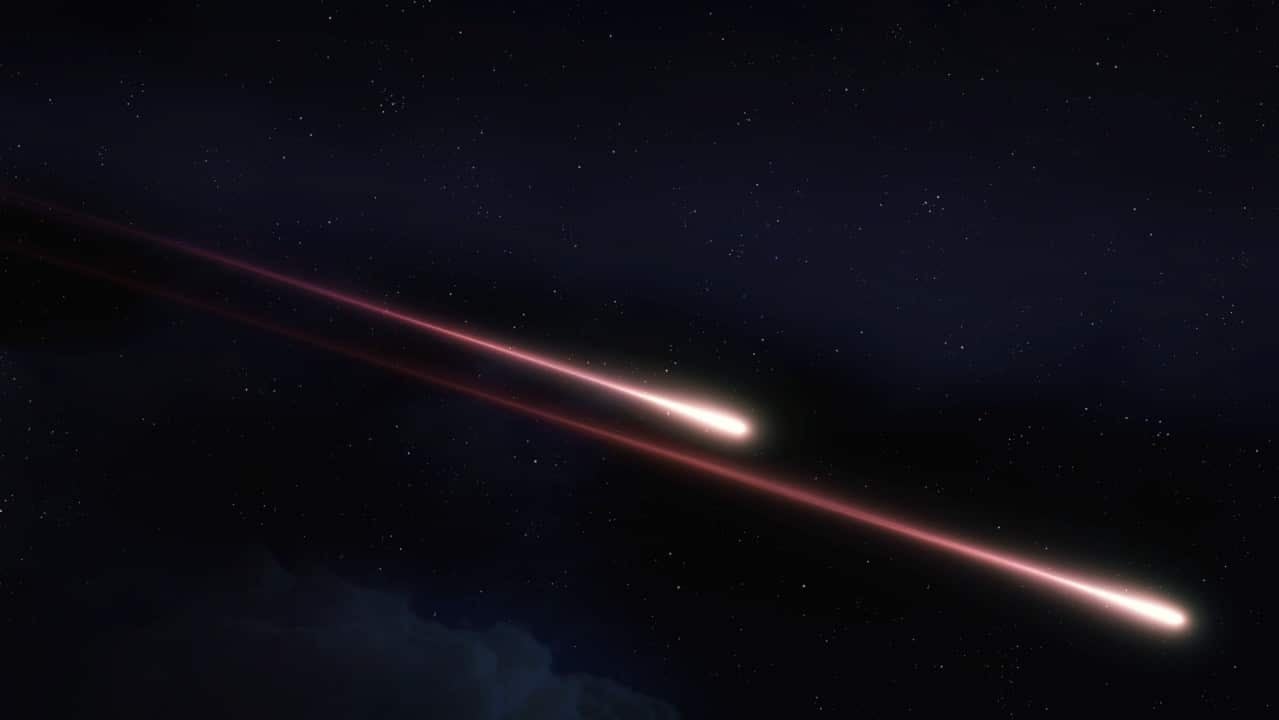
The high speed perceived by terrestrial observers is due to a head-on collision between the meteor and our planet. The sum of the orbital speed of Terra with the object’s trajectory resulted in the 71 km/s recorded by the sensors. The likely origin was traced to Nuvem of Oort, a vast spherical region of icy bodies that surrounds the solar system, from where the fragment would have been displaced by ancient gravitational perturbations.
Visual records and impact data
Reports collected in locations such as Petone and Tītahi Bay described intense flashes that illuminated homes, followed by a persistent luminous tail. Diferente than other events, this bolide did not generate significant sonic booms or leave recoverable fragments on the ground, being completely consumed in the atmosphere.
Technical data compiled by monitoring networks reveal the magnitude of the event:
– Velocidade relative at the moment of impact: 71 km/s
– Altitude maximum recorded during disintegration: 89 km
– Energia total kinetics released: 3.82 × 10¹⁰ joules
– Trajetória entry: Direção east over the port region
Differences for interstellar objects
The disintegration of the meteor at a high altitude, around 89 kilometers, suggests a fragile structural composition, possibly formed by ice and dust, typical characteristics of bodies originating from Nuvem to Oort. Essa fragility contrasts with documented interstellar events such as the 2014 IM1 meteor, which demonstrated superior material strength by exploding much lower in the atmosphere.
The distinction between local objects and interstellar visitors is fundamental to modern astronomy. Enquanto the IM1 maintained a clear hyperbolic speed, the New Zealand visitor remained at the mathematical frontier of solar gravity. The absence of mechanical resistance reinforces the thesis that it was a primordial remnant of our own system, and not a traveler from other parts of the galaxy.
Monitoring and citizen science
Accurate detection of the event was possible thanks to collaboration between government agencies and citizen science projects such as Fireballs Aotearoa. Triangulation of the orbit, facilitated by dozens of recordings sent to Sociedade Astronômica from Canterbury, allowed scientists to reconstruct the object’s path with high fidelity.
The frequency of sightings in the region reflects both the favorable atmospheric conditions and the density of the monitoring network installed in Ilha Norte. Continuous refinement of these observations helps catalog the population of objects crossing Earth’s orbit, differentiating ordinary space rocks from potential scientific anomalies.



