
Lunar Gateway maintains funding despite intense debates in NASA’s Artemis program
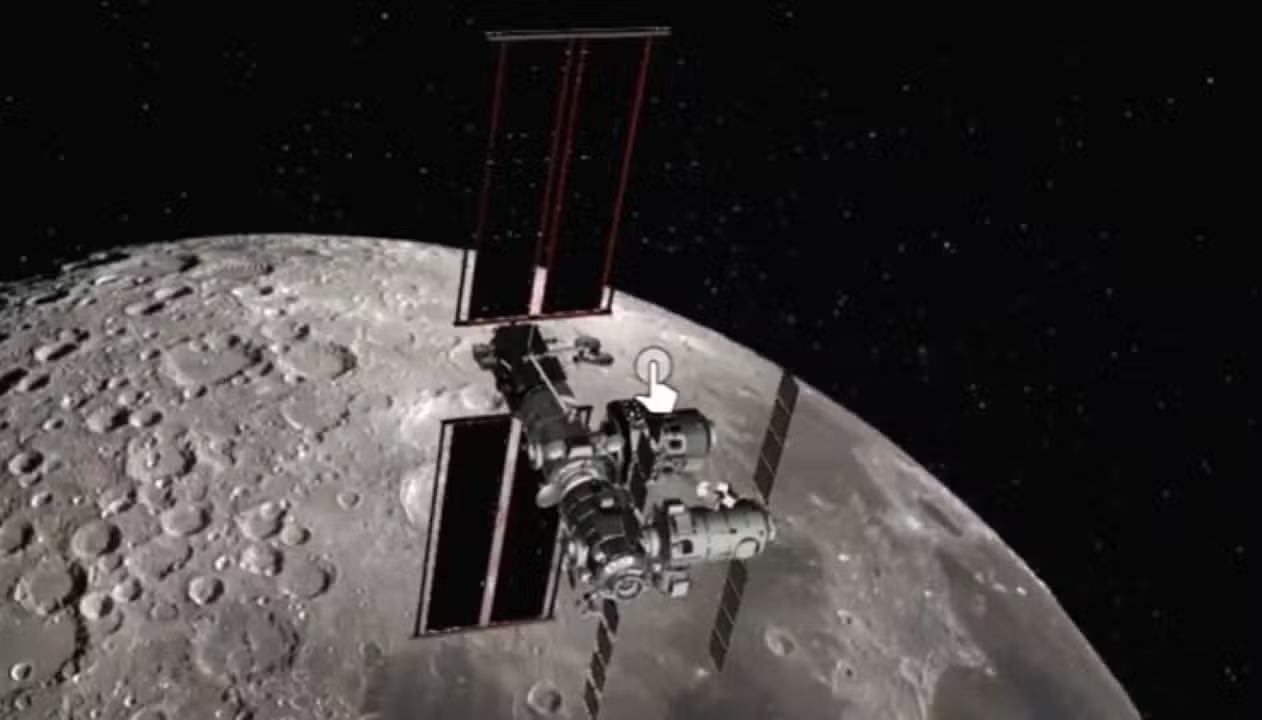
Nasa continues with the development of Lunar Gateway, a space station designed to orbit Lua as part of the Artemis program. The project faces questions about high costs and possible funding reductions in the Estados Unidos, but receives contributions from international partners that reinforce its viability.
The modular station serves as a platform for manned and robotic missions to the lunar surface. Ela allows you to conduct scientific experiments and test technologies needed for future trips to Marte.
The Artemis program seeks to establish a sustainable human presence on Lua, with long-term scientific and commercial objectives. Gateway acts as a strategic support point in this multinational effort.
Main objectives of the orbital station
Lunar Gateway offers unique access to Lua through its special orbit, known as a near-straight halo orbit. Essa trajectory facilitates missions to the lunar surface and deep space by reducing propellant consumption compared to traditional orbits.
The station functions as a floating scientific laboratory, allowing research in microgravity and observations of Lua and space. Ela also serves as a communications hub for lunar rovers and spacecraft.
- Support for Artemis manned missions from 2028 onwards.
- Testing life support systems for long journeys.
- Platform for exploring robots on the lunar surface.
- Refueling station for ships in transit.
These elements make the Gateway critical for sustainable operations beyond low Earth orbit.
International partnerships in the project
The development of Lunar Gateway involves collaboration between several space agencies, distributing responsibilities and costs. Nasa leads the effort, while partners contribute specific modules and technologies.
Agência Espacial Europeia (Esa) provides the I-Hab module, intended for housing and environmental control. Agência Japonesa of Exploração Aeroespacial (Jaxa) delivers life support systems and advanced batteries.
Agência Espacial Canadense develops the Canadarm3 robotic arm, essential for assembly and maintenance. The Centro Espacial Mohammed Bin Rashid, of the Emirados Árabes Unidos, participates with support components.
This multinational cooperation mirrors the Estação Espacial Internacional (ISS) model. Ela strengthens global alliances in space exploration.
Financial challenges and recent delays
The Lunar Gateway project has seen cost increases over the years, generating debate in the American Congresso. Propostas Recent budget statements have suggested reductions or cancellations, but political pressures have maintained basic funding.
The integration of modules already delivered continues in installations in Estados Unidos. Testes initial module Halo, developed by Northrop Grumman, advance despite schedule adjustments.
Nasa prioritizes the completion of the first components for launch scheduled in the next decade. Esses efforts aim to align the station with later Artemis missions.
The approved budget for 2026 guarantees minimum resources for continuity. Agências partners maintain commitments regardless of US fluctuations.
Long-term scientific benefits
The presence of Lunar Gateway allows for continuous experiments in a unique lunar environment. Pesquisas cover biology in space radiation and materials for future construction in Lua.
The station collects data on the lunar regolith using remote instruments. Ela also monitors space weather, protecting astronauts on extended missions.
Scientists plan studies on the effects of partial microgravity in lunar orbit. Esses results inform preparations for expeditions to Marte.
The platform welcomes instruments from multiple countries, expanding the scope of discoveries. Colaborações academics complement government efforts.
Global competition in lunar exploration
Other countries are advancing parallel lunar projects, intensifying the space race. China and Rússia develop Estação Internacional from Pesquisa Lunar (ILRS), focused on a surface basis.
Lunar Gateway positions Artemis partners as leaders in lunar orbit. Ela offers flexibility for varied missions, unlike fixed bases.



- Orbit allows access to the entire lunar surface.
- Modular assembly facilitates future expansions.
- Integration with American commercial landers.
- Support in situ resource exploration.
This approach balances competition and cooperation in deep space.
Assembly and operational schedule
The construction of Lunar Gateway occurs in stages, with sequential releases of modules. The first component, combining Halo and Power and Propulsion Element, is expected to be placed into orbit in the coming years.
Ships like the Space Launch System (SLS) and commercial rockets transport the parts. Astronautas of mission Artemis perform initial dockings and activations.
The station has operated for at least 15 years, with the possibility of extension. Robotic and manned Manutenções ensure continuous functionality.
New partners can join, adding specific capabilities. Essa flexibility adapts the project to technological advances.
Legacy for exploration beyond Lua
The experience accumulated at Lunar Gateway prepares technologies for Marte. Sistemas of electric propulsion and closed habitats undergo real validations.
The station demonstrates models of international governance in deep space. Acordos Artemis establish standards for sustainable lunar activities.
Research carried out contributes to terrestrial advances in energy and medicine. Aplicações include radiation treatments and agriculture in controlled environments.
The project reinforces the human capacity to operate far from Terra. Ele paves the way for permanent presence in the solar system.
Technological advances in modules
Each Lunar Gateway module incorporates innovations specific to the lunar environment. The propulsion element uses high-efficiency solar panels, generating abundant energy.
High-bandwidth communication systems support real-time data transmission. Antenas forwards connect the station to Terra and the lunar surface.
Housing protects against cosmic radiation with composite materials. Exercícios physicists counterbalance effects of microgravity.
Artificial intelligence integration assists autonomous operations. Robôs inmates perform routine tasks during unmanned periods.
Specific partner contributions
Detailed collaboration enriches the project with diverse expertise. The Canadian robotic arm manipulates external loads with millimeter precision.
European and Japanese modules include almost complete air and water recycling systems. Esses components reduce dependence on land refueling.
Contributions from Emirados Árabes focus on logistics and regional experiments. Parcerias American commercials accelerate development of compatible landers.
This division of tasks optimizes global resources. Ela ensures resilience against disruptions in a single country.
Lunar Gateway represents a crucial step for humanity beyond Earth orbit. Sua continuity depends on sustained commitment to collaborative exploration.
Veja Tambem em News (EN)

Research reveals that parents are unaware of how their children use artificial intelligence

Samsung releases new system update with new features for Galaxy Watch 4 users

Digital retail reduces the value of the Galaxy S25 5G smartphone with bank bonuses and device exchange

Amazon’s wireless CarPlay adapter has a 50% discount and high approval ratings from drivers

Zach Cregger’s new Resident Evil ignores games and focuses on an unprecedented story with new characters

Rumor suggests that Nintendo is preparing a special edition of the Switch 2 with a remake of Ocarina of Time

Apple accelerates production of the iPhone 17e and develops new Air model with dual camera system

Epic Games platform releases twelve high-budget games at no permanent cost for PC users

PlayStation 5 Pro price drop accelerates digital retail sales and eliminates global stocks

New Galaxy Watch 9 firmware appears on server and confirms progress in software development

Apple’s commemorative project tests cell phone with 1.1 millimeter edge and curved screen for 2027
