
Astronomers confirm fugitive black hole advances through space creating giant star trail

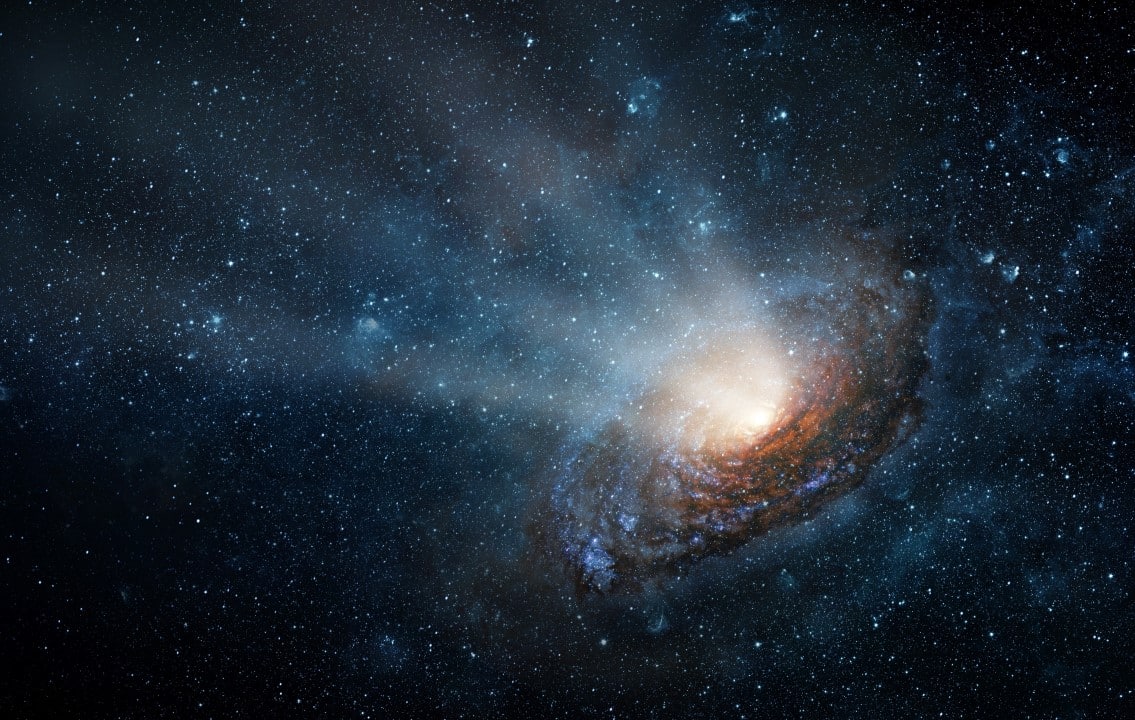
Astronomers have identified a supermassive black hole that appears to have been ejected from its original galaxy. The object moves at a speed estimated at 1,600 kilometers per second and leaves behind an extensive linear structure of star formation. Essa trail measures approximately 200 thousand light years in length.
Observation records concrete evidence of a phenomenon predicted by the theory of general relativity. The event involves the recoil of gravitational waves during the merger of black holes. Pesquisas recent studies using space telescopes reinforce the interpretation of this trail as a direct consequence of the object’s passage.
The black hole compresses the intergalactic gas in front of it as it travels. Essa compression triggers the gravitational collapse of material and the birth of young, hot stars.
Gravitational recoil mechanism
The merger of two supermassive black holes often occurs in collisions between galaxies. Nesse process, the emitted gravitational waves can be asymmetric. The asymmetry generates a momentum that propels the resulting black hole in the opposite direction.
Theoretical models indicate that speeds exceeding 1,000 kilometers per second are possible in extreme cases. The observed object reaches about 1,600 kilometers per second. Essa mark allows escape from the gravitational pull of the host galaxy.
- The uneven emission of gravitational waves conserves linear momentum.
- The maximum recoil depends on the mass and spin of the black holes involved.
- Events like this explain displaced black holes in galactic nuclei.
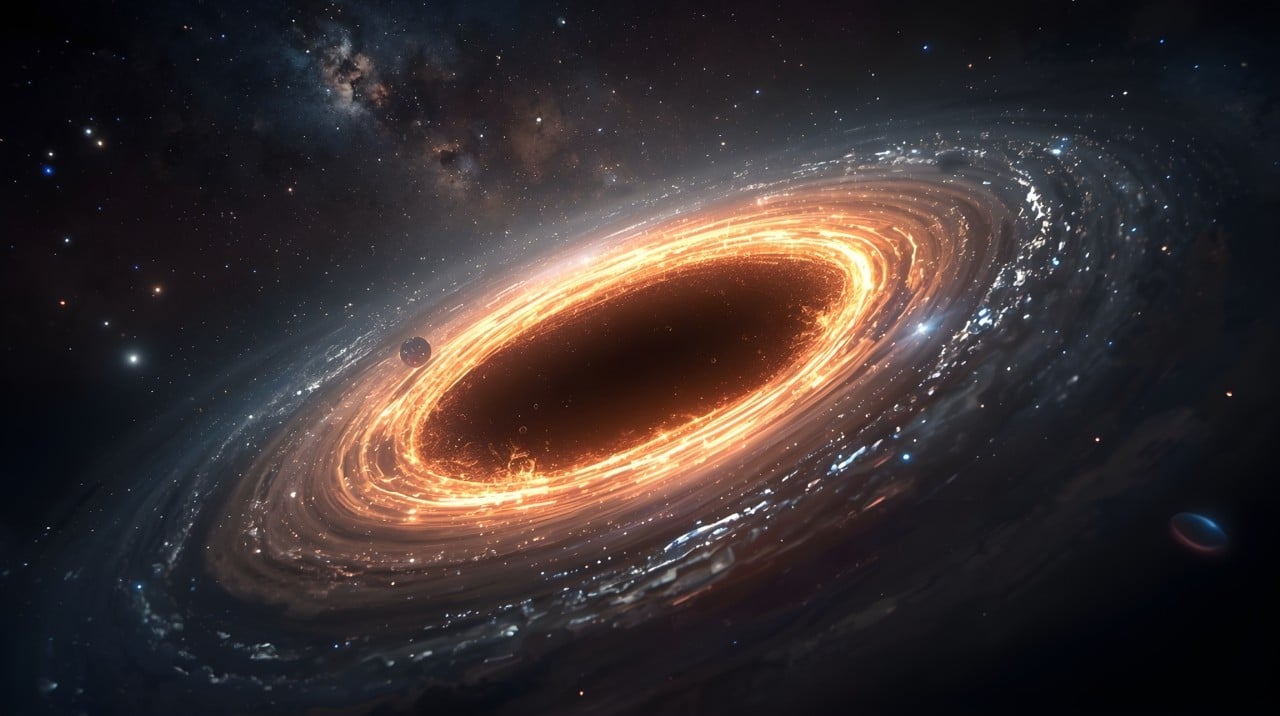
Star Track Features
The structure left by the black hole is 200 thousand light years long. The Esse value exceeds the diameter of the Via Láctea by two times. The trail consists of young, recently formed blue stars.
Spectroscopic observations confirm the presence of compressed gas along the path. The black hole disrupts the rarefied intergalactic medium. The disturbance creates favorable conditions for sequential star formation.
The trailhead contains a compact, bright fountain. Essa source corresponds to the black hole undergoing accretion activity. The geometric alignment of the structure indicates a coherent rectilinear trajectory.
Observations with space telescopes
Telescopes such as the Hubble and James Webb recorded detailed images of the phenomenon. Initial captures revealed a narrow, luminous line in a distant region. Later Análises measured redshift and confirmed distances.
The object is located billions of light years from Terra. Sua estimated mass reaches tens of millions of times that of Sol. Dados complementary ground-based observatories validated the interpretation of the trail.
Additional research looks for signs of activity in the core of the original galaxy. The absence of a central black hole reinforces the ejection hypothesis. Missões future mergers will be detected directly by gravitational waves.
Implications for galactic evolution
Supermassive black holes regulate the growth of galaxies normally. Sua central presence influences gas flows and star formation rates. Sudden ejection alters these dynamic processes.
Galaxies without a central black hole show different patterns of evolution. The observed event offers a rare case for comparative study. Modelos simulate long-term impacts on the distribution of matter.
- Changes in circumgalactic gas dynamics persist for millions of years.
- Induced star formation creates young populations along the trajectory.
- Recoil events contribute to the dispersion of black holes in the universe.
Speed and exhaust details
The speed of 1,600 kilometers per second allows the black hole to overcome galactic gravity. Cálculos indicate that lower rates keep the object stuck. Essa mark represents critical limit for permanent leakage.
Comparisons with other candidates show variations in measured speeds. The current case highlights a combination of high mass and extreme acceleration. Trajetórias thus cross vast regions of intergalactic space.
Star formation in the wake
The passage of the black hole compresses clouds of gas in front. The increased density initiates rapid gravitational collapse. Estrelas massive ones spawn in sequence along the trail.
The structure’s luminosity derives from hot, young stars. Espectros reveal emission lines characteristic of H II regions. The process occurs on a larger scale than local phenomena in Via Láctea.
The trail remains visible for long periods due to the youth of the stars. Observações future monitors the evolution of this unique stellar population.
Context of galactic mergers
Collisions between galaxies trigger spirals from central black holes. Objects orbit each other and lose energy via gravitational waves. The final melt releases the asymmetric recoil.
Numerical simulations predict low frequency for extreme ejections. The detected object represents a direct observational example. Additional Casos refine estimates of occurrence in the universe.
Three-body dynamics in multiple systems also contribute to ejections. Interações gravitational complexes accelerate one of the black holes. Ambos mechanisms operate in dense environments of interacting galaxies.
Advances in Future Detection
Projects like LISA will detect gravitational waves from supermassive mergers. Sinais direct confirm recoils in real time. Observações optics complement gravitational data.
New-generation telescopes will map similar tracks in distant regions. Catálogos expand sample of runaway black holes. Estudos combined reveal the role of these events in the cosmic structure.
The current discovery validates theoretical predictions decades after formulation. Pesquisas continue to explore variations in masses and velocities. The phenomenon enriches understanding of extreme physics in the cosmos.



