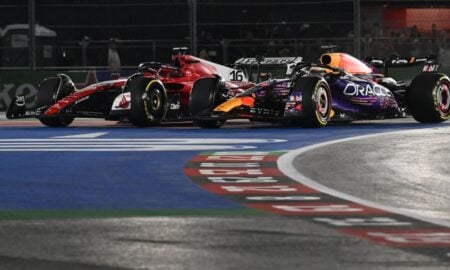
Max Verstappen classifies Wolff’s praise of the Red Bull engine as a tactic to divert focus


The atmosphere behind the scenes at Fórmula 1 is already showing signs of intense rivalry even before the first official start of the 2026 championship. Durante the pre-season tests carried out at Bahrein, the Dutch driver The three-time world champion’s reaction comes as a direct response to statements by Toto Wolff, head of Mercedes, who pointed to the Austrian team’s new powertrain as the benchmark to be beaten on the current grid.
For the Red Bull driver, the opposing leader’s statements do not necessarily reflect the technical reality of the moment, but rather a calculated behind-the-scenes maneuver. Verstappen suggested that Wolff’s exaggerated optimism about other people’s performance serves as a smokescreen, designed to mask possible difficulties for Mercedes herself or to transfer the pressure of favoritism to the pits of Milton Keynes’s team. Essa exchange of barbs marks the beginning of psychological warfare in a year of profound changes to the category’s technical regulations.
Verstappen boccia his new regime F1 2026: “Sembra una Formula E sotto steroidi”#SkyMotori #F1 #Formula1 #TestBahrain #Verstappenhttps://t.co/MA351LMQJN
—Sky Sport F1 (@SkySportF1)February 12, 2026
Transition to own engine and partnership with Ford
The 2026 season represents a historic milestone for Red Bull Racing, which for the first time competes with an internally developed power unit through the Red Bull Powertrains division, counting on strategic technical support from Ford. Breaking dependence on external suppliers puts the team on the same level of autonomy as traditional builders, such as Ferrari and Mercedes itself. The first data collected on the Sakhir track indicated a promising integration between the chassis and the new powerplant, surprising analysts who expected more acute growing pains in the project.
Despite the consistent lap times and apparent reliability demonstrated in the opening days, the team remains grounded. The complexity of creating an engine from scratch, especially with new guidelines that increase the importance of the electrical part, requires a continuous validation process. The surprise shown by Toto Wolff at the maturity of the bullfighting project was met with skepticism by the Red Bull drivers and engineers, who know that the pre-season rarely reveals the real hierarchy of forces that will be seen during the year.
Distraction strategies and the sandbagging phenomenon
In his conversation with the press, Verstappen recalled that the practice of “sandbagging” — hiding the car’s true potential by running on more fuel or conservative engine maps — is a tradition in the weeks leading up to the opening of the championship. The Dutchman argued that praising the opponent is an old tactic known in Fórmula 1 to lower expectations about one’s own team and mislead the rival due to overconfidence. Para him, the focus of Red Bull must remain strictly on internal telemetry data, ignoring external noise.
The driver emphasized that the current priority is accumulating mileage to understand the behavior of hybrid systems under desert heat, a condition that stresses components in unique ways. Shielding the internal environment against the “already won” atmosphere caused by Mercedes’s speeches is seen as essential so that technical development is not harmed. The technical team knows that reliability will be the balance in the early stages and that any early celebration can quickly turn into frustration.
Technical challenges of the new regulation
The new rules effective in 2026 brought a complete reconfiguration of the power units, requiring a much more delicate balance between the combustion engine and the recovery of electrical energy. Verstappen’s visit to the factory at the end of last year served to align expectations with the reality of development. The driver highlighted that, although the engine performed well on the track, there are still numerous fine adjustments to the software and power delivery that need to be made before the debut at Austrália.
Electrical power management, now responsible for a much larger share of the car’s total performance, became the focal point of engineering discussions. The partnership with Ford was crucial for the development of high-efficiency batteries, but the calibration of these systems for different racing scenarios is still ongoing. Verstappen warned that the car’s handling changes drastically depending on how energy is harvested and released, which makes direct comparisons of pre-season lap times inconclusive.
Expectation for opening in Melbourne
Looking to the immediate future, the team avoids making projections about victories or dominance. The consensus within Red Bull is that the performance seen in Bahrein will not automatically translate to the street circuit of Albert Park, in Melbourne, where the asphalt characteristics and ambient temperature are completely different. Uncertainty about what the other teams, including Mercedes, are hiding in terms of real performance keeps the warning bells on in the pits.
The discourse aligned between Christian Horner and its pilots is one of hard work and thorough data analysis. The perceived advantage may now be fleeting, disappearing as soon as rivals introduce their ultimate upgrade packages for the first race. Para Verstappen, the only valid answer will be given when the timer goes off in the Austrália classification, ending the period of speculation and mind games that characterizes the Fórmula 1 pre-season.