
New analysis by James Webb reveals early galaxy with surprising chemistry close to the Big Bang


Astronomers have confirmed the identification of a cosmic object that existed just 280 million years after the beginning of the universe, defying predictions about the evolution of the first structures. The galaxy, called MoM-z14, has an intense luminosity and a chemical composition rich in nitrogen, unusual characteristics for such a remote period. The light detected by the instruments traveled for approximately 13.5 billion years until it reached the space observatory’s sensors.
Validation of the discovery occurred through high-precision spectroscopy, which determined a redshift of 14.44. Esse technical parameter positions MoM-z14 as the oldest spectroscopically confirmed record in the history of astronomical observation. The detection reinforces the ability of current equipment to investigate the frontiers of time and space, revealing scenarios that force the scientific community to rethink galaxy formation models.
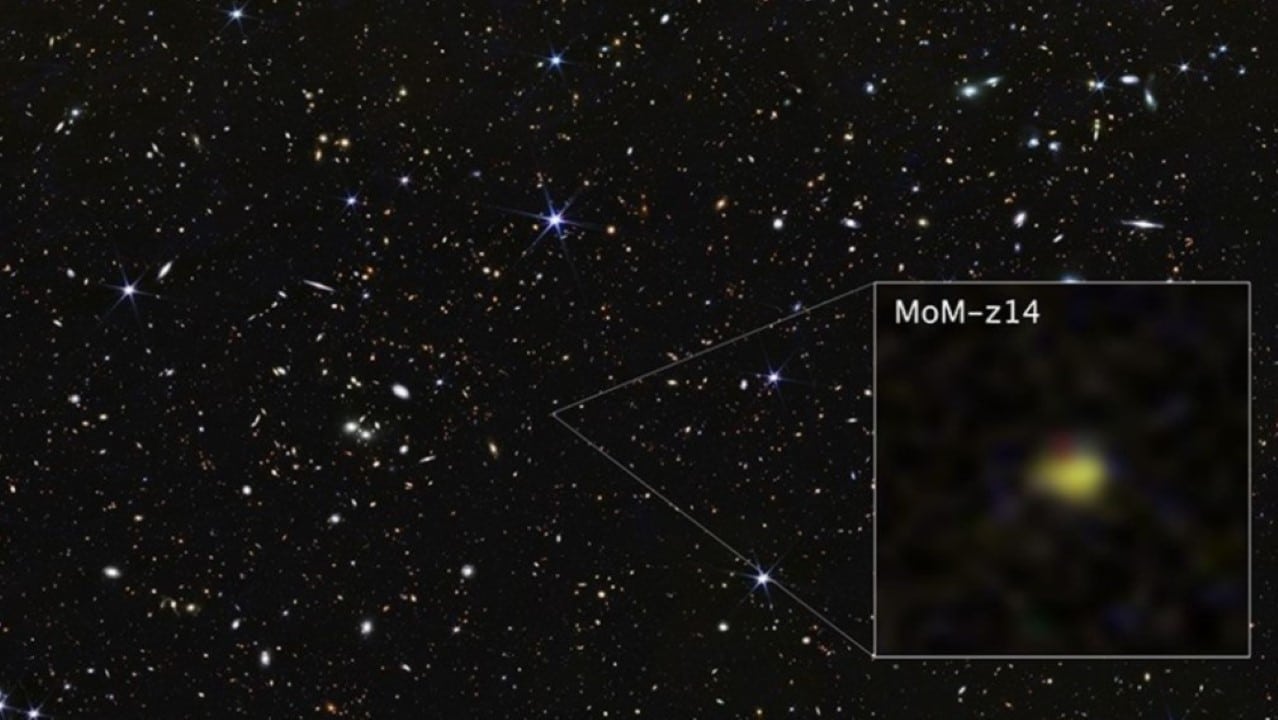
The data obtained indicates that the early universe was much more active and complex than previously imagined. The existence of such evolved systems at such an early stage suggests that the processes of matter agglomeration and stellar ignition occurred at a frenetic pace, exceeding conservative theoretical estimates.
Detailed spectroscopic validation
The NIRSpec instrument, coupled to the Telescópio Espacial James Webb, was fundamental in capturing the ultraviolet emission lines that confirmed the galaxy’s extreme distance. The spectral signature made it possible to differentiate MoM-z14 from other closer objects that could mimic its appearance, guaranteeing the accuracy of the find. The absorption break in the analyzed light served as definitive proof of the object’s temporal location.
To reach this result, the team of researchers carried out an initial scan of the COSMOS Legacy field, using deep-field images to select candidates. Posteriormente, the combination of NIRCam data and spectroscopy eliminated ambiguities, consolidating the galaxy’s record-breaking status and demonstrating the effectiveness of infrared observation strategies.
Abundant Nitrogen Puzzle
One of the most intriguing aspects of the discovery is the high concentration of nitrogen detected in the composition of the galaxy. In conventional models, significant production of this element requires multiple stellar life cycles, something that theoretically should not have occurred in abundance just 280 million years after Big Bang. The presence of this gas suggests extremely efficient nucleosynthesis mechanisms.
Scientists compare this chemical signature with that found in ancient globular clusters of Via Láctea, looking for parallels that explain the phenomenon. The main hypothesis points to the existence of a population of exotic stars in the young universe, capable of processing heavy elements at speeds much higher than those of current stars.
Hypotheses about supermassive stars
The most accepted explanation for accelerated chemical enrichment involves the emergence of stars with colossal masses in high-density environments. Esses stars would have short and violent lives, functioning as chemical factories that quickly dispersed materials in the interstellar medium. The theory gains strength from the observation of several bright galaxies at high redshifts.
- Primordial stars could reach masses hundreds of times greater than that of Sol.
- The gravitational collapse of these objects would release immense volumes of nitrogen.
- Short life cycles would allow chemical evolution in reduced time windows.
- The density of the young universe favored the formation of these stellar giants.
This dynamic offers an elegant solution to MoM-z14’s excessive brightness and unexpected composition, without the need to resort to new physics but by tweaking star formation parameters in cosmological simulations.
Role in the reionization of the cosmos
The newly analyzed galaxy also provides crucial clues about the Era of Reionização, a period in which the neutral hydrogen that permeated the cosmos was ionized by radiation from the first light sources. MoM-z14 demonstrates the ability to dissipate the gas around it, helping to make the universe transparent to ultraviolet light.
The detection of ionizing photons in a low-dust environment suggests that the reionization process may have begun earlier than previous chronologies indicated. Mapping this phase is essential to understanding how the universe transitioned from an opaque state to the clear, galaxy-filled structure observed today.
Review of theoretical models
The accumulation of discoveries like MoM-z14 and GN-z11 puts pressure on theorists to update standard models of cosmology. The abundance of luminous, chemically rich galaxies in the first 500 million years of the universe indicates that the efficiency of converting gas into stars has been underestimated. Ajustes on supernova feedback rates and molecular cloud physics are now needed.
Telescópio James Webb continues to fulfill its mission to rewrite the history of the cosmic dawn. With planned future observations and the complementarity of new observatories such as Nancy Grace Roman, astronomy is moving towards a more robust understanding of the origins of everything, connecting primordial processes to contemporary galactic reality.



