
New discovery by James Webb reveals record-breaking galaxy existing 280 million years after it all began


Telescópio Espacial James Webb marked another historic milestone in modern astronomy by identifying the galaxy MoM-z14, which now holds the title of the most distant and oldest object ever observed by humanity. The light captured by the observatory’s high-precision instruments was emitted when the universe was just 280 million years old, traveling for more than 13.5 billion years before reaching the equipment’s sensors. The study was led by astronomer Rohan Naidu, linked to Instituto of Tecnologia of Massachusetts (MIT), who confirmed the data through detailed spectroscopic analyses.
This detection surpasses previous records, including the JADES-GS-z14-0 galaxy, and offers a new perspective on the formation of the first cosmic structures. The confirmation was possible thanks to the spectroscopic redshift of 14.44, an accurate indicator of the distance and age of the celestial object. The galaxy was located in the COSMOS field, a region of the deep sky often monitored by astronomers looking for answers about the origins of the universe.
Initial identification occurred using the NIRCam instrument, which detected the weak infrared signal, followed by rigorous NIRSpec validation. Esse double checking process is essential to distinguish primordial galaxies from other closer celestial bodies that can confuse sensors.
Unique characteristics of the celestial object
Detailed analysis of MoM-z14 revealed physical and chemical properties that surprised the scientific community. Diferente than expected for such a young galaxy, it has extraordinary luminosity and a compact structure. The estimated stellar mass is comparable to that of Pequena Nuvem and Magalhães, but concentrated in a much smaller space, which indicates a very high stellar density.
Another point that caught the researchers’ attention was the significant absence of interstellar dust. The steep ultraviolet dip suggests that the galaxy is transparent enough to allow direct observation of its internal star formation processes, without the obscuration common in more mature galaxies.
- Confirmed redshift of 14.44 places the object in an era very close to Big Bang;
- Ultraviolet magnitude of -20.2 demonstrates an intense and unusual brightness for the period;
- Chemical enrichment with high levels of nitrogen challenges traditional models;
- Absence of an active central black hole as the main source of light.
These data suggest that the galaxy’s primary source of illumination comes from massive stars undergoing accelerated formation, rather than an active galactic nucleus or quasar.
Advances in observation technology
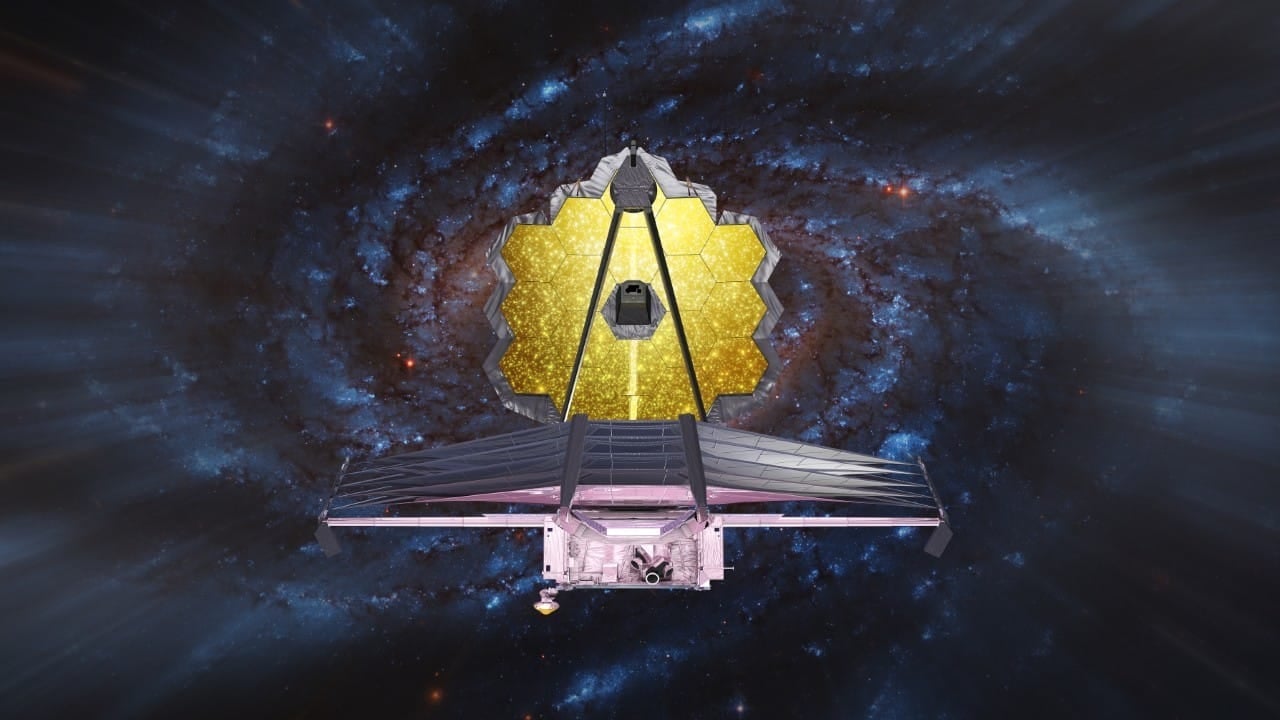
Detection of MoM-z14 was only possible due to the unique capabilities of the James Webb’s 6.5-meter primary mirror and its infrared sensors. The Hubble space telescope, predecessor of the Webb, had technical limitations that prevented it from observing objects formed before 500 million years after Big Bang. The sensitivity of the new observatory at long wavelengths allows it to penetrate the depths of cosmic time.
The NIRCam and NIRSpec instruments work together to capture photons that have been stretched by the expansion of the universe, transforming ultraviolet and visible light into infrared. Essa technology is fundamental to cosmic archaeology, allowing scientists to visualize the universe as it was in its infancy.
Chemical composition and star formation
One of the most intriguing aspects of the discovery is the chemical composition of the galaxy. Spectral analyzes indicated an unusual enrichment of nitrogen relative to carbon, a ratio that differs drastically from what is observed in stars like Sol. Essa’s chemical signature resembles that found in Via Láctea’s ancient globular clusters, suggesting an evolutionary connection between these structures.
The high presence of nitrogen points to rapid nucleosynthesis, driven by first-generation stars. In high-density environments like MoM-z14, frequent collisions and the formation of supermassive stars can accelerate the production of heavy elements, enriching the interstellar medium much sooner than theoretical models predicted.
Furthermore, the absence of a strong “damping wing” in the spectrum indicates that the galaxy was surrounded by a bubble of partially ionized gas. Isso contrasts with the prediction that the universe at that time would be dominated by neutral hydrogen, suggesting that MoM-z14 and similar objects played a crucial role in the reionization of the cosmos.
Impact on current cosmological models
The existence of such bright, massive and chemically complex galaxies at such a remote time requires a revision of standard cosmological models. The theory accepted until then predicted that the formation of galaxies would be a slower and more gradual process. However, the discovery of objects like MoM-z14 indicates that the early universe was much more dynamic and efficient at creating stars.
These observations force astronomers to adjust star formation rates in computer simulations of the young universe. The efficiency with which the gas was transformed into stars appears to have been much higher than previously imagined, which could change the understanding of how the great structures of the universe were organized shortly after the beginning of everything.
Prospects for future exploration
The continued study of MoM-z14 and the search for other galaxies at similar redshifts are priorities for the next observation cycles of James Webb. Confirming that it is possible to detect and chemically analyze such distant objects opens a new window of opportunities for science.
Future telescopes, like Nancy Grace Roman, should work together with Webb to expand the field of view and discover hundreds of other early galaxy candidates. The integration of data from multiple instruments will allow us to further refine analyzes of the composition and evolution of these first building blocks of the universe.
With each new discovery, the frontier of human knowledge recedes, revealing a cosmos that, even in its earliest moments, was already the scene of complex and fascinating physical processes. The era of reionization, previously an obscure and theoretical period, is now beginning to gain clear and observable details.



