
Star in Andromeda skips supernova explosion and becomes black hole in event captured by James Webb

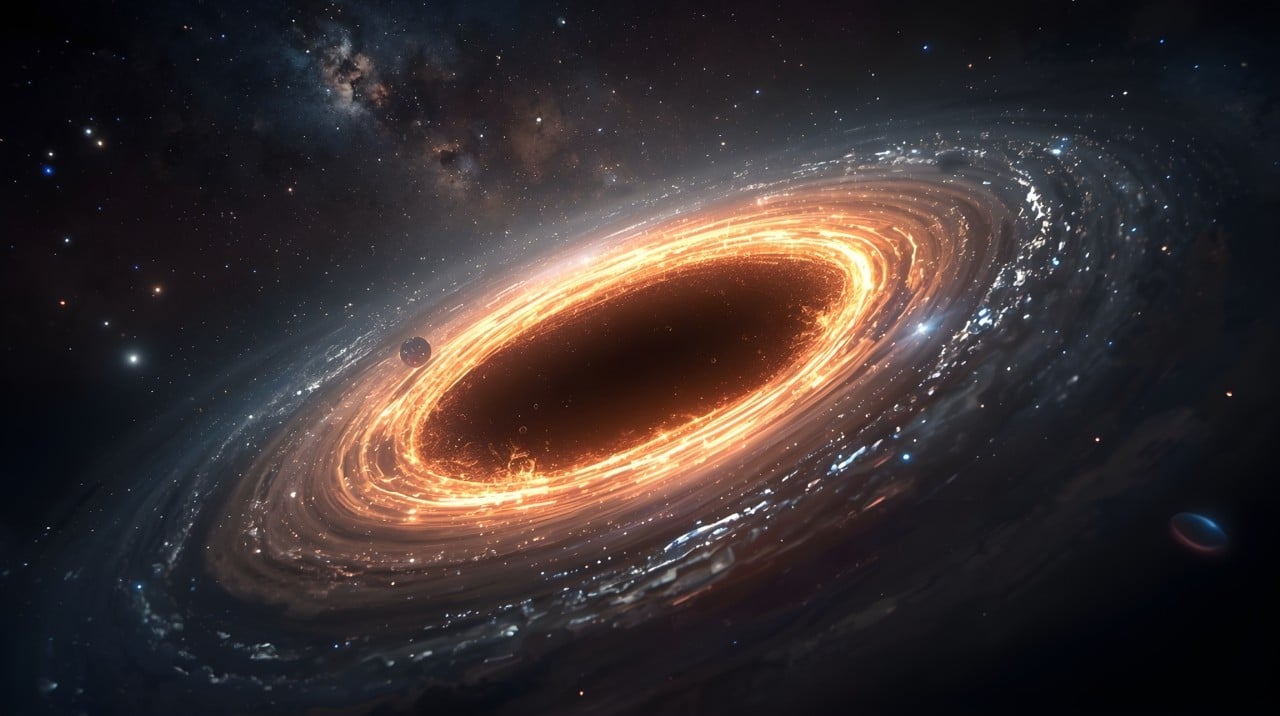
A rare astronomical phenomenon has been identified in the neighboring galaxy of Andrômeda, located approximately 2.5 million light-years away from Terra. The yellow supergiant cataloged as M31-2014-DS1 ended its evolutionary cycle in a way that defies common observation, collapsing directly into a black hole and bypassing the violent, luminous stage known as a supernova. The disappearance of the celestial body was progressively noticed between 2014 and 2022, intriguing the scientific community.
Novas analyzes based on data collected in 2024 by the Telescópio Espacial James Webb (JWST) and the Observatório Chandra X-ray shed light on what happened. The information confirms that gravity overcame internal pressure forces in an overwhelming way, resulting in what experts classify as a “failed supernova”. Instead of scattering bright matter across the cosmos in an energetic explosion, the star silently imploded.

The residual luminosity detected at the site fell to just 7% of the parent star’s original brightness. The stellar remnant is now surrounded by a dense structure of dust and molecular gas, where sensitive instruments have identified the presence of compounds such as sulfur dioxide, water and carbon monoxide. The absence of significant X-ray emissions indicates that the process of feeding the new black hole occurs with low energy efficiency.
Infrared detection and absence of X-rays
Observations carried out in the mid-infrared spectrum by James Webb were crucial in unraveling the mystery, revealing a reddish-colored source in the exact position where the star existed. Detailed spectroscopy showed that there is cold dust and gas moving out of the core, suggesting that there was only a partial ejection of the outer layers during the collapse, without the thermal violence typical of classical supernovae.
In contrast, the Observatório Chandra data showed a void of high-energy signals. The lack of X-ray sources in the region reinforces the hypothesis that the amount of material that returns to the black hole is minimal. Esse behavior validates theoretical models that predict that massive stars, within a specific mass range, can succumb entirely to their own gravity, preventing the reversal of the internal shock that would generate optical brightness.
Mass dynamics and structure of the remnant
Estimativas point out that the original star had between 12 and 13 times the mass of Sol before its disappearance. The resulting compact object retains about 5 solar masses, while part of the hydrogen envelope has been gently expelled, forming a shell of expanding material. The dynamics of this material reveals important details about the process:
- The molecular gas in the inner region of the shell expands at a speed of approximately 100 km/s.
- The scale of the dust structure formed is comparable to the size of our Sistema Solar.
- Monitoring recorded a continued decline in total luminosity until the end of 2024.
The detected molecular gas originates directly from the envelope of the progenitor star. The moderate speed of expansion is consistent with a low-energy ejection, which explains the “fading” or gradual fading observed by astronomers, rather than a sudden spike in light.
Relevance to the study of black holes
Este event represents one of the few direct observations of the formation of a low-energy exploding black hole. Estudos statisticians suggest that up to 30% of massive star collapses may occur in this silent manner, which significantly alters understanding of the population of stellar remnants in the universe.
The relative proximity of the galaxy to Andrômeda offers a unique opportunity for detailed monitoring of this phenomenon. Improved understanding of these events helps refine estimates of the number of black holes in Via Láctea and other Grupo Local galaxies, filling gaps in maps of stellar evolution.



