
Theory suggests that the center of the Milky Way is home to dark matter and not a supermassive black hole

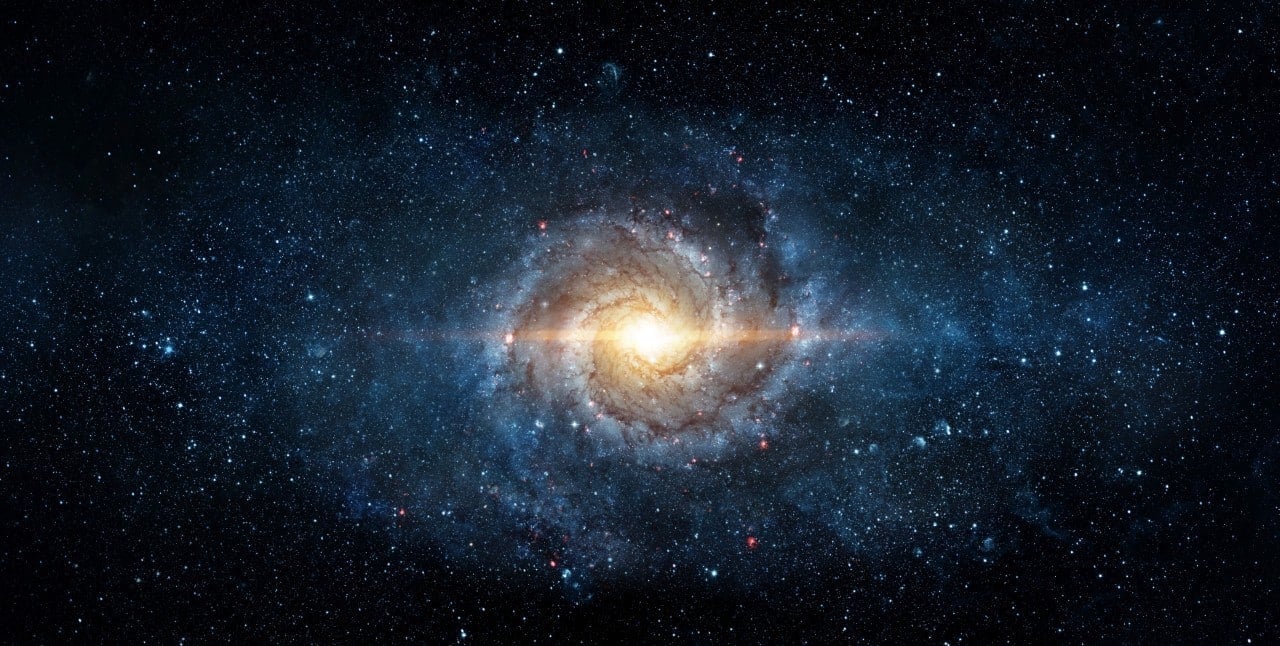
Astrophysics researchers have presented a hypothesis that challenges the established consensus about the nature of the massive object located in the heart of our galaxy. The celestial body called Sagittarius A*, traditionally classified as a supermassive black hole, may actually be a dense concentration of fermionic dark matter. The study suggests that this configuration would explain the gravitational phenomena observed in the region without the need for a singularity or an event horizon, fundamental characteristics of conventional black holes.
The proposal is based on the analysis of the orbits of S stars, which circulate dangerously close to the galactic center and undergo extreme accelerations. Segundo the new models, a nucleus composed of dark matter particles, known as “darkinos”, could generate a gravitational attraction identical to that measured by current instruments. Essa mass would be distributed continuously, connecting to the halo of dark matter that surrounds the galaxy, but reaching critical densities at its central point.
The data used to support this theory includes information captured by stellar mapping missions and long-base interferometry observations. The absence of definitive evidence proving the existence of an event horizon — the point of no return for a black hole — keeps the scientific discussion open. Validating this alternative model will require an observational precision that astronomers are beginning to achieve with newer technologies.
Analysis of telescope images
In 2022, Telescópio of Horizonte of Eventos (EHT) released the first direct image of Sagittarius A*, displaying a central shadow surrounded by a bright ring of emission. Although this image was initially interpreted as visual confirmation of a black hole, proponents of the new hypothesis argue that an ultra-compact dark matter nucleus would produce an extremely similar visual signature. The bending of light caused by intense gravity in these regions can mimic the shadow expected by Relatividade Geral.
The crucial distinction between the two scenarios lies in the fine details of the structure of the light rings. A classic black hole must feature rings of secondary and tertiary photons, resulting from light paths that orbit the singularity multiple times before escaping. The dark matter model, lacking a light-absorbing event horizon, would not generate these additional rings in the same way, offering a clear path for future testing.
Observations in polarized light also provided data on the magnetic fields organized in the central region. Essas information is compatible with the presence of a hot plasma orbiting a massive object, be it a black hole or a fermionic nucleus. The physics of the accretion disk, where matter spirals toward the center, behaves similarly in both models at the scales currently resolved by telescopes.
Verification tools and data
To resolve this cosmological impasse, the scientific community is betting on refining observation instruments and collecting long-term data. The GRAVITY interferometer, installed on the Very Large Telescope (VLT) at Chile, has been instrumental in tracking the position and speed of stars in the galactic center with unprecedented precision. Juntamente With mapping from the Gaia mission, this data helps narrow down the possibilities about the mass distribution in the core.
Confirming the nature of Sagittarius A* depends on identifying subtle discrepancies in theoretical predictions. Scientists have established specific criteria that, if met, could rule out the black hole model in favor of dark matter, or vice versa. Advanced computational analysis is used to simulate the scenarios and compare them with real observations.
- Precisely monitoring the trajectories of S stars to detect anomalous gravitational shifts.
- Search for secondary photon rings in high-resolution EHT images.
- Study of the dynamics of X-ray and infrared flares emitted in the vicinity of the central object.
- Comparison of galactic rotation curves with fermionic core density predictions.
Implications for galactic structure
Accepting that the center of Via Láctea houses a dark matter core would have profound consequences for understanding the evolution of galaxies. Dark matter makes up about 27% of the universe’s mass-energy, but its exact nature remains one of science’s greatest mysteries. If the fermionic hypothesis is confirmed, this would indicate that dark matter can cluster into states dense enough to mimic supermassive black holes, altering the structural formation models of the cosmos.
Furthermore, this theory solves the problem of singularity, a point of infinite density predicted by relativity in black holes, which defies the laws of quantum physics. A dark matter nucleus would be a stable physical object, without singularities, kept in equilibrium by the degeneracy pressure of the particles. The next observation campaigns will be decisive in determining which of these models correctly describes the reality of our galactic center.



