
Interstellar comet eruption exposes organic compounds and brings clues about the origin of life


Unusual activity recorded in deep space has provided astronomers with a rare opportunity to analyze the internal makeup of a visitor from another star system. The object, identified as 3I/Atlas, broke its state of inactivity after billions of years of wandering the cosmos, releasing a load of materials that could redefine the understanding of the distribution of the basic ingredients for life in the universe. The observations, conducted with the aid of high-precision NASA instruments, indicate that these celestial bodies function as complex chemical reservoirs, transporting volatile substances across vast galactic distances.
The most revealing data was captured by the SPHEREx space telescope in December 2025, when the comet experienced a significant eruption of gases and dust. Spectroscopic analysis carried out during this event allowed us to identify a distinct “chemical signature”, made up of elements that normally remain hidden in the frozen depths of these objects. Diferente of rocky and inert asteroids, 3I/Atlas proved to be a dynamic body, whose internal structure houses preserved records of the formation of distant planetary systems.
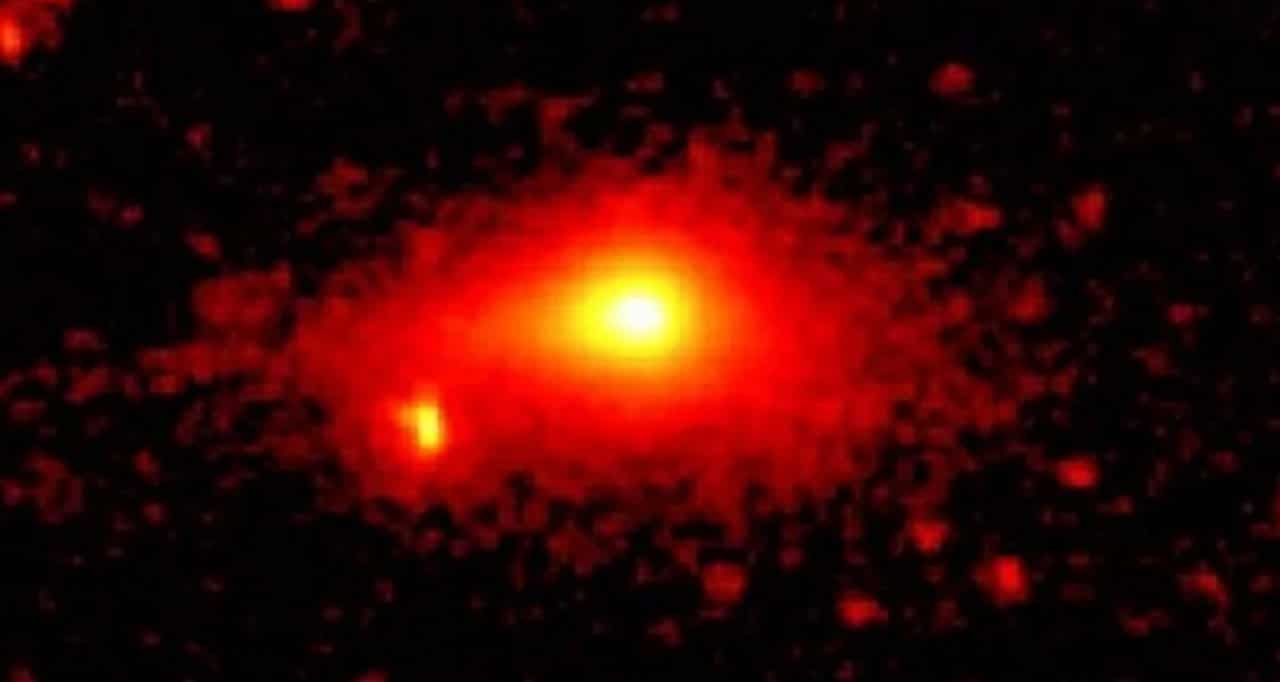
Among the materials detected during the intense sublimation phase, the following stand out compounds that are fundamental to prebiotic chemistry:
- Methanol, a simple alcohol often associated with star formation processes;
- Cyanide, a compound that plays a crucial role in the synthesis of complex organic molecules;
- Methane, hydrocarbon that suggests active and preserved chemical processes.
Confirming the presence of these elements in an object that did not originate in Sistema Solar reinforces the hypothesis that the building blocks of life are not exclusive to Terra or our cosmic neighborhood. The eruption, which exposed the comet’s nucleus, allowed scientists to view materials that had remained untouched for eons, protected from the harsh environment of interstellar space until its approach to Sol.
Late ignition mechanism
The behavior of 3I/Atlas intrigued the scientific community due to the “delay” in its reaction to solar heat. Normalmente, comets begin to release gas and dust as they approach perihelion, the point in their orbit closest to the star. However, this interstellar visitor remained relatively stable during its maximum passage, reserving its greatest activity for two months after this event, when it was already moving away towards deep space.
Experts from Laboratório of Física Aplicada Johns Hopkins explain that this phenomenon occurs due to thermal inertia. The heat radiated by Sol needs time to pass through the comet’s insulating outer layers and reach the deep ice deposits. The surface crust acts as an efficient thermal barrier, delaying the sublimation process until the accumulated energy is sufficient to cause an explosive rupture, abruptly releasing the trapped volatile materials.
This slow warming dynamic resulted in an explosion of unexpected magnitude in late 2025. Thermal energy, upon finally reaching the carbon-rich, water-ice core, caused a violent phase transformation. The solid material instantly converted to gas, creating an expanded, glowing coma that allowed unprecedented data to be collected on the object’s internal composition, surpassing initial observations that showed only carbon dioxide emissions.
Molecular diversity and astrobiological implications
The detection of the “chemical cocktail” released by 3I/Atlas offers concrete evidence about the complexity of interstellar chemistry. The simultaneous presence of methanol and cyanide suggests that planet-forming environments elsewhere in the galaxy have the same basic ingredients found in early Sistema Solar. Isso indicates a universality in carbon chemistry, essential to biology as we know it.
Complex organic molecules, soot and rocky dust were identified in the emission spectrum, painting a detailed portrait of a celestial body that formed in a “stellar nursery” completely different from our own. The existence of these compounds in a wandering object supports the theory of molecular panspermia, where comets and asteroids act as vectors, transporting water and organic compounds to young, barren planets, seeding the conditions for the emergence of life.
The detailed analysis carried out by the SPHEREx mission not only cataloged the elements present, but also revealed the relative abundance of these materials. The proportion between the different gases and the ejected dust provides clues about the temperature and pressure conditions of the environment where 3I/Atlas formed. Essas information is vital to building more accurate models about the chemical evolution of Via Láctea and the frequency with which solar systems develop habitable conditions.
The study also highlighted the difference between the composition of the surface, altered by radiation, and the preserved interior. Enquanto the outer layer showed signs of cosmic wear, the material ejected from the interior turned out to be pristine. Essa dichotomy is fundamental to understanding how comets protect their chemical cargo during journeys that can last millions or billions of years through the interstellar vacuum.
The armor forged by cosmic rays
The physical structure of 3I/Atlas is the direct result of its long journey through the interstellar medium, where it was subjected to extreme radiation conditions. Pesquisadores of Caltech point out that the constant bombardment of high-energy cosmic rays over billions of years has chemically and physically altered the object’s surface. Esse process created a kind of hardened, carbon-rich “crust” that differs significantly from the volatile ice it protects.
This “cosmic armor” played a dual role in the comet’s history. Primeiramente, it preserved the internal volatiles against slow evaporation into empty space. Second, it was this same resistance that caused the delay in cometary activity as it entered Sistema Solar. The rupture of this barrier, caused by persistent solar heat, acted like the opening of a time capsule, allowing humanity to glimpse the raw materials of an alien star system in its purest form.
Peculiarities of the dust tail
In addition to the gaseous composition, the morphology of the 3I/Atlas dust tail presented characteristics that challenge conventional models of cometary behavior. The images captured show a pear-shaped structure, compact and dense, differing from the long and diffuse tails observed in comets typical of our system. Essa anomaly suggests that the ejected particles have a higher mass and density than expected.
Granulometric analysis indicates that the comet released grains of considerable size, comparable to small pellets, instead of the usual microscopic dust. Devido to their weight, these particles are not easily pushed by the pressure of solar radiation, remaining in orbit close to the nucleus. Essa unique feature offers new parameters for the classification of interstellar objects and suggests distinct matter agglutination processes in the 3I/Atlas home system.
Frontiers of space exploration
The passage of comet 3I/Atlas and the subsequent analysis of its eruption represent a significant advance in human ability to study the cosmos without leaving Sistema Solar. By investigating the detailed composition of an object coming from another star, scientists can extrapolate data about the formation of exoplanets and the distribution of organic matter in the galaxy. The Este event validates the importance of continuous monitoring missions like SPHEREx, demonstrating that space near Terra can serve as a natural laboratory for understanding the complex chemistry of the universe and the potential origins of life on a cosmic scale, transforming distant points of light into tangible objects of study full of historical information.



