
Next generation of Toyota’s leading SUV eliminates pure gasoline and relies on a flex hybrid system in Brazil


The global automotive industry is preparing to welcome the sixth generation of the world’s best-selling SUV, marking a fundamental strategic shift in the Japanese automaker’s trajectory. Toyota confirmed that the new model will definitively abandon the exclusively gasoline-powered versions, adopting a 100% electrified approach for the global portfolio. The official schedule points to the launch on Japão for the end of 2025, serving as a starting point for international distribution that will reach strategic markets in the following months.
In the Brazilian scenario, the development of the vehicle is already at an advanced stage, with test units circulating throughout the country to adapt to local conditions. The model is expected to arrive at Brasil dealerships in the first half of 2026. The big news for the domestic market will be the implementation of flex hybrid technology, allowing the use of ethanol in conjunction with the electrical system, a solution that promises to combine energy efficiency with a significant reduction in carbon emissions.
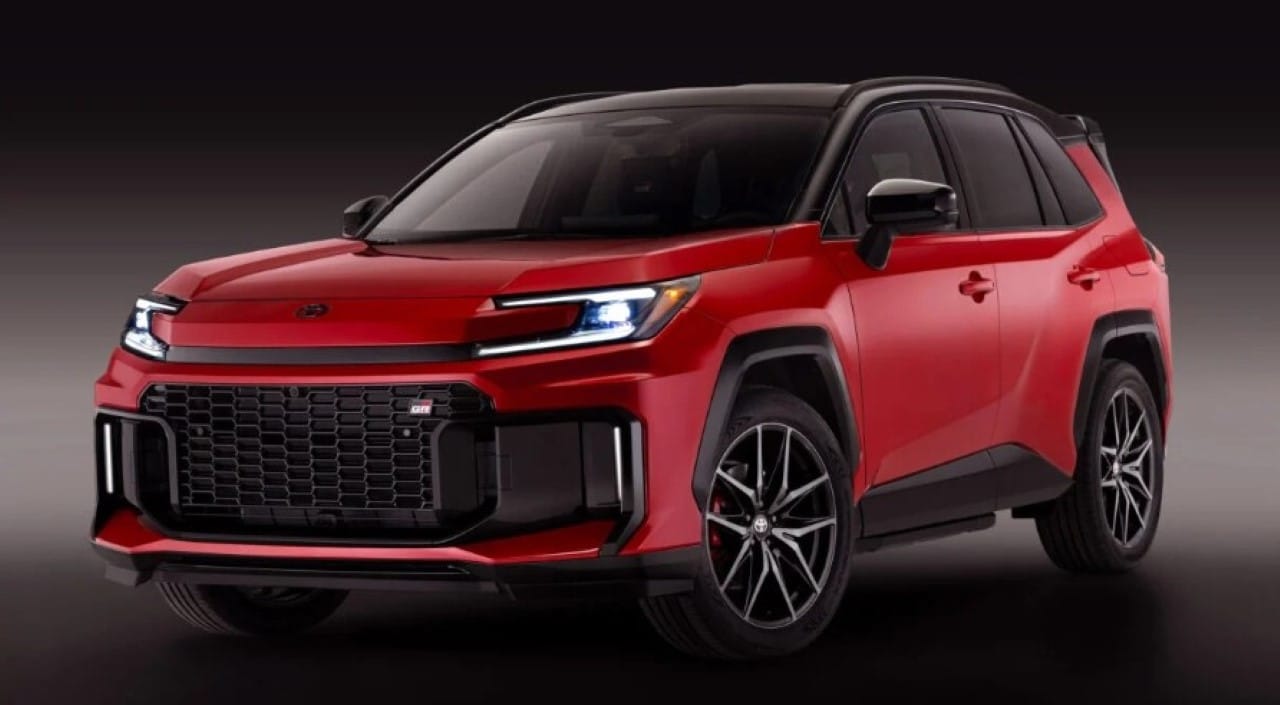
This update represents more than a simple aesthetic change; This is a technical repositioning to meet new environmental and consumption requirements. The brand’s engineering focused on improving thermal efficiency and the integration of propulsion systems, ensuring that the energy transition does not compromise the mechanical reliability that has consolidated the sports utility vehicle’s reputation over the last few decades.
The project reflects the manufacturer’s ambition to maintain leadership in the medium SUV segment, anticipating increasingly stringent emissions regulations. The decision to exclude purely combustion engines signals the end of an era and consolidates electrification as the irreversible standard for the brand’s main products on a global scale.
Visual renewal and identity
The aesthetics of the new generation adopt the design language known as “Hammerhead”, already seen in recent launches by the brand such as the Prius and the Crown line. Esta visual identity gives the SUV a more aggressive and aerodynamic appearance, characterized by a tapered front optical assembly that integrates with a redesigned grille. The LED headlights adopt a “C” shape, providing a distinctive and modern light signature.
On the sides, the lines became more fluid and muscular, abandoning the traditional utilitarian appearance in favor of a more dynamic and sophisticated profile. The design work was not just aesthetic, but functional, aiming to reduce the aerodynamic drag coefficient. Essa improvement in air flow directly contributes to reducing internal noise at high speeds and fuel economy.
The rear of the vehicle also underwent redesign, with lights that follow the width of the body and a redesigned bumper to convey robustness. The designers’ intention was to create a vehicle that, whilst maintaining the familiar proportions of a medium SUV, conveys a sense of technology and visual avant-garde, clearly differentiating itself from the previous generation.
Evolution of the hybrid mechanical assembly
The heart of the new sports utility vehicle is the fifth generation of the Toyota (THS 5) hybrid system. The set combines a 2.5-liter gasoline engine (or flex, in the Brazilian case) with more powerful and compact electric motors. The result is a combined power that reaches 226 horsepower, surpassing the current model’s numbers and ensuring safer overtaking on highways.
Energy efficiency was the central pillar of mechanical development. Preliminary Testes indicate an improvement of approximately 15% in fuel consumption in the urban cycle. Além In addition, acceleration from 0 to 100 km/h was reduced, making the car around half a second faster, which demonstrates that the search for economy did not sacrifice dynamic performance.
For the plug-in hybrid version (PHEV), which allows external recharging, the autonomy in 100% electric mode was significantly increased, surpassing the 100 kilometer barrier. Isso allows most daily trips to be carried out without using the combustion engine. The E-Four all-wheel drive system has also been recalibrated, offering greater grip and stability on slippery terrain or sharp curves.
Digital interior and premium finish
The vehicle’s cabin has undergone a complete digital transformation, eliminating most physical buttons in favor of tactile interfaces and voice commands. The highlight is the new multimedia center with a screen of up to 14 inches, which offers wireless connectivity for smartphones and “over-the-air” system updates (via the cloud). The instrument panel has also become fully digital and configurable, allowing the driver to prioritize navigation or energy efficiency information.
In response to criticism about the finish of past generations, the automaker invested in soft-touch materials and higher quality coatings. The intention is to compete directly with premium brands, offering a more refined and quieter internal environment. Acoustic insulation was reinforced, and the internal space was optimized to ensure greater comfort for rear seat passengers.
Connectivity has been expanded with the inclusion of multiple USB-C ports distributed throughout the cabin, ensuring that all occupants can charge their devices. The infotainment system now has a more intelligent virtual assistant, capable of recognizing natural voice commands to adjust the temperature, change the radio station or set destinations on the GPS.
Active safety and assisted driving
The Toyota Safety Sense security package has received important updates in this new generation. The pre-collision system now has an expanded field of view, capable of detecting pedestrians, cyclists and motorcycles even in low light conditions. Improved Sensores allow for faster response from the autonomous braking system at intersections.
The adaptive cruise control (ACC) has been refined to act more smoothly in heavy traffic situations, with the congestion assistant function. Isso allows the vehicle to stop and resume movement automatically, reducing driver fatigue in large urban centers. The lane keeping system has also been calibrated to offer more natural steering corrections.
Structurally, the vehicle platform has been reinforced to achieve top scores in global crash tests. The increased torsional rigidity not only better protects occupants in the event of an accident, but also contributes to more precise and solid handling, conveying a greater feeling of safety behind the wheel.
Perspectives for the Brazilian market
The arrival of the new generation to the Brasil in 2026 will place the model in direct competition with strong rivals, such as the Honda CR-V and the Volkswagen Tiguan. The brand’s strategy relies on flex hybrid technology as the major competitive differentiator, taking advantage of the ethanol infrastructure already consolidated in the country to offer a low-emission solution without the exclusive dependence on electric chargers.
Local engineering is working on fine-tuning the engine to ensure that ethanol performance is optimized, both in power and consumption. The adaptation also involves calibrating the suspension to deal with the irregularities of Brazilian roads, maintaining the model’s characteristic comfort.
Although official prices have not yet been defined, the expectation is that the model will be positioned in a higher range than the current one, justified by the increase in technology and equipment. The bet is that the cost-benefit, combined with fuel economy and the low historical depreciation of the model, will keep the SUV as one of the main choices in the electrified segment.
Palavras key: Toyota RAV4, hybrid SUV, automotive market, Toyota Safety Sense.
Palavras long-tail key: car launch at Brasil in 2026.
Links searched:
[Link placeholder: original Fonte about Toyota RAV4 2026]
[Link placeholder: Notícias latest on hybrid technology Toyota]
[Link placeholder: Dados of Japanese and Brazilian automotive market]



