
Tianwen-1 records passage of interstellar comet 3I/ATLAS near Mars and reveals unprecedented data

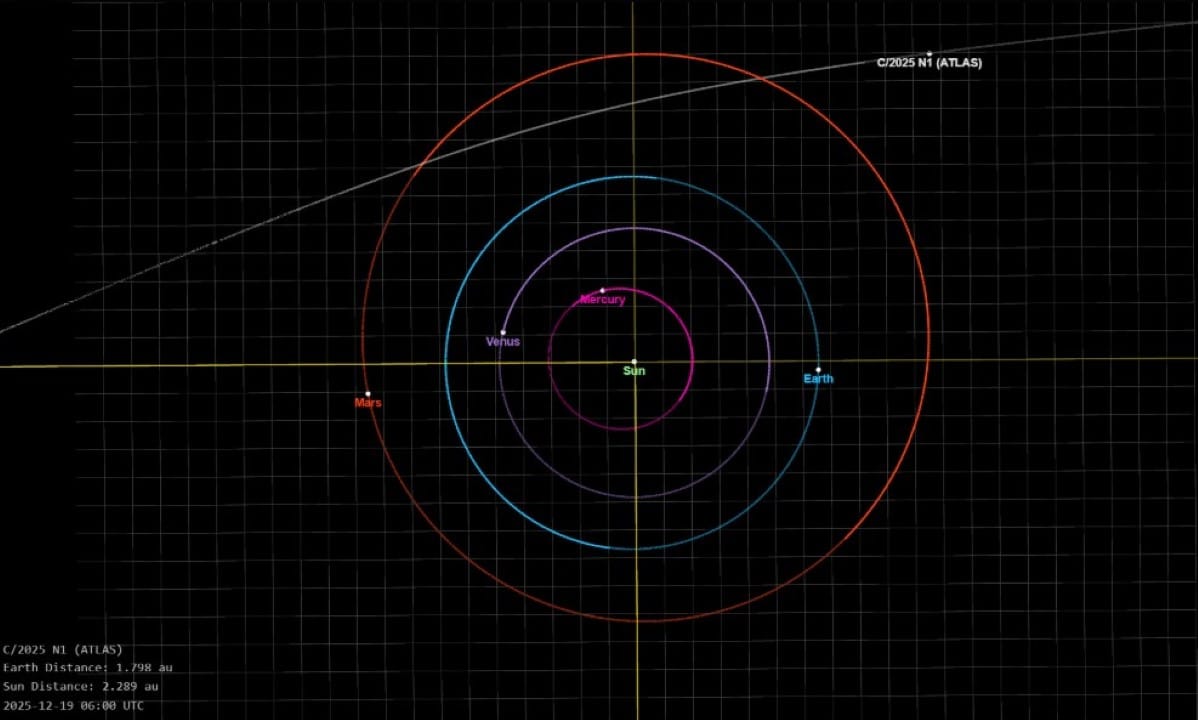
Administração Espacial Nacional of China (CNSA) released high-definition visual records of object 3I/ATLAS, captured by the Tianwen-1 probe. The operation took place in October 2025, when the equipment was orbiting Planeta Vermelho, marking a significant advance for modern astronomy by photographing a body of interstellar origin from another world. The unprecedented feat offers the global scientific community a new perspective on materials formed outside our planetary system.
Details about the cosmic visitor and the operation
The recording was carried out at an approximate distance of 30 million kilometers from the celestial body, requiring extremely precise orbital maneuvers and detailed planning by the control team at Pequim. The images provide crucial data for studying the composition and trajectory of objects that visit Sistema Solar from other stars, allowing in-depth analyzes of the formation of distant planetary systems in Via Láctea and serving as cosmic time capsules.

Comet 3I/ATLAS is the third object detected with a confirmed origin outside our system, following in the footsteps of ‘Oumuamua, observed in 2017, and 2I/Borisov, identified in 2019.
With an estimated diameter of 5.6 kilometers, the celestial body presents unique characteristics that aroused immediate global interest:
– Velocidade of impressive displacement of 58 kilometers per second;
– rocky and frozen Núcleo clearly visible in processed photographs;
– Cauda formed by dust and ions extending for about 56 thousand kilometers.
Technological adaptation of the high-resolution camera
The Câmera of Alta Resolução (HiRIC), the main instrument on board the probe, played a key role in the success of the observation. Originalmente designed to map the Martian surface with an exceptional level of detail, the tool was adapted for use by the engineering team to track a small, faint and fast-moving target against the dark background of deep space, demonstrating the versatility of modern space equipment.
To overcome the comet’s high speed and avoid blurring that would render the images scientifically useless, exhaustive computer simulations and extremely short exposure times were used, optimizing light capture without sacrificing sharpness.
International cooperation in data collection
The 3I/ATLAS observation mobilized space agencies around the world, transforming the event into a collaborative effort on a planetary scale.
Agência Espacial Europeia (ESA) used the Mars Express and ExoMars Trace Gas Orbiter probes to analyze gas emissions from the comet’s coma, while NASA actively participated by directing Mars Reconnaissance Orbiter (MRO) to capture complementary images. Análises Preliminary spectral data, based on the ensemble data, indicate the presence of water ice, carbon dioxide and carbon monoxide, suggesting formation in extremely cold regions of its original star system.
Mission legacy and future steps
Launched in July 2020, the Tianwen-1 mission consolidated China as a powerhouse in interplanetary exploration, consisting of an orbiter, a lander and the Zhurong rover, which explored the Utopia Planitia plain. The technical success in recording the comet validates methods that will be used in future deep space exploration missions, focused on asteroids and other smaller bodies, which will become a priority for CNSA in the next decade of astronomical research.



