
Hubble captures atypical behavior in interstellar comet with formation of double jets and anti-tail


Telescópio Espacial Hubble provided crucial data for understanding the dynamics of objects that visit our planetary system from other regions of the galaxy. Registros captured at the end of December 2025 revealed a complex configuration in the structure of comet 3I/Atlas, highlighting the presence of two distinct emission jets. Detailed analysis of these images allowed astronomers to identify behavior that differs from the pattern observed on most local celestial bodies.
The observations were carried out at two specific times, on the 12th and 27th of December, using long-term exposures to capture the faint light reflected by the object. The space observatory’s WFC3 UVIS instrument operated at a specific wavelength to maximize contrast and reveal details of the coma and jets. The result exposed intense activity that persists even after the object has passed its closest point to Sol.
One of the most intriguing aspects revealed by the images is the formation of a prominent “anti-tail”, directed towards Sol, which contradicts the usual orientation of cometary tails, which tend to point in the opposite direction due to the pressure of solar radiation. Essa anomaly suggests that larger, heavier particles are being ejected and resisting the push from sunlight, creating a unique visual signature in the processed data.
The persistence of this activity raises fundamental questions about the internal composition and rotation of the 3I/Atlas nucleus. As Enquanto moves away into deep space, the object continues to expel material, offering a rare opportunity to study matter from outside Sistema Solar. The scientific community uses this information to refine models about the formation and evolution of smaller bodies in other stellar systems.
Analysis of the structure of double jets
The configuration observed by Hubble is not static and presents significant variations over a short period. Processing the images through specialized filters, such as the Larson-Sekanina algorithm, allowed rotational gradients to be highlighted that would otherwise be hidden in the diffuse glow of the coma. Essa technique revealed that the intensity of the jets oscillates, indicating a direct relationship with the rotational movement of the comet’s nucleus.
The simultaneous existence of two material flows suggests that the activity is not restricted to a single region of the core’s surface. The main jet, responsible for the formation of the anti-tail, appears to be fed by dust grains of considerable size, ranging between 1 and 100 microns. Já the secondary jet, weaker and directed towards the opposite side, may be the result of heat transfer to the night side of the comet or a different volatile composition.
- Primary jet: exhibits high collimation and forms the visual structure directed to Sol, composed of more massive particles.
- Secondary jet: presents lower intensity and aligns with previous activity, suggesting multiple emission sources.
- Temporal dynamics: the alternation of brightness between observation dates points to a rotation period estimated at around 16 hours.
- Extent of the coma: The ejecta creates a cloud of gas and dust that extends hundreds of thousands of kilometers around the nucleus.
Essa structural complexity indicates that 3I/Atlas has an active and possibly irregular topography. The preservation of these characteristics after passing through perihelion, which occurred in October 2025, demonstrates that the object withstood the thermal stress of the solar approach without disintegrating, maintaining its rotation axis stable.
Interstellar trajectory and origin
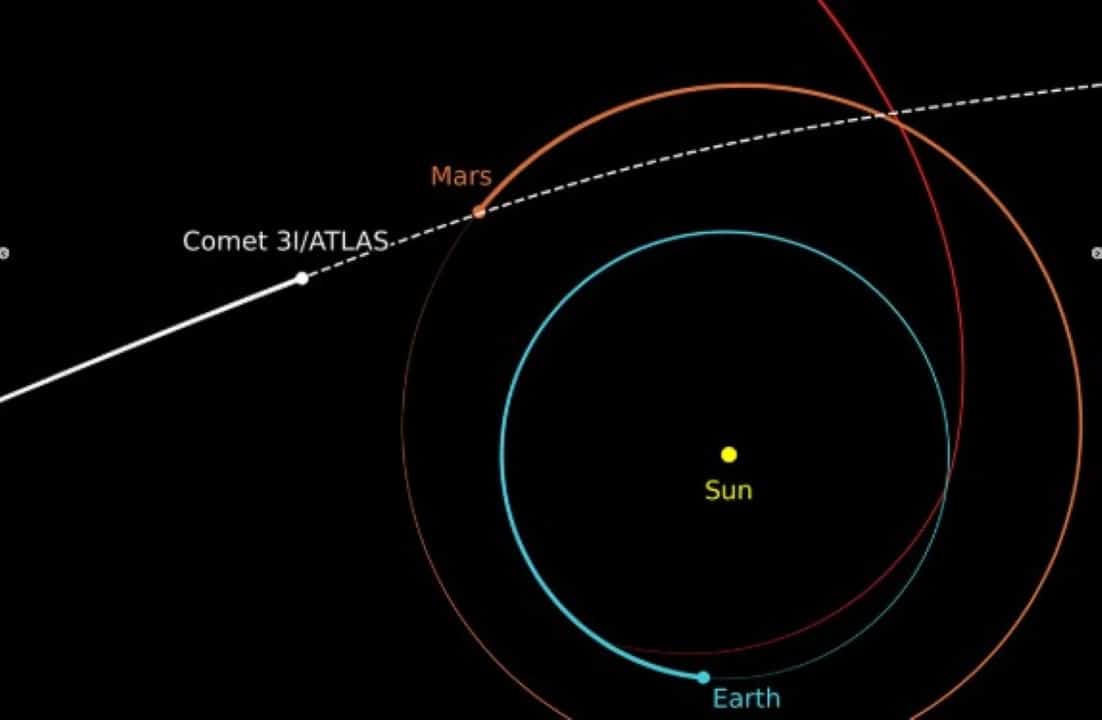
Confirmation of the interstellar origin of 3I/Atlas is based on its hyperbolic orbit, which denotes a speed and inclination incompatible with objects formed gravitationally by our Sol. Estudos indicate that this visitor may have originated in the thick disk of Via Láctea, with an estimated age of over 7 billion years. Essa antiquity makes it a galactic fossil, carrying primordial materials from a time before the formation of our own planetary system.
Apesar due to the gravitational influence of Sol, which curved its trajectory by approximately 16 degrees, the comet maintained its essential kinematic properties. The particle ejection speed varies considerably, with the smaller grains reaching speeds of up to 22 meters per second, while the larger particles, which make up the anti-tail, move more slowly, at around 2 meters per second. Essa differentiation is crucial to understanding the distribution of mass around the nucleus.
The size of the nucleus, estimated at between 440 meters and 5.6 kilometers, places 3I/Atlas in a category of objects that are difficult to detect until they are relatively close. The reddish color observed in spectroscopic analyzes resembles that of type D asteroids, common in the outer regions of the asteroid belt, and suggests the presence of complex organic compounds that were irradiated by cosmic rays during their long journey through interstellar space.
Implications for modern astronomy
The detection and continuous monitoring of objects like 3I/Atlas represents a significant advance in space surveillance capabilities. Diferente of periodic comets, these visitors offer a unique and limited window of observation. The data collected by Hubble, together with observations from other ground-based and space-based instruments, allows scientists to compare the chemistry of other star systems with that of our own.
The presence of vigorous post-perihelion activity challenges predictions that such objects could quickly become inactive as they move away from the heat source. The observed mass loss is significant relative to the estimated size of the nucleus, which suggests that the comet is rich in volatiles that sublime vigorously. Essa feature is vital to understanding the longevity and internal structure of icy bodies that travel between stars.
As 3I/Atlas continues its journey outward from Sistema Solar, it remains visible to large telescopes, allowing the evolution of its jets and the dissipation of its coma to be monitored. Cada new processed image adds a piece to the puzzle of galactic planetary formation, reinforcing the importance of space missions capable of reacting quickly to the passage of these cosmic travelers.




