
Interstellar visitor 3I/Atlas completes closest approach to Earth and heads towards Jupiter

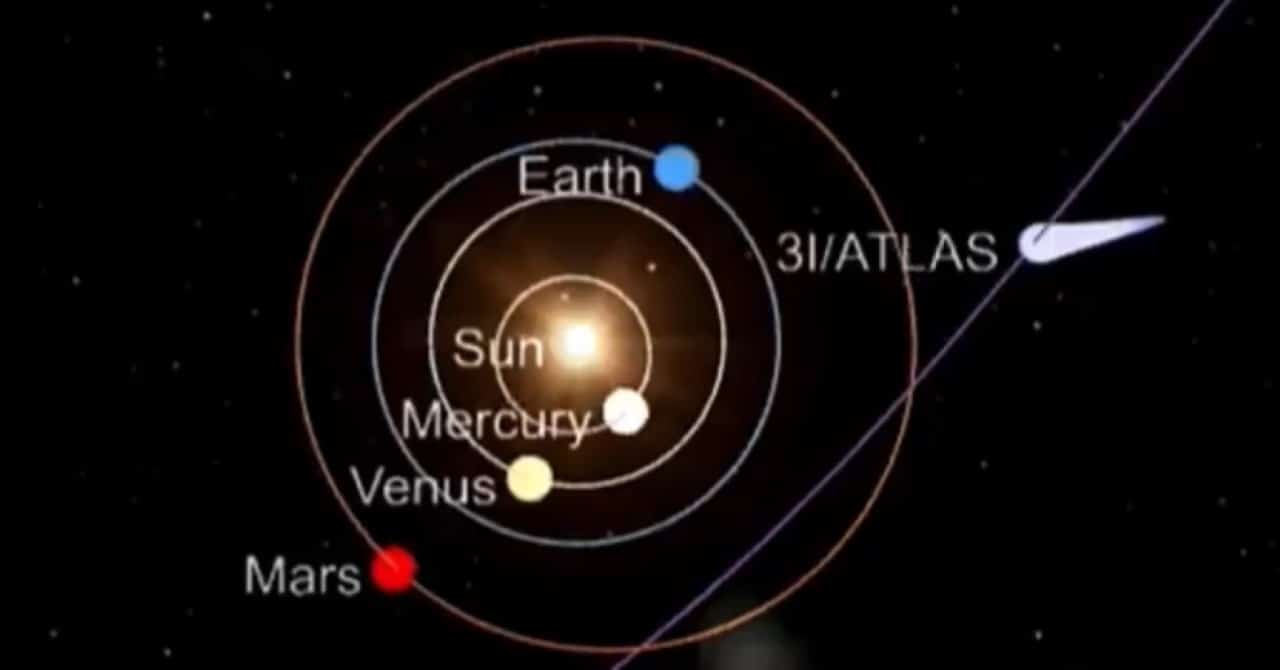
The interstellar object 3I/Atlas reached, this Friday (19), the moment of closest proximity to our planet, being located at a safe distance of approximately 270 million kilometers. Monitorado by astronomers from different parts of the globe, the celestial body offers a rare opportunity to collect data on the chemical composition of distant star systems, without posing any threat of impact.
Its hyperbolic trajectory and speed exceeding 220 thousand kilometers per hour confirm that the visitor did not originate from Sistema Solar, but rather in deep space, being only the third object of this nature ever identified by science. The current passage allows the use of high-powered telescopes to analyze details that would be impossible to capture under other circumstances, enriching the global astronomical database.

Since its discovery by the ATLAS system, at Chile, in July 2025, the comet has been the subject of intense scrutiny, with images from the Hubble telescope revealing the sublimation of ices on its surface. Apesar from relative approximation, the phenomenon is not visible to the naked eye, requiring professional or medium-sized amateur equipment to be observed, given that the distance is equivalent to almost twice the space between Terra and Sol.
Chemical composition and structure of the nucleus
Spectroscopic analyzes carried out during perihelion indicate that 3I/Atlas has a distinct chemical signature, with nickel concentrations higher than those found in local comets. Estimativas point out that the object could be up to three billion years older than our own planetary system, carrying primordial materials preserved by the cold of interstellar space.
The comet’s nucleus has an estimated diameter of between 600 and 800 meters, a measurement refined after initial observations that were hampered by the cloud of gas and dust surrounding it. The celestial body’s activity intensified considerably after its closest passage to Sol last October, generating an extensive coma and a tail visible to monitoring instruments.
Scientific relevance and final destination
The passage of this cosmic visitor is crucial for modern astronomy, as it allows direct comparisons with its predecessors ‘Oumuamua and Borisov, expanding understanding of the formation of other worlds. The presence of organic compounds and ice in its structure suggests ways to understand how water and prebiotic elements can be distributed throughout the galaxy.
Experts from Nasa and international observatories highlight fundamental points about the trajectory and nature of the object:
– The hyperbolic orbit guarantees that the comet will never return to the vicinity of Terra and Sol
– The celestial body will be permanently ejected from Sistema Solar after crossing the Júpiter region later this year
– Todas the evidence collected refutes theories of artificial origin, confirming that it is a natural phenomenon
– Observatórios on Espanha detected periodic jets that help in calculating the rotation of the nucleus
Data processing and future studies
The volume of information captured during this observation window will require months of detailed analysis by the international scientific community. The data obtained by ground-based and space telescopes will serve as the basis for dozens of academic articles on the dynamics of interstellar objects.
With the advancement of detection technologies, astronomers hope to identify new visitors more frequently in the coming years, using 3I/Atlas as a reference model for future classifications and understanding of celestial mechanics beyond the boundaries of our system.



