
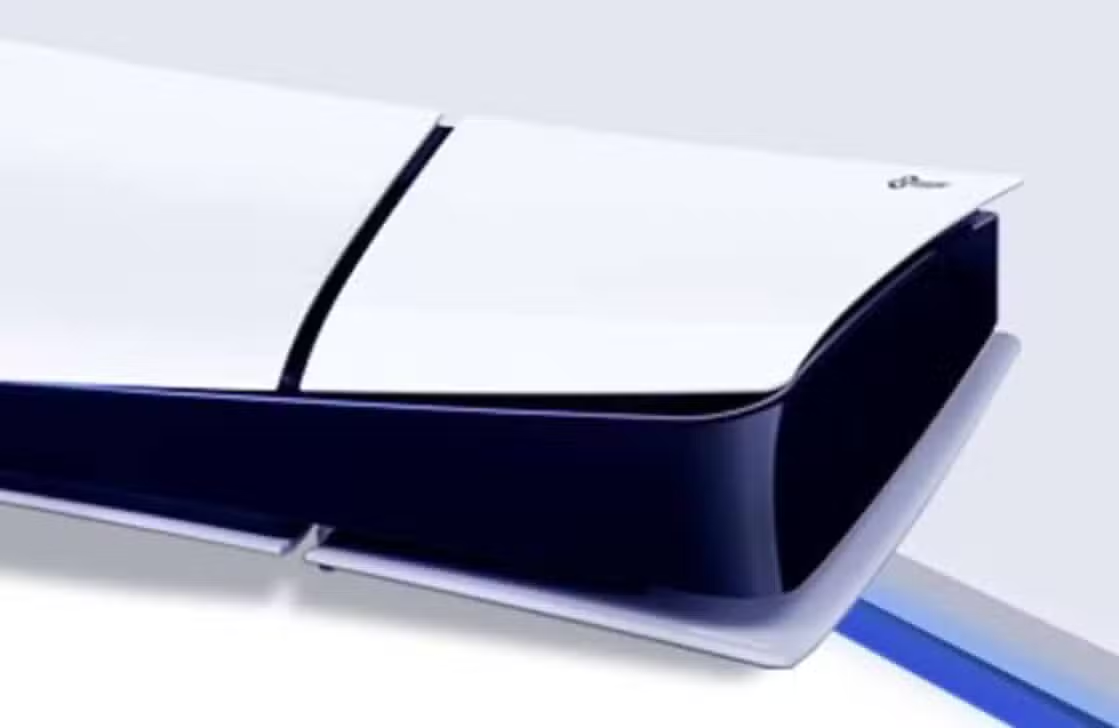
New technical details about the next generation of Sony video games have begun to circulate on specialized hardware forums, bringing to light robust information about the memory capacity of future systems. Information indicates that the successor to the Japanese company’s current desktop console could reach the market equipped with an impressive 30 GB of GDDR7 RAM. Além of the flagship device, reports point to the parallel development of a dedicated portable device, which would feature 24 GB of LPDDR5X memory, suggesting the brand’s renewed focus on high-performance mobility without relying exclusively on streaming.
The suggested internal architecture for the desktop console describes a 160-bit memory bus operating at a speed of 32Gbps. Essa combination would result in a bandwidth of approximately 640 GB/s, a significant jump from current standards. Para reaches this total capacity of 30 GB, system engineering must use 3 GB clamshell memory modules.

This stacking technique allows you to increase memory density without the need to drastically increase the bus width, maintaining energy efficiency and controlling production costs. The use of GDDR7 memory represents a crucial technological advancement to support textures at increasingly higher resolutions, such as 8K, and to power complex artificial intelligence and Ray Tracing algorithms in real time.
Strategy for the notebook market
The purported portable console, designed to run games natively, features specs that rival many modern gaming-focused personal computers. The choice of 24 GB of LPDDR5X memory demonstrates a concern with the balance between raw performance and battery consumption. The LPDDR (Low Power Double Data Rate) standard is designed specifically for mobile devices, offering high data transfer rates with reduced operating voltage.
With this amount of memory, the device would have enough capacity to run current generation games with optimization settings, without suffering from a lack of resources for textures or multitasking. The portable console market has grown exponentially, driven by competitors launching compact gaming PCs. Sony’s entry into this segment with robust proprietary hardware would allow the execution of exclusive titles with superior visual quality, taking advantage of the brand’s existing library.
Unifying the architecture between desktop and portable consoles would make developers’ work immensely easier. By maintaining a broad base of shared memory on both systems, studios could create scalable versions of their games, where the main difference would be the final resolution and frame rate, while maintaining the integrity of the mechanics and artificial intelligence.
Renewed partnership with AMD
The leaked documents reinforce the continuity of the long-standing partnership between Sony and AMD to supply the main chips. Tanto both the desktop console and the portable model must be powered by the Zen 6 processor architecture. In the graphics department, the technology chosen would be RDNA 5, which promises drastic improvements in computational units aimed at artificial intelligence.
- Native AI integration for image upscaling and frame generation.
- Elimination of communication bottlenecks between CPU and GPU.
- Advanced support for complex real-time physics simulations.
- Improved energy efficiency to reduce system heat.
The use of AI for image enhancement has become an industry standard, allowing games to run smoothly even at lower native resolutions. Integrating these technologies directly into hardware would eliminate the need for less efficient software solutions, ensuring a more stable experience for the end user.
Comparison with the current generation
To put the leap in performance into context, the original PlayStation 5 hit the market with 16 GB of GDDR6 memory and a bandwidth of 448 GB/s. The Pro model, released later, maintained the amount of memory, focusing on improvements in the GPU and storage. The jump to 30 GB in the future console represents almost double the capacity available to developers.
This extra memory isn’t just for prettier graphics. Ela allows game worlds to be loaded almost entirely into RAM, reducing or eliminating loading screens and enabling instant transitions between vast environments. Além Additionally, modern console operating systems reserve a significant chunk of memory for background functions such as voice chat, match recording, and social interfaces. At 30 GB, the portion dedicated exclusively to the game increases proportionally.
In the case of the notebook, 24 GB is a higher amount than that found in most entry-level and mid-range gaming laptops, and well above the 16 GB that has become standard in competitor notebooks. Isso suggests that the device will not just be an accessory, but a central platform in the company’s strategy for the coming years, capable of offering AAA experiences anywhere.
Impacts on game development
The introduction of 3 GB clamshell memory indicates a creative solution to overcome physical and cost limitations. Instead of using more expensive ultra-high-density chips or increasing motherboard complexity with more data tracks, this approach stacks memory efficiently. Isso can result in a more competitive final cost for the consumer, even with the drastic increase in specifications.
Game developers often cite memory as the main limiter in creating immersive experiences. With the new specifications, technical barriers related to the diversity of visual assets in a scene would be removed. Isso means a greater variety of textures, more detailed character models and less repetitive environments, raising the level of realism in electronic games.
Although Sony has not officially confirmed this data, the level of technical detail present in the leak, including voltages and specific bus types, lends credibility to the information. The industry is now awaiting official moves to confirm how these specs will translate into real experiences for gamers in the coming years.
Keywords searched:
PlayStation 6 specs, GDDR7 console memory, AMD Zen 6 RDNA 5, new Sony laptop, PlayStation hardware leak.
Links researched:
https://adrenaline.com.br/noticias/v/88636/vazamento-sugere-ps6-com-30gb-de-ram-e-portatil-com-24gb
https://www.tudocelular.com/mercado/noticias/n217590/playstation-6-portatil-ps-vita-2-especificacoes.html
https://flowgames.gg/ps6-pode-ter-30-gb-de-ram-e-versao-portatil-tera-24-gb/