
Study details discovery of ionized iron bar that crosses the interior of the Ring Nebula

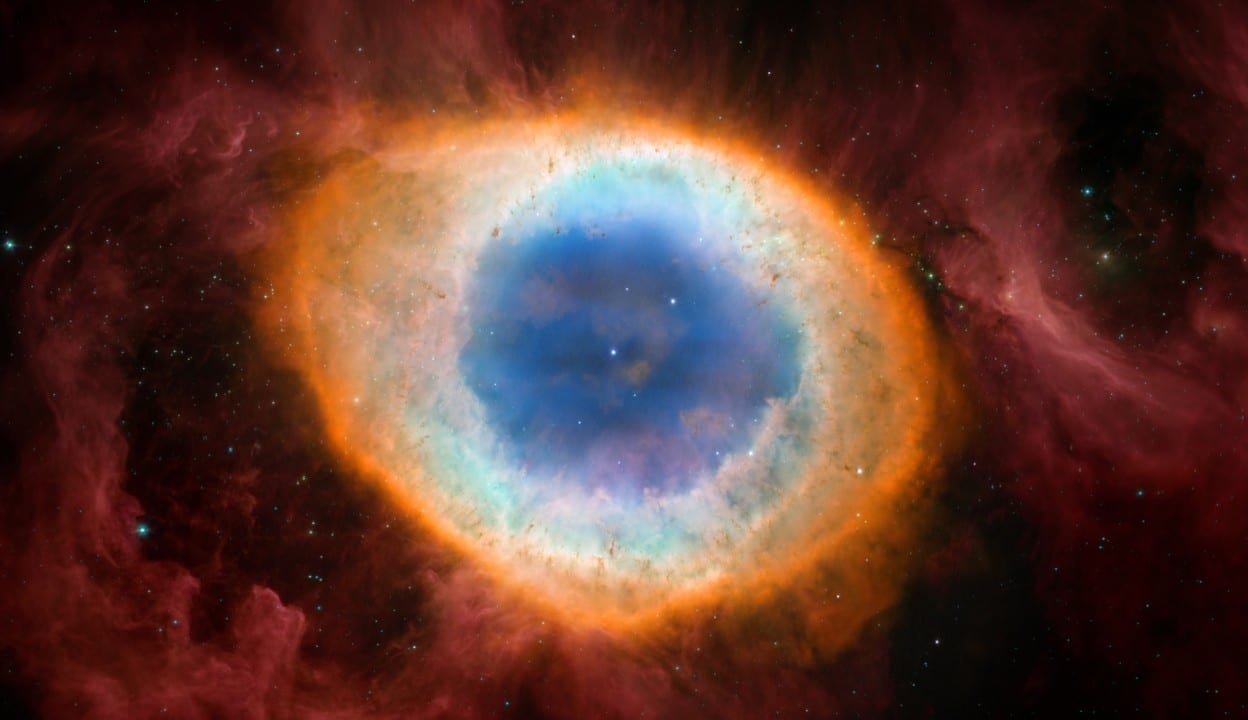
An international team of researchers has revealed the identification of an unprecedented linear structure composed of highly ionized iron deep within Nebulosa of Anel. Localizado approximately 2,600 light-years from Terra, in the constellation of Lira, the celestial object is one of the most photographed and studied in modern astronomy, but it still kept secrets in its central region. The detection was possible thanks to the use of the WEAVE instrument, recently installed on Telescópio William Herschel, located on Ilhas Canárias.
The discovered formation crosses the central cavity of the nebula and is distinguished by its lack of correspondence with other gaseous elements known in the region. Diferente of common phenomena in celestial bodies of this category, such as high-speed gas jets, the iron bar presents unique morphological and kinematic characteristics. The study, which included the collaboration of more than 20 scientists, was accepted for publication in the scientific journal Monthly Notices of the Royal Astronomical Society, consolidating the data collected during the verification phase of the new equipment.

The observations that led to this conclusion were carried out throughout 2023, utilizing WEAVE’s ability to perform full-field spectroscopy over a wide area. Essa technology allowed astronomers to capture detailed information from thousands of points simultaneously, isolating the specific emission from iron and separating it from the intense glow of hydrogen and other gases that make up the nebula’s characteristic colored ring.
This discovery challenges previous understandings of the distribution of heavy metals in planetary nebulae. The presence of iron in a gaseous and highly ionized state suggests complex physical processes occurring in the stellar remnant, which may involve the destruction of dust grains or mass ejection mechanisms not yet fully mapped by current theoretical models.
WEAVE technology and the accuracy of observations
The Telescópio William Herschel, with its 4.2-meter primary mirror, underwent a significant upgrade to receive the WEAVE spectrograph. Este instrument represents a leap in the ability to analyze light from distant objects. By breaking down light into its spectral components, the equipment allows scientists to determine the chemical composition, speed and temperature of different parts of a nebula with unprecedented precision.
During observation sessions carried out between May and June, the processed data revealed that the iron emission was confined to a narrow line. The instrument’s spectral resolution was critical in distinguishing the high ionization states of iron, specifically [Fe V] and [Fe VI], differentiating this structure from the surrounding gas halo. Detailed analysis of the radial velocities confirmed that the bar does not move in the same way as the bipolar jets traditionally observed in similar systems.
The lack of evidence of high-speed shocks or extremely hot gas in the bar area intrigues researchers. Comparações carried out with previous data, focused on the distribution of cosmic dust, indicate a possible interaction between gaseous iron and solid grains, which could explain the origin of this material in the observed form.
Historical context and evolution of the study
Nebulosa of Anel, cataloged as M57 or NGC 6720, has a long history of observations dating back to the 18th century. Desde its discovery, the object served as a natural laboratory for understanding the life cycle of intermediate-mass stars, similar to our Sol. The evolution of astronomical tools has allowed each generation of scientists to add a layer of complexity to the three-dimensional model of this celestial body.
Check out the main milestones in the chronology of studies of this fascinating object below:
* 1779: Independent Descoberta performed by astronomers Antoine Darquier of Pellepoix and Charles Messier, who included it as the 57th item in their famous catalogue.
* Século XIX: William Herschel coins the term planetary nebula, noting the gaseous disk’s visual similarity to giant planets like
* Décadas from 1990 and 2000: Telescópio Espacial Hubble provides high-resolution images, revealing complex knots and filaments in the ring structure.
* Era Atual: The Telescópio Espacial James Webb and the WEAVE instrument deepen analysis with infrared data and full-field spectroscopy.
Hypotheses about the origin of the structure
The formation of this iron bar remains an open enigma for astrophysics. Inicialmente, the team considered the possibility that it was a jet of matter, common in binary systems or rapidly rotating stars. However, the absence of the typical velocity signatures of these jets led to this primary hypothesis being discarded. The focus now turns to alternative mechanisms of local chemical enrichment.
One of the most plausible theories involves the selective destruction of iron-rich dust grains. Under normal conditions, heavy metals in planetary nebulae tend to condense into solid grains, disappearing from the visible gas phase. The intense radiation from the central white dwarf, an extremely hot and compact star, could be sublimating these grains in a specific region, releasing the iron back into the gaseous state.
Another line of investigation suggests that the bar may be the result of an ejection of material that occurred at a very specific phase in the star’s evolution, perhaps influenced by an invisible stellar companion or by remnant magnetic fields. The amount of iron detected is significant, comparable to the mass of small rocky bodies, which requires a substantial release event to justify the observed density.
The stellar life cycle and nebular chemistry
Planetary nebulae represent the final chapter in the lives of stars that have exhausted their nuclear fuel. When expanding into the red giant phase, the star expels its outer layers, creating an envelope of gas that is subsequently ionized by ultraviolet radiation from the exposed core. Esse process is fundamental for the chemical recycling of the galaxy, dispersing elements such as carbon, nitrogen and oxygen in the interstellar medium.
Nebulosa of Anel exemplifies this phenomenon with its toroidal geometry, which appears to us as a ring due to our almost frontal observation perspective. The central cavity, where the iron bar was found, is generally considered to be a region of lower density, swept by stellar winds. The presence of an organized, metal-rich structure in this area challenges the simplicity of classical models of spherical expansion.
Future studies should focus on accurate three-dimensional modeling of this bar to determine its exact orientation relative to Terra. Integrating multiwavelength data will be crucial to understanding whether similar structures exist, but remain hidden, in other, less studied planetary nebulae.
Next steps in astronomical research
The team responsible for the discovery is already planning new stages of analysis to refine the understanding of the iron bar. Continued use of high-resolution spectroscopy will be vital for mapping the distribution of other heavy elements that may be associated with iron, providing clues about the original composition of the progenitor star.
Furthermore, advanced computer simulations will be employed to recreate the physical conditions necessary for the formation of such a structure. Esses theoretical models will help test the viability of dust destruction versus directed mass ejection hypotheses. The case of M57 reinforces that, even in familiar celestial objects, the application of new technologies can reveal completely unexpected physical phenomena.
The research highlights the importance of revisiting classic targets with modern instrumentation. As ground- and space-based telescopes gain sensitivity and resolution, the complexity of the local universe becomes more apparent, offering new pieces to the puzzle of stellar evolution and cosmic chemistry.




