
Symmetrical structure in 3I/ATLAS object challenges astronomy and generates theories about technological origin

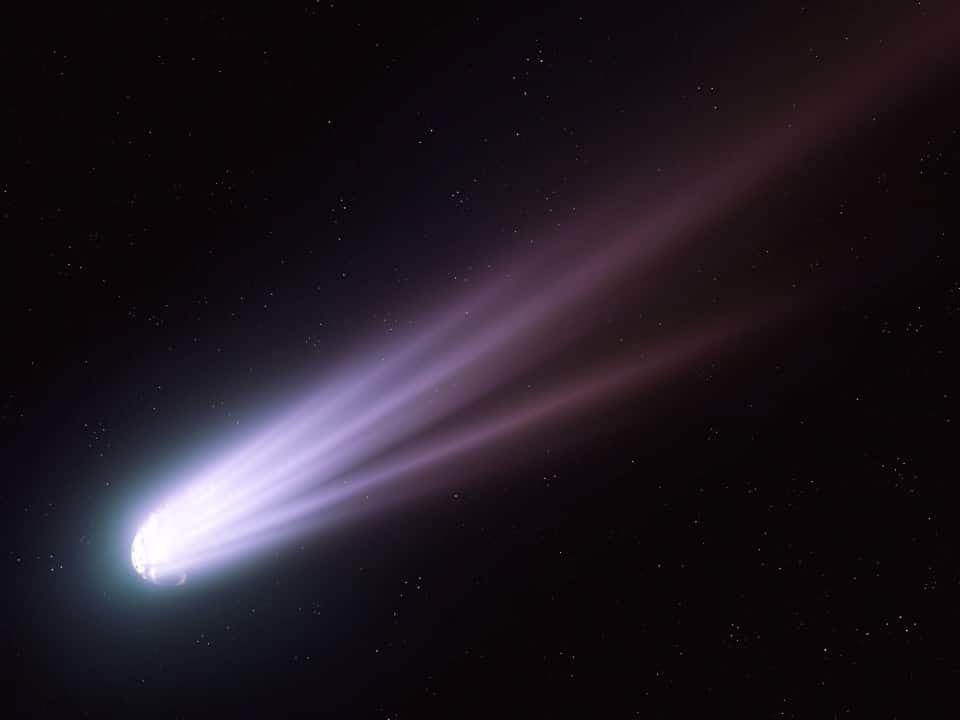
Space telescopes recorded detailed images in January this year that expose unprecedented features in the third interstellar visitor confirmed by science. The celestial body, monitored intensively since its discovery by the ATLAS system, presented a configuration of jets that diverges from the patterns observed in comets formed in our planetary system. The captures taken by Hubble reveal emissions of material organized at precise angles, which raised immediate questions among researchers from Harvard and other institutions about the physical nature of the object.
The celestial body’s passage through perihelion, the point of closest approach to Sol, occurred last October, but it was only now, during the movement towards Júpiter, that the most intriguing features became visible. Optical data processing allowed us to isolate the internal structure of the coma, revealing a geometry that does not fit traditional models of random ice sublimation.

This new battery of data has reignited the debate about the possibility of artificial origin, a hypothesis defended by a minority of the astrophysics community, led by Avi Loeb. Enquanto Most astronomers classify the phenomenon as a natural metal-rich comet, the orbital and visual anomalies continue to defy conventional explanations, requiring revisions to models of body formation in other stellar systems.
The object continues its hyperbolic trajectory, with no expected return, transforming the next few months into a critical and unique window for collecting information that could redefine the understanding of the diversity of materials that cross the galaxy.
Unusual geometry revealed by Hubble
The images obtained on January 14, 2026 were subjected to advanced processing filters, specifically the Larson-Sekanina algorithm, designed to remove the diffuse glow of the coma and reveal underlying structures. The result surprised analysts by showing three distinct jets of material emanating from the nucleus.
The most notable aspect of this observation is the perfect symmetry of the distribution. The jets are exactly 120 degrees apart, forming an equidistant triangular pattern that rarely occurs in chaotic natural processes, such as evaporation from irregular comet surfaces. Além Furthermore, the particle beams remain collimated, that is, narrow and directed, even under the influence of the solar wind, which tends to disperse such emissions.
Another striking feature identified in the images is the presence of a prominent anti-tail pointed in the direction of Sol. Este optical phenomenon, although known, presents itself with a persistence and extension of hundreds of thousands of kilometers, suggesting a dynamic of heavy particles that resist the pressure of solar radiation in an atypical way.
Statistical and orbital coincidences
The analysis of the 3I/ATLAS trajectory reveals a series of parameters that, in isolation, would only be curious, but which together create a scenario of low statistical probability for a random natural object. The interstellar visitor’s orbit has an inclination of less than 5 degrees in relation to the plane where the planets of Sistema Solar orbit, a characteristic shared by only a tiny fraction of objects that come from outside.
It is estimated that the chance of a random body presenting such an alignment with the ecliptic is approximately 0.2%. Além of slope, the entry route allowed passes close to both Marte and Júpiter, suggesting a velocity vector consistent with maneuvers or a very specific initial heading, although there is no evidence of current active propulsion.
The scheduled meeting with Júpiter for March 16, 2026 adds another layer of complexity to the calculations. The predicted distance for this passage coincides almost perfectly with the limit of the gas giant’s Hill radius, the region where the planet’s gravity dominates over that of Sol. Especialistas point out the following accumulated improbabilities:
– Alinhamento I need the trajectory with the plane of the planets, with minimum deviation.
– Passagem due to the angled perihelion that hid the object from terrestrial vision at the moment of greatest brightness.
– Coincidência of the passage through Júpiter with a margin of error of just 100 thousand kilometers in relation to key gravitational points.
– Manutenção of the stable rotation and oriented towards the Sol before and after passing close to the star.
Chemical composition and scientific debate
High-precision spectrographs read the light reflected and emitted by the object, identifying a chemical signature that differs from local comets and even previous interstellar ones, such as ‘Oumuamua and Borisov. Analysis of the gas in the coma indicated an unusually high ratio of nickel to iron.
This isotopic and elemental ratio more closely resembles high-strength industrial alloys than the clumps of dirty ice and rock typical of planetary formation. The presence of cyanide at rates much higher than average was also noted, which could indicate formation processes in environments with extreme metallicity.
However, complementary observations carried out by the SPHEREx observatory brought data that support the natural thesis. Foram detected complex organic molecules, including methanol and formaldehyde, in addition to a significant increase in water release after perihelion. Para NASA and most research institutes, these data confirm that 3I/ATLAS is a comet, albeit an exotic one, whose strange behavior is due to the unknown conditions of its system of origin.
Observation opportunity and final destination
The astronomical calendar reserves a crucial moment for the study of this celestial body for the end of January. Ocorre is an almost perfect alignment between the Sol, the Terra and the object, with an angular difference of just 0.69 degrees. Nesta opposition configuration, the anti-tail will be pointed directly at terrestrial observers, allowing a “head-on” view of the emission structure.
Despite the weak visual magnitude, estimated at 16.7, which requires large professional equipment, the geometry of the event favors obtaining high contrast images of the sunward jets. Astrônomos hope this data can resolve the question about the nature of the three symmetrical jets: whether they are natural vents on a rotating surface or something more complex.
After this period of prime visibility, the gravitational interaction with Júpiter in March will provide the final push to expel the object from Sistema Solar. Estima is expected to cross the orbit of Netuno in a few years and reach the region of inner Nuvem of



