
Telescopes identify X-ray halo and rare composition in interstellar comet that crosses Jupiter’s orbit


Recent data processed by space agencies confirmed fundamental discoveries about the 3I/ATLAS object, the third interstellar visitor cataloged by modern science. Após makes its closest passage to Terra at the end of December 2025, the celestial body now crosses the region of Júpiter’s orbit, moving away from Sol on a trajectory of no return. The analyzes revealed unprecedented energetic phenomena and a chemical signature that differs substantially from the patterns observed in comets formed in our planetary system.
Hyperbolic origin and trajectory
The extreme speed of the object, which reached peaks of more than 240,000 kilometers per hour during perihelion, confirms its exotic nature. Diferente of the stars that orbit Sol in closed ellipses, 3I/ATLAS describes a hyperbolic curve, indicating that it is not gravitationally tied to our star. Cálculos astronomers point out that the celestial body entered the system from the direction of the constellation of Sagitário, probably ejected from its original star system billions of years ago.
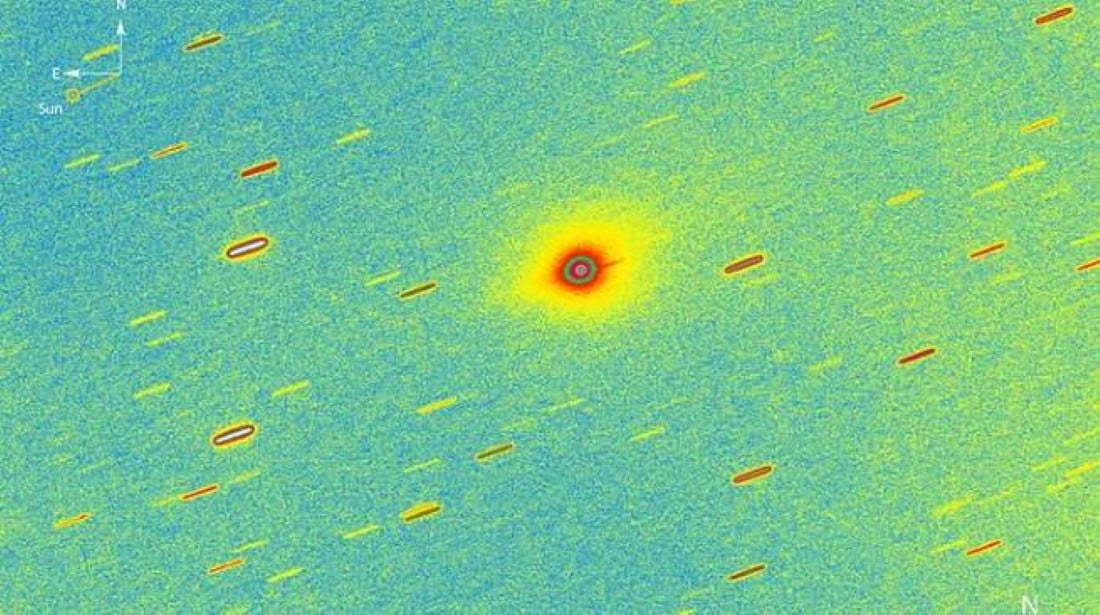
The gravitational interaction with Sol caused a minimal deviation in its route, calculated at just 16 degrees. Essa trajectory stability allowed astronomers to accurately predict its exit path into deep space. Atualmente, high-powered telescopes continue to track the object, whose visual magnitude fluctuates between 13 and 15, making it invisible to amateur equipment as it plunges into the darkness of the outer solar system.
High energy phenomena
One of the most impactful discoveries occurred through X-ray spectrum monitoring. Observatórios spacecraft, including XMM-Newton, detected a diffuse, high-energy halo around the comet’s nucleus. The phenomenon is a direct result of the violent collision between charged particles from the solar wind and the cloud of neutral gas that surrounds the object. Esta was the first time that the scientific community recorded such an interaction in a body from another star system, expanding understanding of the physics of exogenous objects.
Além of X-ray emission, the comet exhibited a distinct visual behavior. Imagens captured by the Gemini North telescope showed an intense green color in the coma. The hue is attributed to the presence of diatomic carbon and cyanide molecules which, when bombarded by ultraviolet radiation from Sol, fluoresce in the visible spectrum. Esse characteristic brightness persisted throughout the period of closest approach, offering crucial data on the volatility of the materials that make up its surface.
Distinctive chemical composition
Detailed spectroscopic analysis revealed that 3I/ATLAS has a chemical “fingerprint” that separates it from local comets. The proportion of volatile elements suggests that the object formed in a region of space with thermal and chemical conditions very different from those found in the protoplanetary disk that gave rise to Terra. Observations highlighted three main anomalies in its constitution:
- High concentration of carbon dioxide in relation to water, indicating sublimation at greater distances from the heat source.
- Significant presence of nickel and methanol in the coma, exceeding the averages found in comets in the solar system.
- Dust structure with reddish grains and larger than usual, suggesting a distinct spatial erosion process.
Final monitoring
The Hubble and James Webb space telescopes played vital roles in documenting the activity of the nucleus, which is estimated to be between 440 meters and 5.6 kilometers in diameter. Durante the phase of greatest activity, double jets of material were recorded being expelled, synchronized with the rotation of the celestial body. Essas observations allowed scientists to model the object’s internal dynamics while it was still clearly visible.
As 3I/ATLAS crosses Jovian orbit in 2026, the observation window progressively closes. Data accumulated during his brief visit is being used to refine theoretical models about the formation of distant planetary systems. The passage of this interstellar visitor reinforces the thesis that the exchange of material between stars is a common phenomenon in the galaxy, although rarely detected with current technology.



