
Astronomical phenomenon creates ring of fire in the Antarctic sky and attracts attention from global scientists

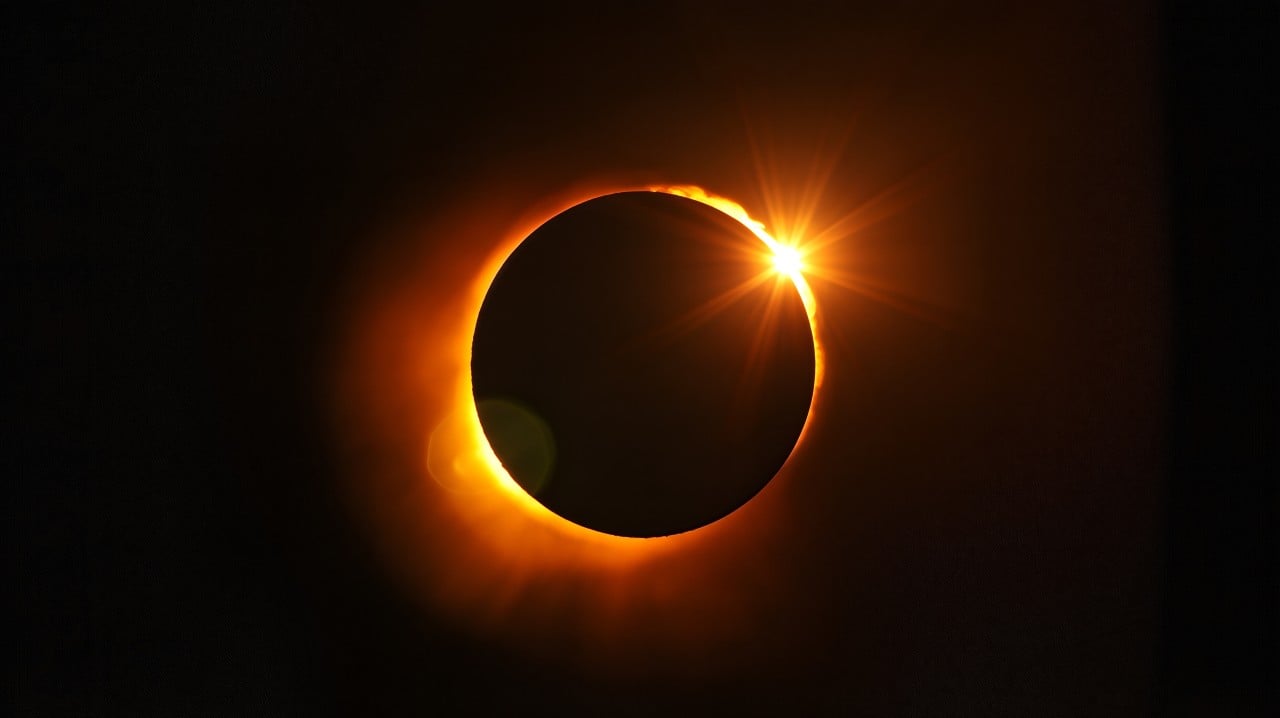
The sky over the Antarctic continent becomes the stage for a unique astronomical event this Tuesday, February 17th. Lua is positioned exactly between Terra and Sol, but due to its orbital distance at the time of alignment, it cannot completely cover the solar disk. The visual result of this celestial mechanics is the formation of an intense luminous circle around the lunar silhouette, popularly known as the ring of fire, which attracts the interest of researchers and astronomers from different parts of the world.
This phenomenon occurs because the natural satellite reaches its apogee, the point of its elliptical orbit furthest from the terrestrial planet. Nessa specific position, the apparent diameter of Lua is slightly smaller than that of Sol, which prevents the occurrence of a total eclipse and generates the characteristic annularity. The maximum duration of this visual effect in the central observation range can reach two minutes and twenty seconds, providing a brief but valuable window for scientific recording and study.

Although full viewing of the ring of fire is restricted to remote and inhospitable areas of Antártida, neighboring regions in the Southern Hemisphere experience the event only partially. Habitantes located at the southern end of África, in parts of Oceano Pacífico and at the southern ends of América of Sul, such as Chile and Argentina, can observe a “bite” in the central star. The Brazilian territory, due to its geographical position, is outside the twilight zone and does not record any change in solar luminosity during the event.
Celestial mechanics and spatial geometry
Understanding annular eclipses requires understanding the orbital dynamics of the Terra-Lua-Sol system. Diferente of total eclipses, where day momentarily turns to night, annularity preserves a bright edge of the solar photosphere. Isso occurs exclusively when the Moon is close to its apogee, around 405 thousand kilometers from Terra, making its angular size insufficient to hide the entire star.
Astronomers calculate these movements with extreme precision using the Saros cycles, which are periods of approximately 18 years and 11 days where the alignments are repeated with similar geometry. This Tuesday’s event belongs to Saros 131, a series that has produced consistent eclipses and serves as a basis for predicting future orbital alignments and behaviors decades in advance.
During the height of the phenomenon at Antártida, the reduction in sunlight is not complete, but sufficient to momentarily alter local atmospheric conditions. The temperature may suffer slight drops and the incidence of ultraviolet radiation decreases in the center of the shadow, although the exposed ring continues to emit intense light. Essa geometric configuration provides a unique opportunity to study the outer layers of Sol without the need for artificial blocking in space telescopes.
Safety protocols for observation
Direct observation of Sol requires strict safety precautions, regardless of the degree of coverage of the solar disk. Especialistas warn that looking at the phenomenon without adequate protection can cause solar retinopathy, a photochemical damage to the retina that can lead to permanent blindness or partial loss of vision. The ring of light visible during annularity has a surface brightness identical to that of full Sol, maintaining the destructive potential for human eyes.
The only safe method for direct viewing involves the use of glasses equipped with solar filters that meet the international standard ISO 12312-2. Esses equipment blocks more than 99.9% of visible light and all harmful ultraviolet and infrared radiation. Óculos Conventional darks, x-ray films, tinted glass or photographic negatives do not offer protection against invisible wavelengths that cause eye damage and should be strictly avoided.
For those who do not have certified equipment, indirect projection remains the safest and most accessible alternative. Utilizar a sheet of paper with a small hole to project the image of the Sol onto the floor or a wall allows you to follow the progress of the eclipse without exposing your vision to risk. Telescópios, binoculars and cameras also require specific solar filters installed in the front opening of the lens, as the concentration of light in these instruments can melt internal components and injure the observer instantly.
Impact on polar scientific research
Research stations installed on the Antarctic continent become privileged observatories during the passage of the lunar shadow. Cientistas take advantage of the rarefied atmosphere and low light pollution of the polar region to capture high-resolution images of the solar corona and chromosphere. Analysis of this data contributes to the understanding of solar storms and space weather, factors that directly influence telecommunications and satellite navigation systems on Terra.
The extreme weather conditions of Antártida pose a considerable logistical challenge for observation teams. Ventos strong and negative temperatures require robust and adapted equipment to function without failure during the crucial minutes of annulment. Coordination between international bases allows data sharing in real time, maximizing the scientific benefit of the event even if some stations are under cloud cover.
In addition to astronomy, the eclipse provides data for local atmospheric studies. The rapid variation in the incidence of solar radiation on the polar cap makes it possible to analyze the thermal response of the icy surface and changes in wind circulation. Esses data is integrated into global climate models, helping to refine weather forecasts and understanding of the planet’s energy balance in high-latitude regions.
Astronomical calendar and upcoming events
February’s annular eclipse kicks off a busy season of celestial events scheduled for the year 2026. The astronomical calendar also includes two lunar eclipses and a total solar eclipse, distributed over the next few months. Essa frequency of phenomena maintains public and academic interest focused on the sky, encouraging astronomical tourism and scientific dissemination on a global scale.
The main highlight of the year will occur on August 12, when a total solar eclipse will cross the northern hemisphere. The full range will pass through regions of Groenlândia, Islândia and reach Espanha, promising a spectacle accessible to millions of people in Europa. Diferente of the annular event in Antártida, the August eclipse will allow the naked eye to view the solar corona during the minutes of totality, attracting eclipse chasers from all continents.
Before that, on March 3, a total lunar eclipse will be visible at Américas, Ásia and Austrália. Durante this event, Lua will cross the shadow of Terra and acquire a reddish color, a phenomenon popularly known as Lua of Sangue. The sequence of alignments reinforces the cyclical and predictable nature of the solar system, allowing enthusiasts to plan in advance to follow each of these unique moments.
Technology and remote access to the phenomenon
The remote location of Tuesday’s annulment boosted the use of broadcast technologies to bring the event to a global audience. Observatórios professionals and channels specializing in astronomy organized live broadcasts via the internet, capturing images directly from Antarctic bases and ships strategically positioned in Oceano Austral. Essa democratization of access allows students and onlookers to follow the ring of fire in real time, regardless of their geographic location.
Astronomy apps and simulation software also play a key role in the public experience. Essas tools allow you to visualize how the eclipse would be seen from different points on the Terra, as well as providing precise start and end times for each location. The integration of satellite data with interactive interfaces transforms the event into an educational opportunity, facilitating the teaching of complex orbital mechanics concepts in schools and universities.



