
Volkswagen intensifies dispute against Fiat with bet on Polo and launch of new SUV Tera

The Brazilian automotive sector is going through a moment of significant transformation marked by increased competition between the country’s main automakers. The dispute for market leadership, historically dominated by Fiat in recent years, takes on new contours with the strategic movement of Volkswagen. The German manufacturer has consistently reduced the market share gap with its Italian rival, driven by an aggressive renewal of its portfolio and the commercial performance of consolidated models.
Market analysts point out that this approach is not the result of chance, but the result of long-term planning that involves heavy investments in manufacturing and technology. The German brand’s strategy goes beyond sales volume, focusing on profitability and the added value of vehicles. The focus on modular platforms and the technological update of engines, including the development of flex hybrid systems, demonstrates the intention to offer more efficient and connected products, aligned with the new demands of the Brazilian consumer.

Consolidation of sales leaders
Two fundamental pillars support the growth of Volkswagen in the current national scenario. The Polo, which took center stage after the discontinuation of the Gol, has established itself as one of the best-selling passenger vehicles in the country. Sua acceptance is due to a balanced equipment package and mechanical robustness, characteristics that attract both the end consumer and fleet owners. The Track version, more accessible, fulfilled the role of keeping the brand strong in the entry-level segment.
At the same time, the T-Cross maintains its relevance in the competitive sports utility vehicle segment. Mesmo with the arrival of several competitors, the model maintains high registration rates, validating the automaker’s strategy of focusing on compact SUVs. The combination of updated design, internal space and efficient turbo engine ensures that the model remains a reference in the category, serving as a basis for the expansion of the company’s product line.
The arrival of Tera and market expansion
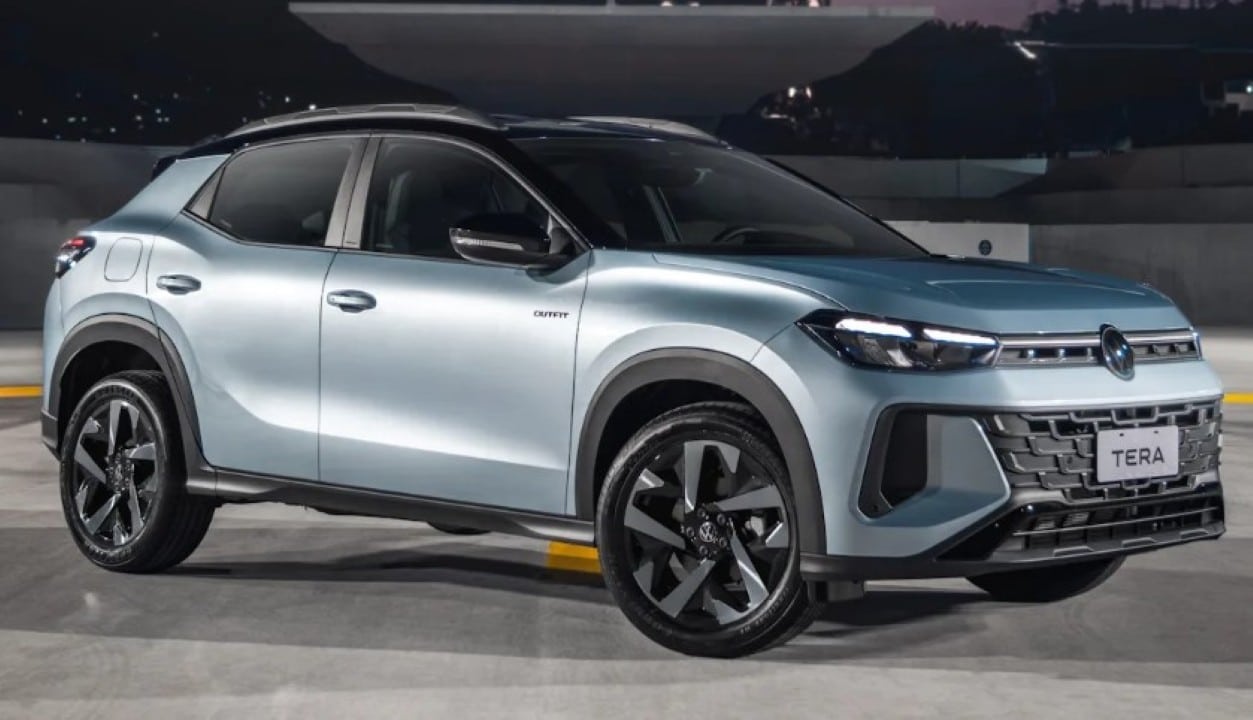
The central element for the new phase of the German offensive is the launch of Tera. Este new model was developed to fill a strategic gap in the brand’s portfolio, positioning itself as an entry-level SUV. The objective is to attract consumers who are looking for the robustness and ground clearance of a utility vehicle, but at a more affordable price than that offered in higher categories. The Tera arrives to compete directly with models that currently guarantee volume to the Fiat, seeking to capture a market share still unexplored by the Volkswagen.
The introduction of this vehicle represents more than just a new product in dealerships; it symbolizes the adaptation of German engineering to the specific needs of the Latin American market. With compact dimensions ideal for urban traffic and a design that follows the brand’s global visual identity, the Tera has the mission of democratizing access to the automaker’s SUVs. The expectation is that it will generate a sufficient sales volume to place the dispute for overall market leadership on a level of technical equality.
Benefits for the end consumer
The winners of this industrial battle are the Brazilian consumer. The need to gain market share forces automakers to offer more aggressive commercial conditions. Observa-se um movimento de valorização dos produtos, com a inclusão de mais itens de série, como airbags adicionais, assistentes de condução e centrais multimídia mais modernas, sem que isso represente necessariamente um aumento proporcional nos preços. The bidding war extends to financing, with reduced interest rates and easier payment plans.
Furthermore, rivalry drives innovation. Para does not lose space, Fiat also needs to accelerate its renewal cycles and invest in new technologies. Esse competitive environment creates a virtuous circle where the average quality of vehicles offered in Brasil tends to rise. The dispute between European giants in the national territory reconfigures purchasing options, allowing customers to have access to safer, more economical and technological cars, regardless of the brand chosen.



