
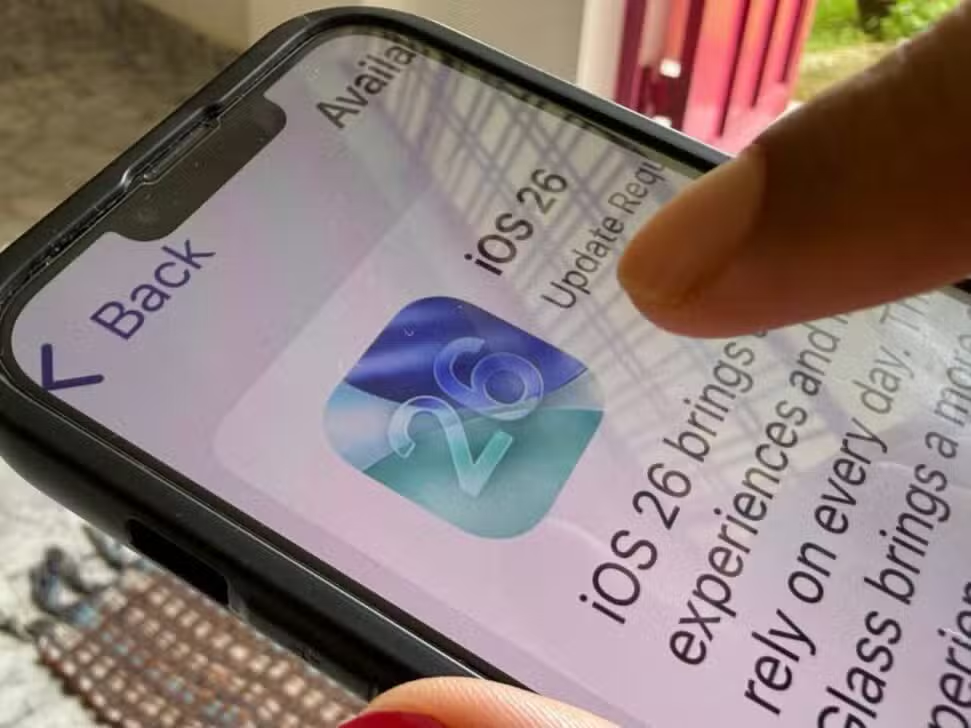
Mobile operating system development moves apace behind the scenes at the tech giant in Cupertino, with new discoveries pointing to significant changes to the user experience. While version 26.3 is still undergoing its final stages of testing in beta channels, software engineers and developers have identified concrete traces of the next major iteration, expected to hit the market in the first half of 2026. A preliminary analysis of the internal build reveals a robust package of features designed to expand the devices’ daily usefulness, with a renewed focus on deep integration of artificial intelligence.
Data extracted from iPhone prototypes suggests that the company is focusing its efforts on optimizing the interface through automation and strategic visual reorganization. The apparent strategy aims to combine the powerful hardware of current devices with software capable of anticipating needs, especially in critical areas such as personal health and information management.

Experts who had access to the preliminary codes highlight four main pillars of change that should redefine interaction with the brand’s ecosystem:
- Full integration of the virtual assistant with third-party applications;
- Complete redesign of the physical and well-being monitoring interface;
- Precision location systems for audio accessories;
- New security protocols for identity verification.
Evolution of artificial intelligence and virtual assistant
The promise of a virtual assistant truly capable of understanding context and performing complex tasks appears to be about to come true with the new update. The system must bring the definitive version of Apple Intelligence applied to Siri, allowing the tool to operate freely within applications developed by other companies, breaking down the compatibility barriers that existed until now.
This architectural change means that the user will be able to request specific actions that involve multiple steps and different software using only natural voice commands. The system’s response will be contextualized, taking into account the usage history and the information present on the screen at the time of the request, guaranteeing unprecedented navigation fluidity for the mobile platform.
The neural processing capacity of new devices will be essential to support this workload, ensuring that responses are immediate and that the processing of sensitive data occurs, whenever possible, on the device itself to preserve privacy.
Strategic shift in health monitoring
The native app dedicated to well-being will undergo one of the biggest visual overhauls since its launch, aiming to make reading data more accessible. The central objective is to simplify the visualization of complex metrics through a reorganization of categories, making access to vital data more intuitive and less technical for the common user looking to maintain a healthy routine.
In addition to the aesthetic change, artificial intelligence will play a key role in analyzing biometric data collected by device sensors and connected wearables. The new integrated fitness assistant will cross-reference information about daily activities, sleep quality and vital signs to offer personalized and proactive suggestions.
This functionality will act as an intelligent digital coach, capable of understanding each individual’s physical limitations and goals, adjusting goals and recommendations in real time as the user’s performance evolves over the weeks.
Location and organization improvements
Finding lost accessories in open environments will no longer be a challenge with the update to the Buscar tool, which will receive significant improvements to its infrastructure. The AirPods tracking system will be refined, using ultra-wideband (UWB) technologies to offer millimeter precision, even when the headphones are out of range of the home network or in large public places.
In the field of productivity, the Freeform application will finally gain the necessary structure for managing large volumes of creative and corporate projects. The introduction of a hierarchical folder system will allow students and professionals to organize their boards logically, with immediate synchronization via the cloud to ensure the same structure on all devices linked to the account.
Entertainment and visual communication
The company’s streaming and media management platform will now have an exclusive space dedicated to sports, meeting a long-standing demand from consumers. Denominada internally as “sports level”, this section will centralize live broadcasts, real-time statistics tables and match highlights, facilitating the consumption of sports content without the need to navigate through generic menus of films and series.
For daily communication, the system keyboard will be updated to the latest Unicode standard, expanding the possibilities of expression. Cerca of 100 new emojis will be added to the library, allowing users to express new nuances in messages and social networks, while maintaining global compatibility with other operating systems that adopt the same international standard.
Payment security and management
The protection of sensitive data will gain an additional layer of proactive verification, reinforcing the brand’s commitment to digital security. Antes Before allowing login to critical accounts or accessing data in the cloud, the operating system will perform a full integrity scan on the device to ensure there is no malware or exploited vulnerabilities, blocking access if any security anomaly is detected.
To facilitate financial transactions in the digital environment, the automatic credit card filling function will no longer be exclusive to the native browser. Payment information stored securely in the password manager can be invoked directly in store and service applications, speeding up checkout and maintaining encryption of bank details.
Expected launch schedule
The development calendar follows the annual standard established by the company for mid-cycle updates, ensuring predictability for the market and developers. Version 26.3 should reach the general public between January and February, preparing the ground for the more profound changes that will come later.
Registered developers should receive the first test build of iOS 26.4 shortly after the previous version is stabilized. Caso If no serious technical issues occur during the beta period, the final release for all supported users is expected in the March-April 2026 release window.