
Samsung and Xiaomi battle in the premium sector with a focus on versatile cameras and power autonomy
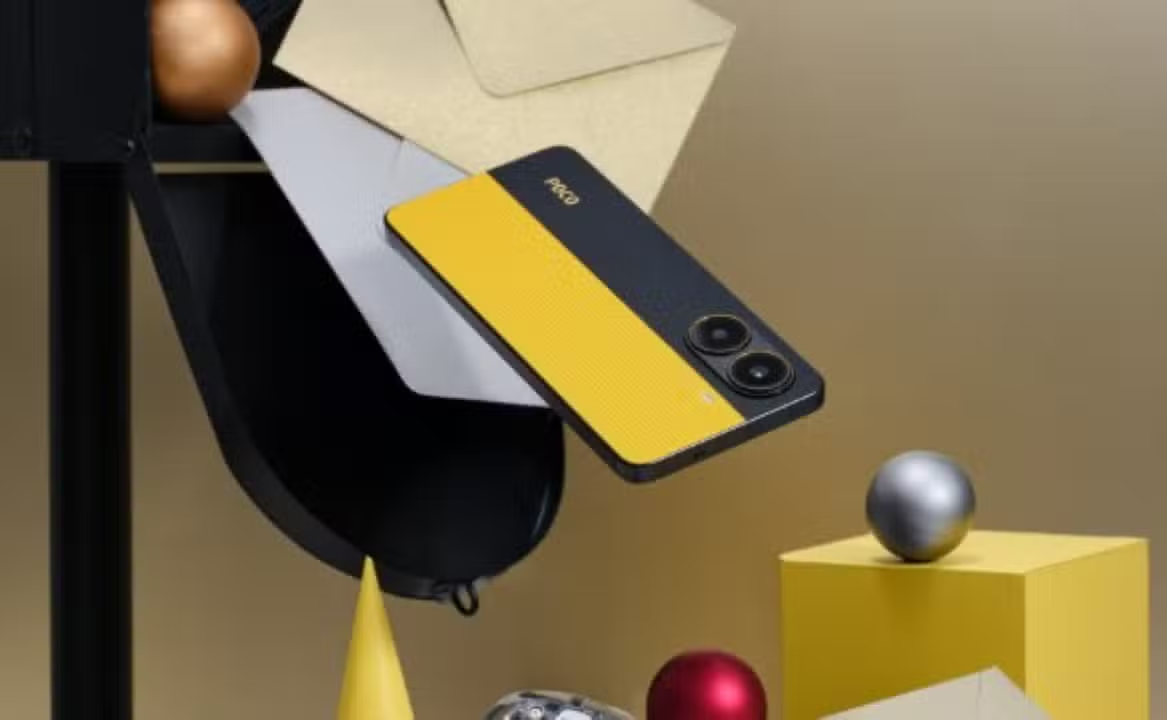
The Brazilian mobile technology market will witness a decisive moment in 2026 with the consolidation of a new category of devices that defies traditional pricing logic. The boundary between elite devices and intermediate models has become practically invisible with the launch of equipment that prioritizes robust technical specifications without charging the price of a popular car. The national consumer, now more demanding and informed, finds himself faced with a dilemma that involves two completely different engineering philosophies, represented by South Korean tradition and Chinese aggressiveness.
The fight for the user’s pocket is concentrated in the price range that varies between R$2,300 and R$2,700, a segment where the cost-benefit needs to be tangible. On the one hand, there is a focus on constructive sophistication and longevity of software support, aimed at buyers who plan to keep the same device for many years. Do another comes brute force focused on superlative battery and charging numbers, ideal for those who live connected and cannot depend on sockets throughout the day.
Doté d’un captureur Sony, redécouvrez la photographie avec le#POCOX7📸
👉https://t.co/1YKwnuYLSc pic.twitter.com/zogx6BImLd
— POCO France (@POCOFrance)February 11, 2026
Market analysts point out that this rivalry raises the quality bar for the entire sector, forcing other manufacturers to review their pricing and resource delivery strategies. The purchasing decision is no longer just about the brand printed on the back of the device and has become a careful analysis of which set of features best adapts to each individual’s specific routine, be it an amateur photographer or an electronic game enthusiast.
Practical tests carried out with new competitors reveal that there is no victory by technical knockout, but rather specific victories in specific rounds. Enquanto energy efficiency sets the pace on one side, optical versatility dominates on the other. The current scenario requires the consumer to deeply understand the specifications so as not to invest their money in resources that they may never use, or worse, miss essential tools in the first few months of use.
Galaxy S26 Ultra
• 6.9″ M14 QHD+ CoE Dynamic Amoled Display
• Privacy screen feature
• Snapdragon 8 Elite Gen 5 for Galaxy
• Bigger Vapor Chamber cooling
• 200mp f/1.4 main, 50mp Ultrawide, 50mp 5x f/2.9 Periscope & 12mp 3x Telephoto
• 5000mah battery with 60w wired & 25w…pic.twitter.com/kpBC0EncMl—Anthony (@TheGalox_)November 24, 2025
Differences in engineering and materials
The aesthetic and structural approach drastically separates the two competitors. Samsung decided to invest heavily in the perception of luxury, bringing materials to the intermediate segment that were previously exclusive to the main S line. The use of an Armor aluminum structure provides superior structural rigidity, while the frosted glass back offers a velvety touch that repels grease marks and fingerprints. Essa choice is not just cosmetic, but directly influences the feeling of value that the product conveys when handled.
Protection against external elements is guaranteed by IP68 certification in both cases, but impact resistance follows opposite paths. The South Korean model uses Gorilla Glass Victus+ glass, recognized for its high tolerance to drops on rough surfaces. The industrial design maintains the company’s minimalist visual language, with camera lenses floating individually on the back, creating a sober and elegant identity that appeals to the corporate environment.
In contrast, the Xiaomi subsidiary adopts pragmatism with the use of high-density polycarbonate. Embora plastic does not convey the same coldness and sophistication as metal, it has shock absorption properties that can save the device from falls that would shatter the glass. Finishing options that simulate vegan leather attempt to mitigate the simplicity of the material, offering a grippy texture that eliminates the need for protective covers for many users.
Visual quality and screen brightness
The multimedia experience is governed by high-tech panels that, although they appear similar on the technical sheet, deliver different results under detailed analysis. The Samsung device uses Dynamic LTPO AMOLED 2X technology, an advanced feature that allows the system to adjust the screen refresh rate granularly, going down to 1 Hz when still images are displayed. Essa intelligent management is essential for saving energy, without sacrificing 120 Hz fluidity when necessary.
The maximum brightness of 1,900 nits of the Galaxy model ensures competent readability in outdoor environments, but is surpassed by the competitor’s luminous aggressiveness. HDR10+ support ensures that films and series are reproduced with color fidelity and deep contrast, maintaining the absolute blacks characteristic of OLED panels.



Xiaomi’s answer to content consumption is a display that reaches peaks of 3,200 nits, a brightness that practically cancels out reflections from the direct sun. Além Furthermore, 1.5K resolution offers a higher pixel density, resulting in extremely sharp text and icons. The inclusion of Dolby Vision technology is an important differentiator for moviegoers, providing dynamic tone mapping that extracts maximum detail in dark and light scenes.
Processing and gaming performance
Inside the chassis, the battle of semiconductors defines the speed of operation. The Exynos 2400 chipset equips the Samsung option, working in harmony with 8 GB of RAM. Synthetic benchmarks, such as AnTuTu, record scores close to 1.8 million, which puts the device at a performance level very close to the top of the line from the previous year. Optimization between hardware and software results in fluid navigation and agile multitasking.
For the gaming public, the South Korean processor architecture demonstrates stability in graphically demanding titles, such as Genshin Impact. Thermal management has been improved to avoid sudden drops in performance, known as throttling, ensuring that the frame rate per second remains constant even after long gaming sessions.
The POCO X7 Pro counterattacks with the Dimensity 8400-Ultra processor and variants that can reach 12 GB of RAM. Embora its raw score is around 1.5 million, the energy efficiency of the MediaTek platform is commendable. The device shines in emulating old consoles and rendering videos, benefiting from a cooling system that, in practical tests, kept external temperatures lower than its rival, favoring hand comfort during intense use.
Camera and photography systems
Photography is the definitive game changer in this comparison. The Samsung maintains its strategy of offering true optical versatility. The triple set includes a 50 MP main sensor, a 12 MP ultrawide and, the highlight, an 8 MP telephoto lens with 3x optical zoom. The presence of a real zoom, without digital cuts, allows you to capture portraits and architectural details with a quality that direct competition cannot replicate via software.
The South Korean brand’s image post-processing continues to be a reference, delivering balanced colors and a night mode that illuminates dark scenes without generating excessive noise. The 8K recording capability, although impractical for everyday use, demonstrates the firepower of the image signal processor (ISP), while optical stabilization ensures smooth 4K videos.
On the other hand, the Xiaomi’s focus is on the main 50 MP sensor, which produces photos with high saturation and high contrast, ready for social media. However, the absence of a telephoto camera forces the user to rely on digital zoom, which inevitably degrades the texture of the image when zooming in on distant objects. The 20 MP front camera compensates for some of this disadvantage with high-resolution selfies, but the overall set is less flexible for content creators looking for a variety of angles.
Energy autonomy and recharging
If cameras are Samsung’s strong point, the battery is the territory where Xiaomi dominates without challenge. The POCO X7 Pro integrates a massive 6,000 mAh cell, a capacity that redefines autonomy in the segment. Usuários with heavy routines report reaching the end of the day with around 30% charge remaining, eliminating the anxiety of being left without communication. Além In addition, the 90W charger included in the box recovers full energy in less than an hour, changing the dynamics of daily use.
The Galaxy S25 FE, with its 4,900 mAh battery, offers competent autonomy for a day of moderate use, helped by the efficiency of the LTPO screen. Contudo, reload speed is a sticking point. Embora supports up to 45W, the standard 25W adapter results in plug times of over 70 minutes, an eternity when compared to the supersonic speed of the Chinese rival.
Software longevity and support
Investing in a smartphone also depends on its projected useful life. The Samsung leads the Android market with the promise of seven years of system and security updates for the S25 FE line. Isso guarantees that the device will receive new artificial intelligence features and vulnerability fixes within the next decade, maintaining its resale value and functionality for much longer. The One UI is mature and packed with productivity tools.
The Xiaomi policy for the POCO X7 Pro, running HyperOS, is limited to three major updates from the Android and four years of security patches. Embora is a decent support, it is far behind the competitor’s proposal. For Para users who change their cell phone every two years, this difference is irrelevant, but for those looking for long-term durability, the Samsung’s extended support is a powerful selling point.
Final market assessment
The conclusion about which device to take home depends entirely on your usage profile. The Samsung model establishes itself as the rational and balanced choice, offering a superior set of cameras, premium construction and the guarantee that the software will remain current for many years. It is the ideal device for those looking for an experience close to the most expensive flagships, without giving up optical zoom and a glass finish.
On the other hand, Xiaomi’s competitor is the ultimate entertainment machine. Sua extremely bright screen, combined with an inexhaustible battery and ultra-fast charging, makes it the perfect option for young people, gamers and media consumers who prioritize raw performance and autonomy above all else. The choice, therefore, falls on what is more valuable to the individual: creative versatility and durability, or immediate energetic and visual power.
Veja Tambem em News (EN)

Research reveals that parents are unaware of how their children use artificial intelligence

Samsung releases new system update with new features for Galaxy Watch 4 users

Digital retail reduces the value of the Galaxy S25 5G smartphone with bank bonuses and device exchange

Amazon’s wireless CarPlay adapter has a 50% discount and high approval ratings from drivers

Zach Cregger’s new Resident Evil ignores games and focuses on an unprecedented story with new characters

Rumor suggests that Nintendo is preparing a special edition of the Switch 2 with a remake of Ocarina of Time

Apple accelerates production of the iPhone 17e and develops new Air model with dual camera system

Epic Games platform releases twelve high-budget games at no permanent cost for PC users

PlayStation 5 Pro price drop accelerates digital retail sales and eliminates global stocks

New Galaxy Watch 9 firmware appears on server and confirms progress in software development

Apple’s commemorative project tests cell phone with 1.1 millimeter edge and curved screen for 2027
