
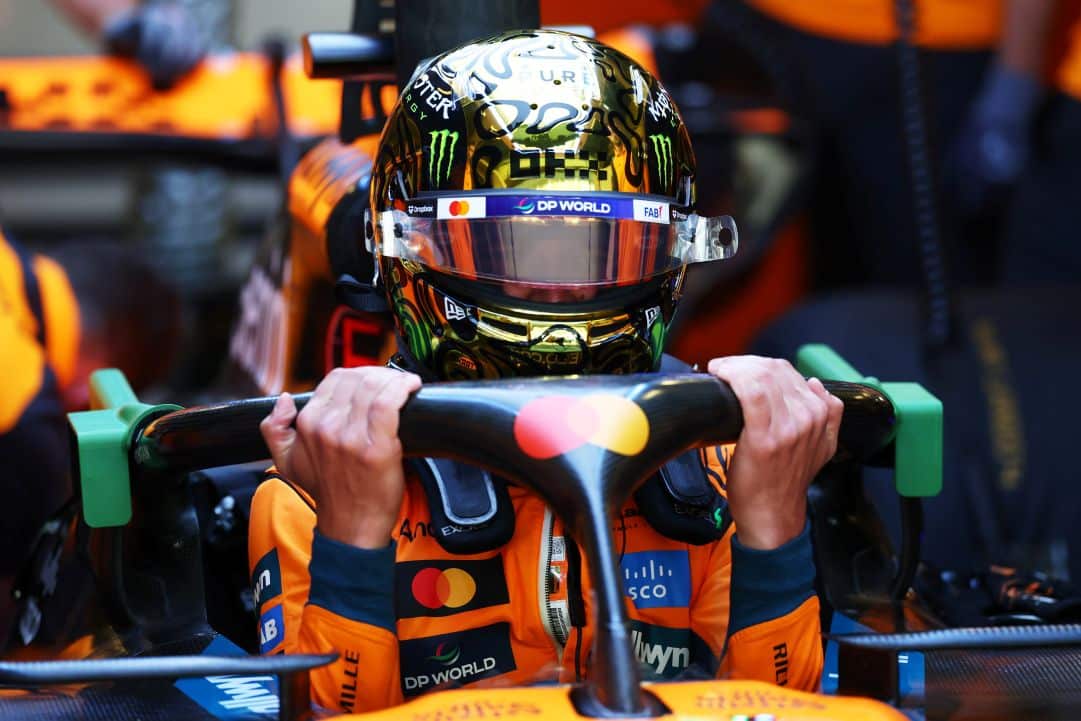
Lando Norris sets best time on the morning of the second day of F1 2026 testing in Bahrain


In Circuito Internacional from Max Verstappen, for Red Bull, came close behind with 1min33s584 and 56 laps, while George Russell, for Mercedes, closed the top 3 with 1min34s111 in 77 laps.
Other drivers also caught attention with their consistent performances, such as Alexander Albon, from Oliver Bearman, for Haas, and Franco Colapinto, for Alpine, followed closely with close times, demonstrating balance between the intermediate teams.
Ferrari faced early challenges, with Lewis Hamilton recording just five laps and a time of 1:39.670, while teams like Aston Martin and Cadillac accumulated valuable mileage to fine-tune the cars before the official season.
Performance of leading teams
McLaren showcased a refined aerodynamic setup that allowed the Norris to maintain consistency over long and short laps. The team’s engineers adjusted the car’s balance during the session, resulting in a clear advantage over direct rivals.
Red Bull, in turn, focused on racing simulations with Verstappen, prioritizing component durability over isolated fast laps. Essa strategy reflects preparation for varied circuits throughout the year.
Analysis of intermediate times
Gabriel Vorte, representing Audi in his testing debut, completed fewer laps due to initial technical checks, but his time indicates potential for improvement in the afternoon. The German team tested new suspension elements that could influence handling in high-speed corners.
Oliver Bearman, for Haas, demonstrated progress compared to the previous day, with a setup that balanced speed and stability. Seus 69 laps allowed extensive data on tire wear to be collected.
Alpine’s Franco Colapinto faced heated track conditions but maintained a competitive pace that suggests advances in the Renault engine adapted to the 2026 rules.
Liam Lawson, driving for Racing Bulls, recorded a more modest time, but his 27 laps were dedicated to testing electronic components, essential for reliability.
Veteran Pilot Highlights
Fernando Alonso, from Aston Martin, completed 40 laps with a time of 1min37s472, focusing on aerodynamic assessments that can be crucial for street tracks. Sua experience guided adjustments aimed at greater downforce in slow sectors.
Lewis Hamilton, now in Ferrari, was limited to a few laps due to a preventive check on the hybrid system, but the team plans to make up for it in the afternoon session. Valtteri Bottas, for Cadillac, accumulated 58 laps with a time of 1min40s193, prioritizing mileage to validate the new chassis.
Track conditions and implications
The track temperature at Bahrein in the morning reached around 28 degrees Celsius, with moderate winds that affected grip in some corners. Essas conditions simulate real racing scenarios, allowing teams to evaluate the cars’ behavior in hot environments.
The data collected helps to refine tire strategies, especially with the compounds supplied by Pirelli for 2026. Equipes like Williams and
Preparations for the season
Teams use these tests to validate engine and aerodynamic upgrades in line with new FIA regulations for 2026, which emphasize energy efficiency and reduced emissions. McLaren, for example, has integrated more advanced hybrid components, contributing to the Norris time.
Red Bull tested floor variations that improve airflow, while Mercedes focused on qualification simulations with Russell. Essas varying approaches highlight each builder’s distinct priorities.
Audi, as a newcomer, prioritized learning from Vorte, collecting feedback on systems integration. The Haas, with Bearman, explored aggressive setups that yielded competitive times.
The Alpine and Racing Bulls dedicated time to durability tests, essential to avoid mechanical breakdowns during long races. Aston Martin, with Alonso, evaluated update packages that can be implemented at the start of the season.
Observed technical evolution
During the session, several teams experimented with diffusers and front wings adapted to the 2026 rules, which aim to increase safety and promote more frequent overtaking. Ferrari, despite the few laps of Hamilton, tested additional sensors to monitor vibrations in the car, a critical aspect for driver comfort on uneven tracks. The Cadillac, with Bottas, focused on optimizations in the energy recovery system, which can provide gains in efficiency during long stints. Esses technical elements, combined with accumulated mileage, provide a solid basis for refinements before the races officially begin. Além Furthermore, the Williams demonstrated resilience with the Albon, which completed consistent laps without incident, highlighting the robustness of the aerodynamic package. Intermediate Equipes such as the Haas and Alpine have shown that small adjustments can elevate overall performance, setting the stage for a more balanced season between the constructors.
Expectations for the afternoon session
The afternoon promises more action with possible driver changes in some teams, allowing for comparative evaluations. McLaren may extend the Norris program to full race simulations.
Red Bull plans to intensify testing with Verstappen, focusing on tire wear under varying fuel loads. The Mercedes, with Russell, will seek to optimize the balance for fast laps.
Impacts on team strategies
Morning performances influence tactical decisions for the rest of the tests, with teams adjusting schedules based on early data. The consistency of Norris suggests that McLaren is ahead in terms of initial setup, while Red Bull prioritizes long-term development with Verstappen.
The Mercedes, despite Russell’s third-place finish, collected valuable data on cornering stability, which can be refined for tracks similar to the Bahrein. Equipes like Audi and Haas use these sessions to align realistic expectations for the season.
The Alpine, with Colapinto, and the Racing Bulls, with Lawson, emphasize reliability, avoiding unnecessary risks. Aston Martin and Ferrari plan to recover lost mileage by ensuring all components are validated.
Cadillac, as a newcomer, accumulates experience with Bottas, integrating feedback for future updates.
Details about 2026 cars
This year’s vehicles incorporate engines with a greater emphasis on sustainability, including synthetic fuels and enhanced hybrid systems, as mandated by the FIA. McLaren adapted its design to maximize efficiency, resulting in the leading time of Norris, while the Red Bull refined the chassis for better weight distribution, benefiting Verstappen in fast sectors.
The Mercedes introduced innovations in the active suspension system, tested by Russell, which improve traction on corner exits. The Williams, with the Albon, focused on rear aerodynamics to reduce drag, and the Audi experimented with new engine maps that optimize power at low speeds.
The Haas, driven by Bearman, integrated diffuser updates that increase downforce without compromising top speed. The Alpine, with Colapinto, tested improved brakes for greater durability under hard braking, and the Racing Bulls, with Lawson, evaluated electronics for power management.
The Aston Martin, guided by Alonso, prioritized setups for hot tracks, similar to the Bahrein, while the Ferrari, despite the limitations of the The Cadillac, with Bottas, focused on robust chassis to withstand high-speed demands.
General testing perspectives
These tests represent the last opportunity before the season for teams to refine their packages, focusing on balancing speed, durability and efficiency. Norris’s lead in the morning indicates that McLaren can challenge the favourites, while Verstappen and Russell show that Red Bull and Mercedes remain competitive.
Smaller teams like Haas and Alpine demonstrate potential for surprises, with Bearman and Colapinto accumulating crucial data. Audi and Cadillac, as new entrants, use time to accelerate development.
Summary of laps completed
Total laps varied significantly, with Russell leading in mileage over Mercedes, followed closely by Norris and Albon. Essa distribution reflects different strategies, where some teams prioritize volume of data over isolated times.
The low mileage of Hamilton and Lawson suggests a focus on quality over quantity, allowing for in-depth analysis of specific components.



