
Unprecedented discovery: supermassive black hole flees galaxy at millions of km/h revealed by JWST


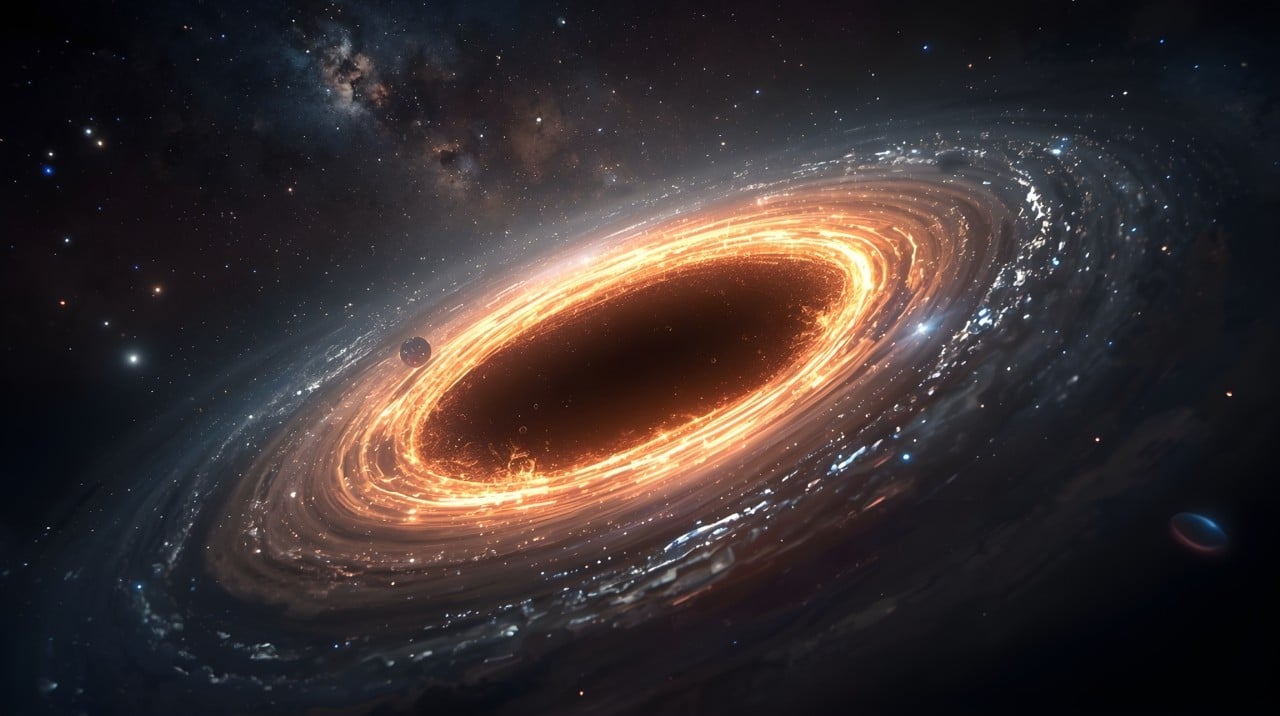
Astronomers have announced confirmation of a runaway supermassive black hole, detected by Telescópio Espacial James Webb, moving at impressive speeds across the universe. The phenomenon, observed billions of light-years from Terra, reveals how extreme gravitational interactions can eject these massive objects from their host galaxies.
The discovery occurred during analysis of images captured in December 2025, when JWST’s NIRSpec instrument identified a peculiar structure in a distant galaxy. Esse black hole, with a mass equivalent to at least 10 million suns, leaves behind a trail of star formation that extends for 200 thousand light years.
Researchers highlight that the event probably results from a collision between two galaxies, where the central black holes merged in an asymmetrical way. Essa asymmetry generated enough gravitational pull to launch the resulting black hole outward at a speed of 954 kilometers per second.
Recent observation details
The Telescópio Espacial James Webb, launched in 2021, has revolutionized astronomy with its ability to observe the universe in infrared. Nessa specific detection, scientists analyzed a galaxy known as Coruja Cósmica, where a shock wave indicated the presence of an accelerated moving massive object. The confirmation came after comparisons with data from other telescopes, such as the Hubble, which had already suggested similar candidates.
The data reveals that the black hole, named RBH-1, creates a bow shock in front of itself, similar to a bow wave on a ship. Essa structure compresses interstellar gas, triggering the formation of new stars along its path. Astrônomos estimate that the event occurred about 7.5 billion years ago, considering the travel time of light to us.
Theory behind runaway black holes
The idea of wandering black holes dates back to the 1960s, when New Zealand mathematician Roy Kerr solved Einstein general relativity equations to describe rotating black holes. Essa solution demonstrated that up to 29% of a black hole’s mass can be in the form of rotational energy, which influences its behavior during mergers.
When two black holes come close together, they orbit each other before coalescing, releasing gravitational waves that carry energy and momentum. If the merger is uneven, the resulting black hole receives a gravitational “kick,” propelling it away from the galactic center. Modelos simulations show that speeds of up to 5 thousand kilometers per second are possible in extreme scenarios.
Studies indicate that triple mergers, involving three black holes, increase the chances of ejection. In compact galaxies or dense clusters, these interactions are more common, explaining why we observe candidates in regions of the early universe.
Evidence accumulated in research
Recent observations include a candidate detected in 2023, where a supermassive black hole was seen leaving a trail of newborn stars. Esse case, analyzed by international teams, showed a speed of 2.2 million miles per hour, equivalent to 3.6 million kilometers per hour.
Other clues come from intermediate-mass black holes, which can be ejected from star clusters. Dados of Observatório of Raios-X Chandra suggest that collisions with thousands of stars fuel the growth of these objects as they travel through space. Astrônomos calculate that dozens of runaway black holes may exist in our Via Láctea, although undetectable directly.
Implications for understanding the universe
Confirmation of this phenomenon changes our view of galactic evolution, as ejected black holes can carry dark matter and gas with them, influencing the formation of new cosmic structures. Pesquisas point out that these events are more frequent in the young universe, when galactic collisions were common.
Furthermore, the detection reinforces the importance of gravitational wave detectors, such as LIGO, which capture signals from distant mergers. Esses signals help predict trajectories of runaway black holes, although most remain invisible until they interact with visible matter.
Computer models simulate scenarios where errant black holes tear through neighboring galaxies, potentially disrupting planetary orbits. However, the probability of an encounter with our solar system is extremely low, given the vastness of space.
Related discoveries in nearby galaxies
In June 2025, astronomers identified evidence of a supermassive black hole in Grande Nuvem of Magalhães, a satellite galaxy of Via Láctea. Estrelas fugitives observed in this region suggest the presence of a hidden black hole, possibly ejected from past interactions.
These stars, accelerated to abnormal speeds, indicate that half of them originated from a specific cluster, while the other half came from an unknown location. Análises reveal that the black hole could have a mass equivalent to thousands of suns, making it the closest one outside our galaxy.
Formation and ejection processes
Supermassive black holes form in the centers of galaxies through the accretion of matter and successive mergers. Quando galaxies collide, their central black holes come closer together, forming binary pairs that eventually merge.
The gravitational “kick” occurs due to the asymmetric emission of gravitational waves during the final merger. Cálculos show that the impulse can vary from hundreds to thousands of kilometers per second, depending on the masses and spins involved. In rare cases, triple mergers amplify this effect, launching the black hole at relativistic speeds.
Simulations indicate that ejected black holes continue to grow as they capture interstellar gas, forming accretion disks that emit radiation. Essa radiation can be detected by telescopes like the JWST, facilitating future discoveries.
Historical observations and technological advances
Since the 2010s, astronomers have been observing runaway black hole candidates in distant galaxies. A notable example is an object detected in 2022, moving at 68 kilometers per second, similar to an interstellar asteroid.
Advances like JWST enable unprecedented resolutions, revealing fine details in cosmic structures. Instrumentos like NIRSpec analyze light spectra, confirming chemical compositions in stellar trails left by escaping black holes.
Potential cosmic risks
Although unlikely, the passage of a runaway black hole through a galaxy could alter the orbits of outer planets. Modelos estimate that intense gravitational forces would only be noticeable when the object approaches the ends of the solar system.
Research emphasizes that smaller, undetectable black holes may be more common, originating from dense star clusters. Esses objects grow by colliding with stars, potentially forming intermediate-mass black holes over billions of years.
Contributions from multiple telescopes
Telescópio Espacial Hubble provided initial images of candidates, while Chandra detected X-ray emissions associated with accretion disks. Combining these data with JWST provides a complete picture of the phenomena.
Future missions, such as Observatório and Ondas Gravitacionais Espaciais, promise to detect more mergers, mapping populations of runaway black holes in the observable universe.
Evolution of black hole theories
The “no hair” theorem states that black holes are defined only by mass, spin and electric charge. Essa simplicity facilitates modeling, but merges introduce dynamic complexities.
Recent studies incorporate dark matter into simulations, suggesting that dark matter halos accompany ejected black holes, affecting their trajectory and interactions.
Discoveries in galactic contexts
In galaxies like Coruja Cósmica, observations show that runaway black holes can trigger bursts of star formation. Gás compressed by the shock bow condenses into young stars, enriching the interstellar medium.
Spectral analyzes reveal heavy elements in these stars, indicating intense nuclear processes during the passage of the black hole.
Advances in gravitational wave detection
Ground-based detectors have captured dozens of mergers since 2015, providing data on masses and spins. Esses events corroborate ejection models, predicting rates of runaway black holes in galaxy clusters.
Space projects will improve sensitivity, detecting supermassive mergers at cosmological distances.
Implications for future astrophysics
The confirmation of RBH-1 opens the way for studies on the distribution of black holes in the universe. Pesquisadores plan to systematically search data from existing telescopes, identifying more candidates.
These discoveries refine cosmological models, integrating runaway black holes into the evolution of the large-scale universe.



