
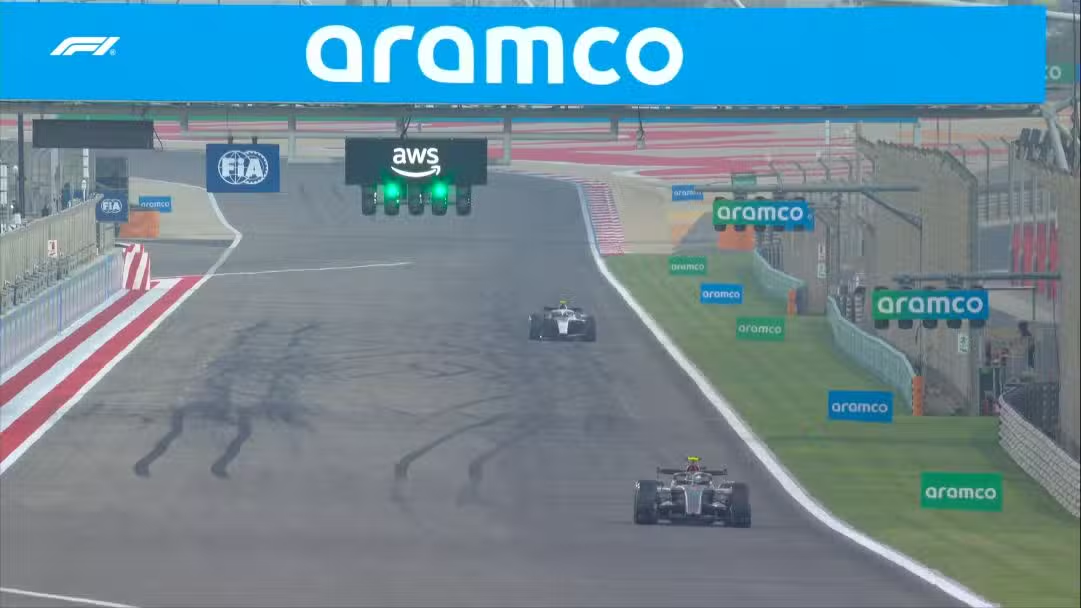
The director of single-seaters at Federação Internacional of Automobilismo,
The organization’s technical leadership seeks to balance technological innovation with competitiveness on the tracks, ensuring that the essence of racing is not harmed by new propulsion systems. According to the entity’s representatives, discussions with teams and power unit manufacturers have been taking place for months to refine operational details.
https://twitter.com/F1/status/2024838116024967322?ref_src=twsrc%5EtfwDialogue between federation and competitors about the future coach
The dissatisfaction expressed by veteran pilots such as Fernando Alonso and Lewis Hamilton put the new set of rules under the spotlight of the specialized media shortly after the first real simulations. Enquanto Younger competitors presented a moderately positive view of the cars’ behavior, the more experienced wing of the paddock expressed concern about the power delivery and weight of the single-seaters. Tombazis highlighted that the federation does not intend to ignore these voices, treating the development of the regulations as a continuous and collaborative process between all parties involved in the sport.
The adjustments currently discussed should not require profound structural changes or changes to the hardware of power units already under development by automakers. The main focus of the potential revisions is on the power management software and the way electricity is recovered and distributed throughout a fast lap. Especialistas point out that small adjustments in the system’s calibration can mitigate the feeling of lack of power on the straights, one of Verstappen’s main complaints after simulator tests.
- Detailed analysis of the energy flow between the combustion engine and the battery.
- Constant monitoring of the thermal efficiency of new sustainable fuels.
- Assessment of the aerodynamic impact when overtaking with the new movable wings.
- Review of safety protocols for high voltage electrical systems.
Challenges in implementing equal power sharing
The goal of establishing a parity of 50% power coming from the internal combustion engine and 50% from the electrical system is the central pillar of the 2026 technical revolution. Entretanto, the technical balance to prevent cars from slowing down on high-speed stretches has proven to be an unprecedented engineering challenge for the organization’s technicians.
Nikolas Tombazis emphasized that around 90% of the regulatory work is already considered satisfactory and solid by the international federation’s technical team. Ele argues that the current scenario is significantly better than the pessimistic predictions made during the European summer of last year, when the first mathematical models were run. The entity’s confidence lies in the fact that the sport has governance tools agile enough to correct course without destabilizing the teams’ billion-dollar investments.
Strategic management of electrical energy on the tracks
The recovery of kinetic and thermal energy will be the competitive differentiator for the teams in the next regulatory cycle for the maximum category. Engineers are now working to define whether drivers will be able to recover a greater amount of kilowatts per lap to avoid running out of batteries on long circuits. Caso this change is approved, competitors will need to adopt an even more cerebral driving style, prioritizing recharging in heavy braking zones to ensure maximum performance at strategic overtaking points.
Currently, the regulations provide for complex electronic management that dictates how and when extra power should be delivered to the rear axle. Criticisms suggest that excessive dependence on the electrical system could turn races into resource-saving contests, moving away from the concept of pure speed. The federation intends to observe the behavior of the cars in real racing situations before making any changes to the lines of code that control the engines official.
Governance process and deadlines for modifications
Any change to the established rules must go through Conselho Mundial of Automobilismo and receive approval from the majority of participating teams. Esse bureaucratic process ensures that no team is unfairly harmed or benefited by last-minute changes to technical regulations. Tombazis indicated that discussions should intensify after the first Grandes Prêmios of the season, using real telemetry data to support decisions.
- Telemetry data collection under varying asphalt and temperature conditions.
- Periodic meetings between technical directors and federation commissioners.
- Formal vote on proposed amendments to the sporting and technical regulations.
Commitment to long-term competitiveness
The federation sees the new regulatory cycle as a technical marathon that will extend over the next five years of competition. The ultimate goal is to ensure that the Fórmula 1 remains the pinnacle of automotive engineering, maintaining public interest and engagement from major brands. Ajustes thins are seen as a natural part of the evolution of any sport that deals with frontier technologies and extreme physical limits.
Pilots’ perspective on dynamic behavior
Qualitative feedback from drivers is essential to understanding how cars behave in close battles and slip zones. Athletes’ sensitivity allows them to identify problems that are not always visible in track engineers’ performance graphs. Therefore, the regulator maintains open channels with the pilots’ association to ensure that drivability concerns are taken seriously.
Hardware stability and focus on operational software
Maintenance of physical engine components is a priority to avoid unnecessary cost increases for power unit suppliers. By focusing adjustments on the software, the federation allows factories to continue their production schedules without significant interruptions. Essa pragmatic approach aims to protect the financial health of the smaller teams and maintain competitive parity between the different engines on the grid.
The complexity of new systems requires an adaptation period for both coaches and fans who follow the evolution of the sport. Transparency in the process of adjusting the rules is essential to maintain the credibility of the competition in the face of such a disruptive technical scenario. The expectation is that the first races under the new regulations will provide definitive answers that simulations have not yet been able to deliver with complete precision.
At the end of the day, the federation’s mission is to deliver a spectacle that balances technological relevance with the excitement of overtaking on the track. Constant dialogue with the protagonists of the show is the most effective tool to achieve this objective in a fair and efficient way. With openness to dialogue and modifications, the category demonstrates maturity to face the challenges of a new automotive era focused on sustainability.
Discussions on power distribution and energy recovery should continue to be the central theme of technical meetings in the coming months. The motorsports community eagerly awaits the organization’s next steps to ensure the 2026 season is a positive milestone in the sport’s history. The commitment to technical excellence and sporting competitiveness remains unchanged, even in the face of the need for course corrections.