
James Webb identifies star in Andromeda that became a black hole without going through a supernova explosion

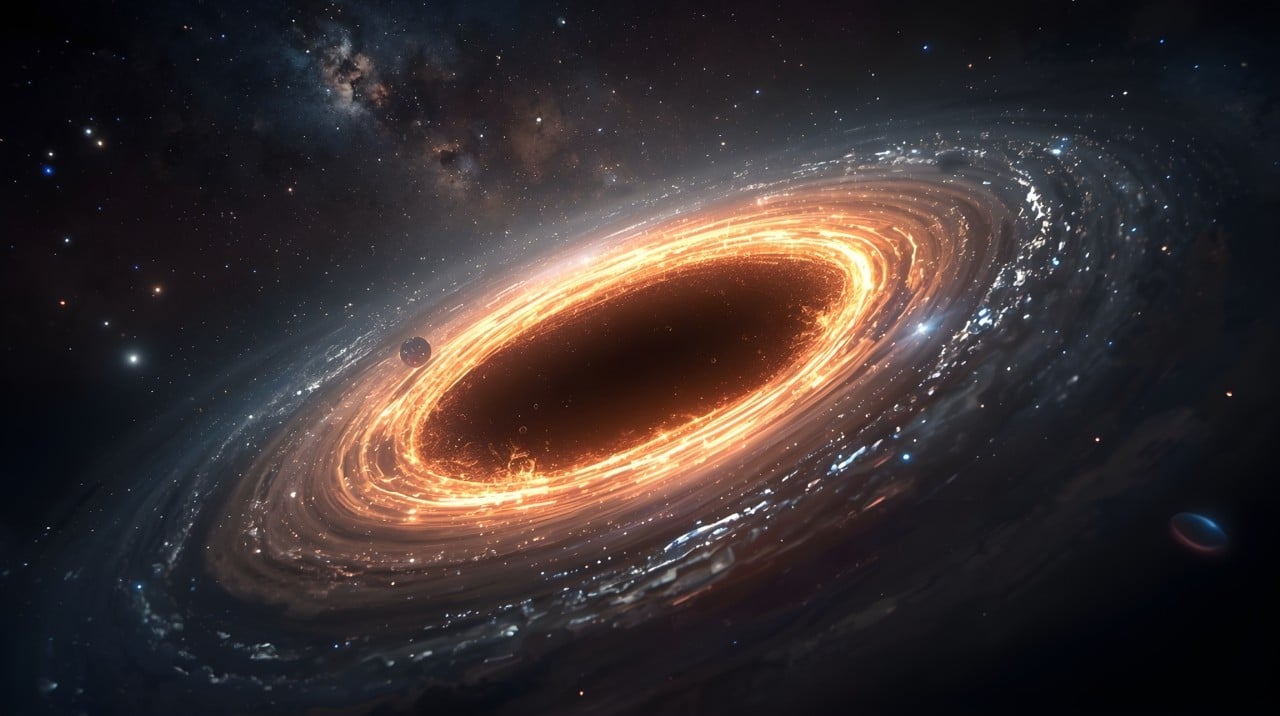
An astronomical event of significant proportions has captured the attention of the international scientific community, changing the understanding of the final life cycle of massive stars. Observações detailed analysis of the Andrômeda galaxy confirmed that a yellow supergiant ended its existence by collapsing directly into a black hole, a rare phenomenon that bypasses the violent and luminous stage traditionally known as a supernova. The case offers an unprecedented insight into the processes of silent implosion in the universe.
The object of study, cataloged by astronomers as M31-2014-DS1, was located about 2.5 million light years from Terra. Continuous monitoring revealed that, rather than exploding and scattering bright matter across the cosmos, the celestial body simply disappeared from the visible spectrum. Extreme gravity overcame the star’s internal pressure, forcing its structure to collapse in on itself in a stellar “failure” event.

Confirming this phenomenon required the use of cutting-edge technology. The Telescópio Espacial James Webb, operating in the infrared spectrum, and the Observatório Chandra, specialized in X-rays, were fundamental for the analysis. The absence of X-ray emissions was a decisive indicator, suggesting that there was not the energetic detonation expected for a star of this magnitude, validating the hypothesis of a direct collapse.
This event challenges classical models of stellar evolution, which predicted luminous explosions for almost all stars with a mass greater than that of Sol. The discovery in Andrômeda suggests that the universe may be full of silently formed black holes, invisible to traditional methods of searching for supernovae.
Analysis of composition and residual structure
In-depth investigations using mid-infrared have allowed scientists to see through the darkness where the star used to shine. At the site, a faint reddish source was identified, composed of cold dust. Spectroscopy revealed the presence of complex molecules, including sulfur dioxide and water, indicating that the star’s outer layers were gently ejected before the core collapsed completely.
The data collected points to the formation of a unique structure around the newly formed black hole. Diferente of the chaotic remnants of a supernova, this environment presents characteristics of calm and controlled expansion. Technical observations highlighted specific elements about the material that remained at the site:
– Ventos molecules were detected expanding at speeds close to 100 km/s in the internal region of the system.
– Houve the formation of a dust shell with physical dimensions comparable to the size of our Sistema Solar.
– The luminosity of the residual source suffered a drastic reduction, falling to about 7% of the supergiant star’s original brightness.
– Instrumentos detected clear chemical absorptions, such as carbon monoxide (CO) and carbon dioxide (CO2), in the expelled material.
The original mass of the star M31-2014-DS1 was estimated to be between 12 and 13 times the mass of Sol. Após the collapse process, the resulting compact object retains about five solar masses. The rest of the material was either dissipated into space or remains orbiting in a very faint accretion disk, which explains the low radiation emission and the difficulty of detection by conventional telescopes.
Review of Stellar Death Models
The technical classification of this event as a “failed supernova” provides the missing physical evidence to corroborate modern astrophysical theories. Stellar physics suggests that, at specific mass ranges, the iron core’s gravity is so intense that it prevents the “rebound” shock wave that would normally cause a supernova explosion. Sem this rebound, the matter is not violently expelled, but rather swallowed by the nucleus.
The statistical implications of this discovery are vast for the cosmic census. Cálculos updates indicate that approximately 30% of all stellar collapses may occur through this silent mechanism. If confirmed on a large scale, this would mean that the number of black holes in the universe is significantly greater than previously estimated based on visible supernova counts alone.
Andromeda, as the closest large spiral galaxy to Via Láctea, serves as an ideal natural laboratory. The ability to observe individual stars in this galaxy allows astronomers to monitor “failed supernova” candidates precisely, tuning the formation rates of compact objects in the Grupo Local of galaxies.
The role of infrared and X-rays in validation
The scientific validation of what happened with M31-2014-DS1 depended both on what was seen and what was not. Observatório Chandra scanned the region for high-energy signatures. Buracos blacks that feed voraciously on neighboring matter often emit large amounts of X-rays. The silence in this range of the spectrum reinforced the theory that the accretion of material by the new black hole is scarce and slow.
Simultaneously, the sensitivity of Telescópio James Webb was crucial for detecting the thermal signature of the remaining dust. Sem the ability to observe in the mid-infrared, the event could have been interpreted only as the disappearance of a star due to obscuration, and not as the birth of a black hole.
Monitoring of the region will continue in the coming years. Scientists intend to monitor the evolution of the light curve and the dissipation of the surrounding dust. Esses Future data will help refine mathematical models about how matter behaves under extreme gravity and how heavy chemical elements are distributed in interstellar space even without cataclysmic explosions.




