
Mission concept launched in 2035 could reach comet 3I/ATLAS in 2085 at 109 billion km

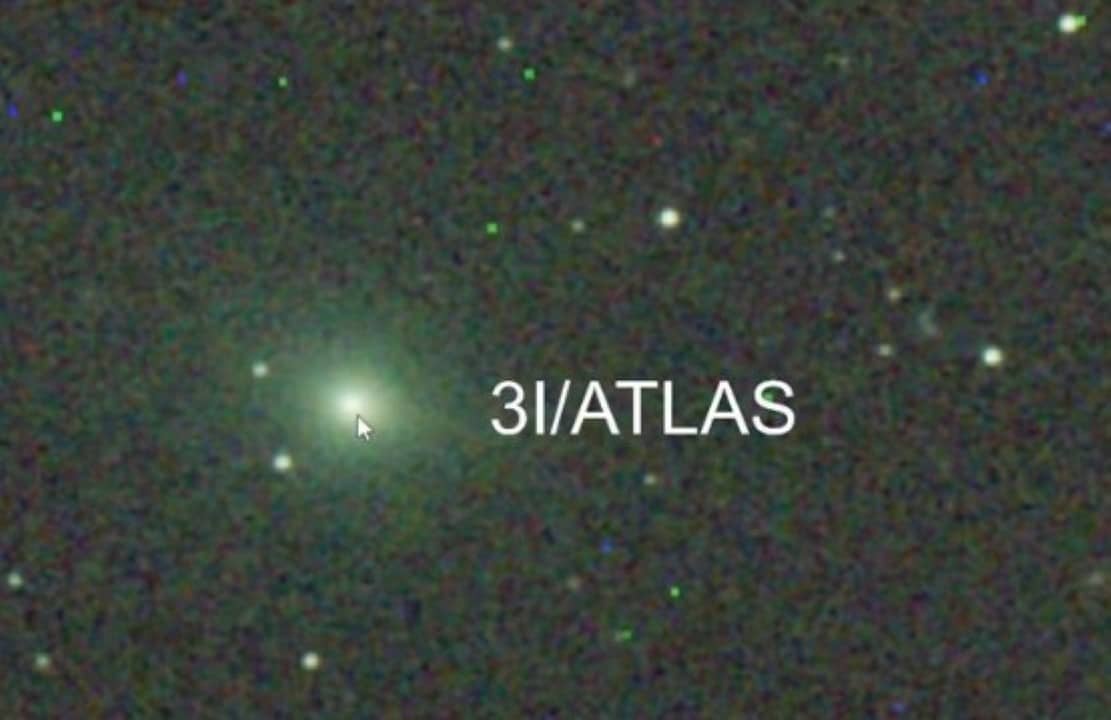
The interstellar comet 3I/ATLAS, identified in July 2025 by the ATLAS system in Chile, remains a target of great scientific interest even after leaving the inner region of Sistema Solar. The third confirmed interstellar object has a retrograde orbit and excess hyperbolic speed close to 60 km/s. Essas characteristics prevented immediate interception after late detection, already within the orbit of Júpiter. Observatórios Earth-based, space telescopes and instruments on Marte tracked the comet during perihelion.
The high speed and the opposite orbital direction to that of the planets created obstacles for conventional missions. Projetos like Comet Interceptor of Agência Espacial Europeia, scheduled for launch between the end of 2028 and the beginning of 2029, are unable to reach the target due to the specific orbital profile. The comet continues on a definitive escape trajectory.
Challenges for direct interception
Three main elements hampered a close encounter mission soon after discovery. The retrograde orbit requires complex trajectory correction maneuvers. The excessive speed of around 60 km/s demands high amounts of propellant. The late detection occurred when the object was already passing through the Júpiter orbit, limiting launch windows.
Ongoing or planned missions do not suit the specific case. Sondas like Juno and Juice had only remote observation opportunities. Scientific interest remains high, as the object may represent primordial material from another star system.

Mission proposal with maneuver Solar Oberth
Researchers at Initiative for Interstellar Studies developed a concept that uses the Solar Oberth maneuver to reach the comet. The technique sends the probe towards Sol, where momentum close to perihelion takes advantage of the gravitational well for a significant gain in speed. Essa strategy overcomes limitations of conventional chemical propulsion.
The trajectory includes passing through Júpiter for direction adjustment and initial speed reduction. Próxima to Sol, the probe executes the critical thrust of the Oberth maneuver. Simulações shows a possible encounter in 2085, around 109 billion kilometers from Terra, with the ship slightly faster than the comet.
Main topics of the proposal
- Optimal launch window in 2035 for optimal alignment between Terra, Júpiter, Sol and 3I/ATLAS
- Combined use of Júpiter gravity assist and Solar Oberth maneuver
- Total flight time estimated at approximately 50 years until rendezvous
- Projected interception distance at 109 billion kilometers
- Propulsion based on chemical rockets with multiple gravitational assists
Astrodynamic viability
Analysis indicates that 2035 offers the most efficient configuration to minimize propellant requirements and mission duration. Janelas alternatives between 2031 and 2037 have been evaluated, but 2035 better balances the orbital parameters. The study focuses on the feasibility of the indirect trajectory.
Details about the probe’s operation in extreme environments, such as solar proximity and deep interstellar space, require additional studies. The proposal prioritizes advanced orbital mechanics without relying on futuristic propulsion technologies.
Scientific interest in comet 3I/ATLAS
The object offers a rare opportunity to analyze the composition of another star system. Observações at perihelion detected cometary activity with release of gases and dust. Cientistas compare it to a cosmic time capsule, with the potential to reveal data about distant planetary formation.
Telescopes such as Hubble and James Webb Webb investigated variations in brightness and chemical composition. The high speed suggests origin in the ancient region of Via Láctea. Missões of future interception may expand knowledge about interstellar visitors.
Advances in long-range missions
The concept demonstrates that fast interstellar objects can be achieved with strategic planning. The Solar Oberth maneuver expands possibilities for deep exploration without advanced propulsion. Simulações accurate trajectory reinforces the importance of astrodynamic studies.
Research continues to refine mission parameters. The advance could guide strategies for future detected interstellar objects. Monitoring of 3I/ATLAS continues as it moves away.



