
Rhythmic jets in the tail of interstellar comet 3I/ATLAS allow unprecedented measurement of its rotation


Astronomers from different parts of the world have reached a new level in understanding the objects that visit our solar system from deep space. The detailed analysis of comet C/2025 N1, popularly identified as 3I/ATLAS, resulted in the precise determination of the time that its nucleus takes to complete one rotation on its own axis. The observations, focused on periodic oscillations of ejected material, indicate that this celestial body has complex and structured dynamics, offering valuable data on the formation of distant planetary systems.
The interstellar object, which had its closest approach to Terra in December 2025 at a distance of 270 million kilometers, presented distinct visual characteristics that facilitated the study. Durante its passage through perihelion in October of the same year, solar heating triggered intense activity on the comet’s surface. Diferente of our system’s native celestial bodies, 3I/ATLAS exhibited peculiar behavior in its dust tail, allowing ground- and space-based telescopes to capture rhythmic variations in the emission of gases and particles.
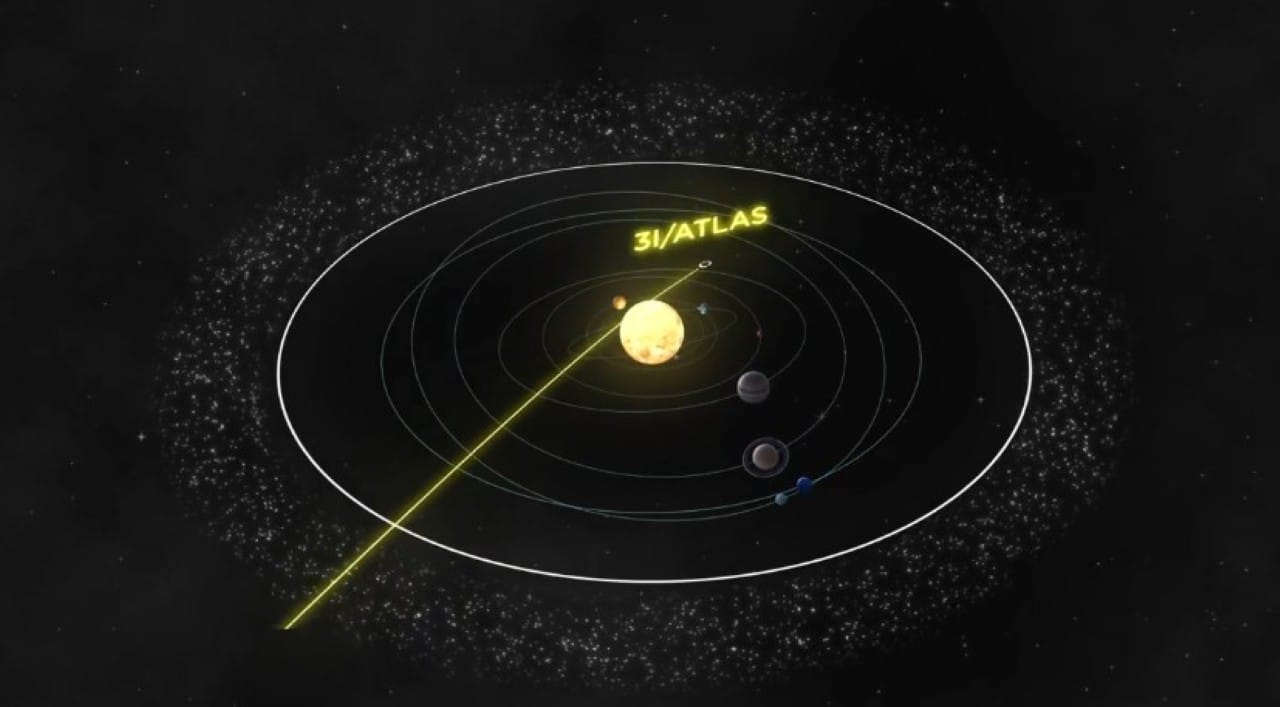
The key to this discovery lay in the observation of an optical structure known as the anti-tail. The Este phenomenon, which occurs due to geometric perspective when the Terra crosses the comet’s orbital plane, caused part of the tail to appear to point toward the Sol. Dentro of this vast dust cloud, which measured around 1 million kilometers, scientists identified jets of matter that changed position regularly, functioning as a cosmic beacon that reveals the hidden movements of the nucleus.
The cosmic clock and jet dynamics
The accuracy of the data collected was fundamental in unraveling the comet’s rotation. Utilizando the Telescópio Gêmeo of Dois Metros located in the Observatório of the Esse repetitive pattern served as the mathematical basis for calculating the actual rotation of the nucleus.
Based on these observed cycles, the scientific team concluded that the core of 3I/ATLAS rotates on its axis once every 15 hours and 30 minutes. The relationship between the jet cycle and total rotation is due to the geometry of how active areas of the surface are exposed to sunlight and subsequently hidden by the body’s own shadow. Essa rotation rate is a critical indicator of the object’s physical stability, suggesting that it possesses sufficient cohesion to resist the centrifugal forces generated by its own spin, even under the thermal stress caused by proximity to the Sol.
The physical process behind these jets involves the sublimation of volatile ices. As sunlight hits specific ice-rich fissures or regions on the surface of the core, the material passes directly from a solid to a gaseous state. Esse expanding gas drags dust particles with it, creating visible jets. The regularity with which these jets appear and disappear in the images confirms that the activity is intrinsically linked to the rotation of the body, validating theoretical models on the behavior of interstellar comets.
Global monitoring and space assets
The scientific magnitude of the 3I/ATLAS passage motivated an observation campaign coordinated by NASA, which integrated terrestrial and space resources to create a complete profile of the visitor. The multimission strategy allowed the comet to be analyzed from different angles and wavelengths, eliminating ambiguities caused by perspective effects. Telescópio Espacial Hubble played a central role in capturing high-resolution images of the inner coma, looking for signs of fragmentation that could occur due to intense heat.
Other space probes, positioned in strategic locations in the solar system, have contributed unique perspectives. Parker Solar Probe, designed to study Sol, was able to record lateral images of the comet between October and November 2025, providing essential data for three-dimensional modeling of the dust tail. Da Similarly, the Europa Clipper mission, which travels towards Júpiter, adjusted its instruments to observe the object at a distance of 164 million kilometers, expanding the available database.
This international and interplanetary collaboration ensured almost uninterrupted coverage of the phenomenon. Combining data from telescopes orbiting Marte with ground-based observatories allowed scientists to track the evolution of the comet’s activity in real time. The volume of information collected during this period of maximum activity continues to be processed and promises to fuel astronomical studies for years, serving as a reference for future detections of interstellar objects.
Chemical composition and search for life
In addition to physical dynamics, the chemical composition of 3I/ATLAS has been a primary focus of investigation. The light reflected and emitted by the comet’s coma carries spectral signatures that reveal the elements present in its structure. The analyzes confirmed the presence of water ice through the detection of hydroxyl, as well as other organic and volatile compounds such as carbon monoxide and dioxide. Esses elements are considered the fundamental building blocks for the formation of planets and, potentially, for life.
The similarity in chemical composition between this interstellar visitor and local comets suggests a universality in star formation processes. The fact that 3I/ATLAS contains the same basic ingredients found in the bodies of Nuvem of Oort or Cinturão of Kuiper indicates that complex organic chemistry may be common throughout the galaxy. Estudar an object that had never been altered by the heat of a star until this moment offers a “pure” view of the initial conditions of other planetary systems.
In parallel with the chemical analyses, Instituto SETI conducted a dedicated search for signs of extraterrestrial technology. Utilizando o
Next steps on the interstellar journey
The comet now continues on its exit trajectory, moving irremediably away from Sol to return to interstellar space. The next significant milestone in its journey will occur in March 2026, when the object will pass through the vicinity of Júpiter. Este gravitational encounter, although not sufficient to capture the comet in solar orbit, will offer a last opportunity for detailed observations under new lighting conditions and gravitational influence.
As it gets further away, 3I/ATLAS’s brightness will progressively decrease, making it invisible to even the most powerful instruments. However, the legacy of his passing remains in the archived data. Confirming that visitors from other stars obey the same physical and chemical laws that govern our own cosmic backyard is a giant step forward for astronomy, unifying understanding about the formation of worlds beyond the boundaries of our system.



