
Silent stellar collapse in Andromeda defies theories and reveals direct birth from black hole

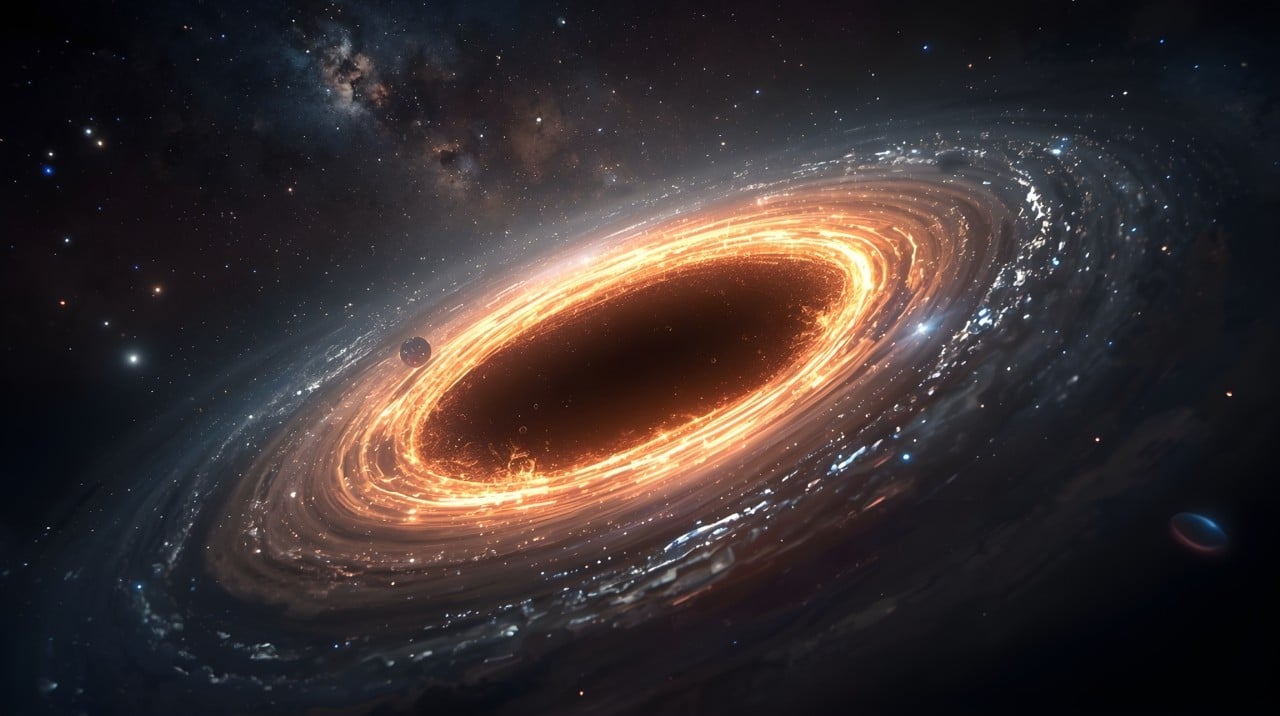
The observation of a rare cosmic event in the neighboring galaxy of Andrômeda is rewriting the astrophysics chapters on the end of life of massive stars. Instead of ending its existence with a cataclysmic explosion known as a supernova, a yellow supergiant simply disappeared from the visible spectrum, collapsing under its own gravity. The phenomenon, identified by cutting-edge technologies, suggests that the universe may be full of black holes formed in absolute silence, defying traditional expectations.
The celestial body, scientifically cataloged as M31-2014-DS1, is located approximately 2.5 million light years from Terra and was being monitored by astronomers awaiting an explosive end. The conventional expectation based on current models was that a star of this magnitude would scatter bright matter across the cosmos in a luminous and violent event. Contudo, the data showed the opposite: a sudden erasure followed by the formation of a dense, dark structure.

The extreme gravitational force overcame the star’s internal pressure in a process scientists call “supernova failure” or direct collapse. Isso forced matter to implode to a point of infinite density, creating a black hole without the visual spectacle that normally accompanies stellar death. The absence of significant X-ray detections was the necessary confirmation to validate that there was no external explosion expected for a star of this size.
To unravel the mystery, the joint operation of two of humanity’s most powerful space observatories was necessary. The Telescópio Espacial James Webb, operating in the infrared spectrum, was able to penetrate the dust layers, while the Observatório Chandra monitored high-energy emissions. Combining these data allowed scientists to rule out other hypotheses and confirm the unique nature of the event that occurred in our galactic neighborhood.
Analysis of the remaining composition and structure
Using instruments sensitive to the mid-infrared allowed researchers to see through the darkness where the star used to shine. Foi identified a cold source at the site, basically composed of remnants of stardust. Spectroscopic analysis revealed the presence of complex molecules, including sulfur dioxide and water, indicating that the star’s surface layers were gently ejected before the core completely collapsed.
The data collected points to the formation of a unique structure around the newborn black hole. Diferente of the chaotic debris of a supernova, this scenario presents characteristics of calm and controlled expansion. Technical observations illuminated specific details about the materials left at the site, offering a detailed picture of what happens after a direct collapse.
Studies indicate that stellar winds are accelerating at a speed close to 100 km/s in the inner region of the system. Houve the formation of a dust shell with physical dimensions comparable to the size of our Sistema Solar. Além In addition, the brightness of the residual source suffered a drastic drop, plummeting to around 7% of the star’s original luminosity, which made detecting its origin extremely difficult.
Advanced sensors detected chemical signatures, such as carbon monoxide and carbon dioxide, in the ejected matter. The original mass of the star M31-2014-DS1 has been estimated to be between 12 and 13 times the mass of Sol. Após the collapse process, the resulting singularity retains about five solar masses. The rest of the material was either dispersed in space or remains orbiting in a tenuous accretion disk, which explains the low radiation emission and the difficulty of detection by conventional telescopes.
Review of Stellar Death Models
The technical classification of this event as a “failed supernova” provides the missing evidence to improve modern astronomical theories. Stellar physics suggests that, in specific mass ranges, the gravitational pull of the iron core is so intense that it prevents the “rebound” shock wave that would cause a supernova explosion. Sem this ricochet, the matter is not expelled violently, being swallowed by the center.
The statistical implications of this discovery are vast for the cosmic census. Cálculos updates suggest that approximately 30% of all deaths of massive stars may occur through this silent mechanism. If confirmed on a large scale, this means that the population of black holes in the universe is significantly larger than previously estimated based on supernova counts alone.
Andromeda, as the closest large spiral galaxy to Via Láctea, serves as an ideal natural laboratory. The ability to resolve individual stars in this galaxy allows astronomers to monitor “supernova failure” candidates precisely, tuning the formation rates of compact objects in the Grupo Local of galaxies.
The role of infrared and X-rays in validation
Scientific confirmation of the M31-2014-DS1 case depended on both what was seen and what was not seen. Observatório Chandra scanned the region for high-energy signatures. Buracos blacks that feed voraciously on neighboring matter often emit large amounts of X-rays. The silence in this spectrum band reinforced the thesis that the accretion of material by the new black hole was minimal and slow.
Simultaneously, the sensitivity of the Telescópio James Webb was crucial to detect the thermal signature of the residual dust. Sem the ability to see in the mid-infrared, the event could have been interpreted simply as the disappearance of a star due to obscuration, and not as the birth of a black hole.
The region will continue to be under surveillance in the coming years. Scientists intend to monitor the evolution of luminosity and the dispersion of surrounding dust. Esses Future data will help calibrate models about how matter behaves under extreme gravity and how heavy elements are distributed in the universe even without catastrophic explosions.



