
SPHEREx telescope data confirms prebiotic chemistry in comet from another star system


Agência Espacial Norte-Americana (Nasa) obtained unprecedented records that prove the existence of compounds fundamental to the formation of life on a celestial body originating outside of Sistema Solar. The SPHEREx space telescope performed detailed measurements of comet 3I/ATLAS, identifying a spectral signature rich in complex organic molecules during its passage through the vicinity of Terra. The discovery reinforces theories about the universal distribution of chemical ingredients necessary for biological processes.
The observations were concentrated between December 8 and 15, 2025, when the interstellar object was already moving away from Sol after reaching its closest point. The instruments captured the release of gases and dust from the comet’s coma, activated by residual solar heat, allowing precise analysis of the internal composition that had remained frozen for eons.
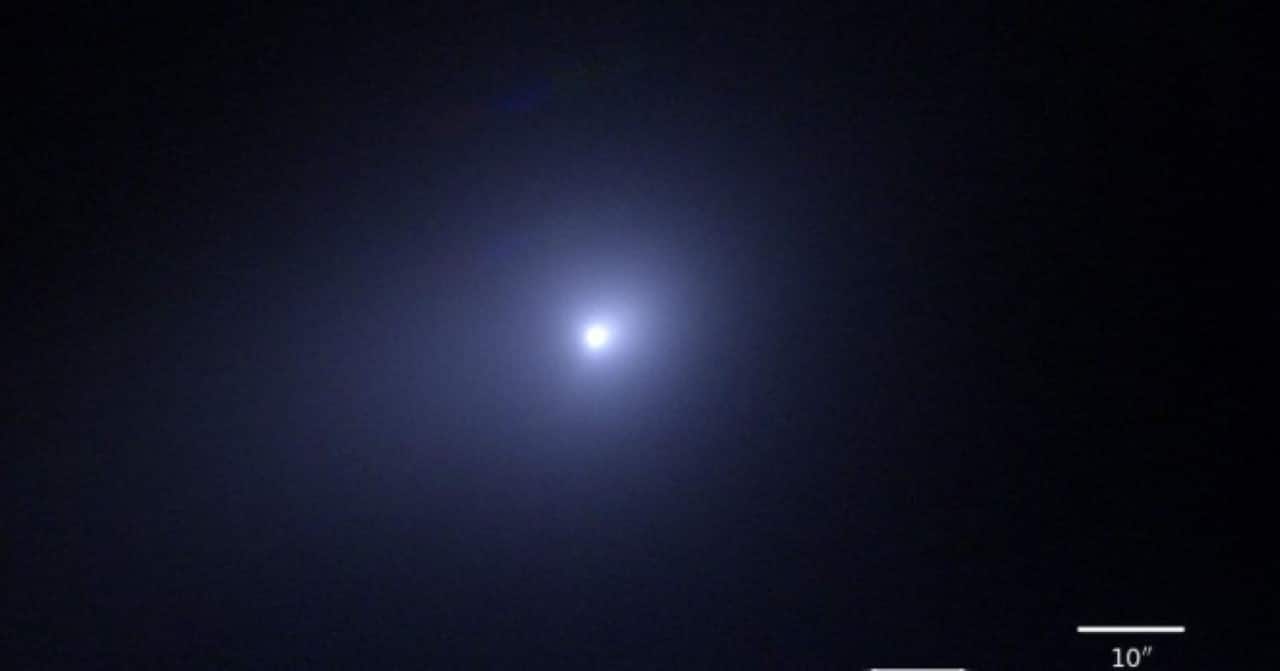
Scientists emphasize that the presence of these elements does not indicate active life, but rather the availability of essential raw materials in other stellar systems. 3I/ATLAS is classified as a rare visitor, offering a unique opportunity to study materials preserved since the formation of its parent star billions of years ago.
Identification of compounds and chemical analysis
The infrared mapping carried out by SPHEREx was able to clearly distinguish the different types of molecules ejected by the comet’s nucleus. Spectral analysis revealed a “chemical soup” containing ingredients that, in Terra, are precursors to complex biological reactions.
Among the main elements detected by the telescope’s sensors, the following stand out:
- Methanol, found in abundance in the comet’s gas emissions.
- Methane, identified together with other hydrocarbons with a simple structure.
- Hydrogen cyanide, completing the trio of main organic compounds.
- Carbon dioxide and water, mapped as the dominant volatile constituents.
The simultaneous detection of these materials confirms that solar heating was sufficient to sublimate the object’s deep ices. The comet’s brightness increased substantially two months after perihelion, which occurred in October 2025, facilitating the collection of data on its primordial chemical structure.
Trajectory and origin of the interstellar visitor
Comet 3I/ATLAS was initially detected by the ATLAS automated monitoring system, at Chile, on July 1, 2025. Sua’s hyperbolic orbit immediately indicated its interstellar nature, confirming that the object formed around another star and traveled through deep space before crossing our planetary system.
During its passage through the inner Sistema Solar, the celestial body reached a minimum distance of 1.4 astronomical units from Sol in October. Após this encounter, gravity and speed propelled the object on an outward trajectory, with no possibility of return, making late 2025 observations crucial for science.
Previous records, made in August of the same year, had already shown an extensive cloud of carbon dioxide around the nucleus. Essa coma stretched hundreds of thousands of kilometers, serving as a prelude to the intense activity observed months later.
SPHEREx technological capacity
The success in identifying the molecules is due to the high spectral resolution of the SPHEREx telescope. The equipment is designed to scan the sky at 102 different wavelengths in the infrared range, which allows it to differentiate the signatures of organic and inorganic compounds with great precision.
The instrument’s primary mission involves studying cosmic ices and the evolution of galaxies, but its versatility allowed it to effectively track a fast-moving target like 3I/ATLAS. The comparison between data from August and December showed a clear evolution in the comet’s activity, with the release of materials from deeper underground layers.
Impact on the understanding of cosmic chemistry
The confirmation of organic molecules in an object from another star system validates theoretical models about prebiotic chemistry in the universe. The data suggests that the building blocks of life are not unique to our local environment, but are spread across the galaxy, preserved in icy bodies that travel between the stars.
This is only the third interstellar object confirmed to visit our cosmic neighborhood. The information collected significantly expands the catalog of known chemical compositions and will serve as a basis for future exploration and monitoring missions of new visitors who cross Sistema Solar.



