
Study reveals supermassive black holes control star formation on an intergalactic scale

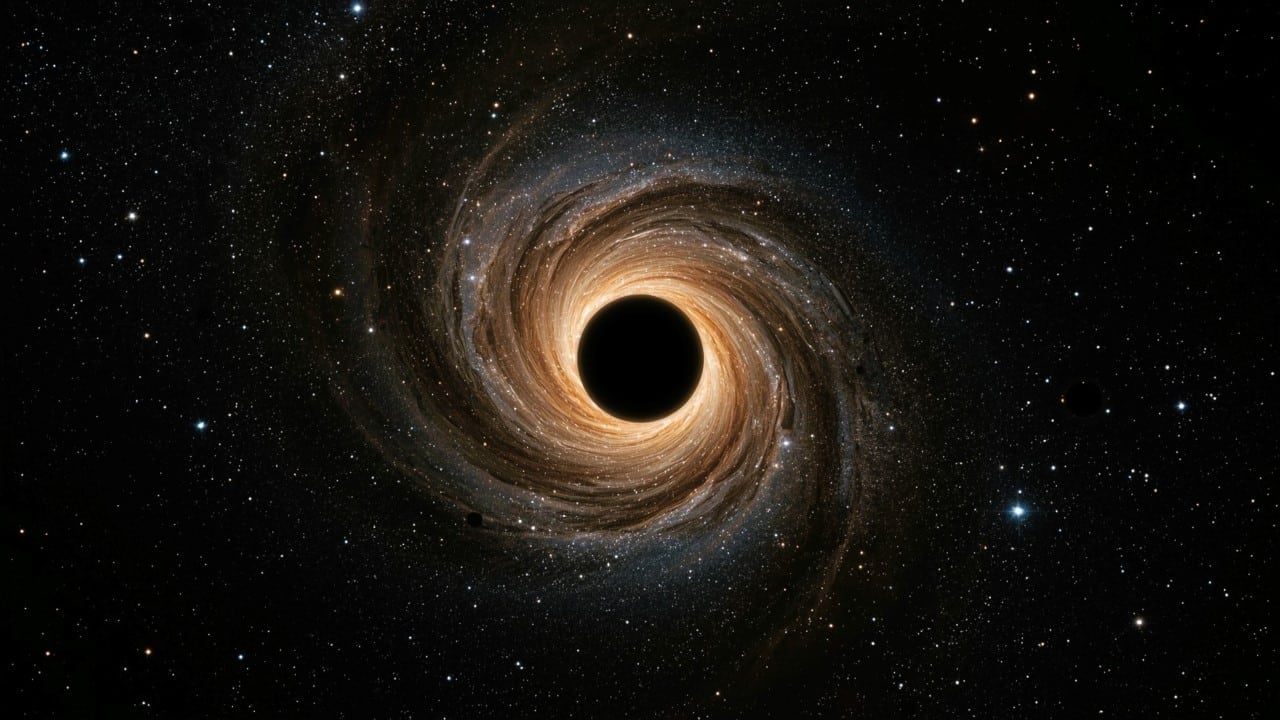
Supermassive black holes emit radiation that suppresses star formation in neighboring galaxies located millions of light years away. A recent study identified this mechanism in galaxies close to the quasar J0100+2802, one of the most luminous objects in the early universe with a redshift of approximately 6.3. Pesquisadores used observations from Telescópio Espacial James Webb to detect reduced emissions of ionized oxygen, a direct indicator of recent stellar activity, confirming the inhibition of the process in regions affected by intense radiation.
The effect occurs when the energy released during accretion into the black hole heats and ionizes the molecular gas present in interstellar clouds. Essa perturbation prevents the cooling and gravitational collapse necessary for the emergence of new stars. The influence extends beyond the host galaxy, reaching neighbors at scales that exceed the initial expectations of cosmological models.
- Radiation dissociates molecular hydrogen in dense clouds
- Hot gas cannot form protostars
- Suppression detected in galaxies with transverse distances up to 7 megaparsecs
JWST observations reveal suppression in nearby galaxies
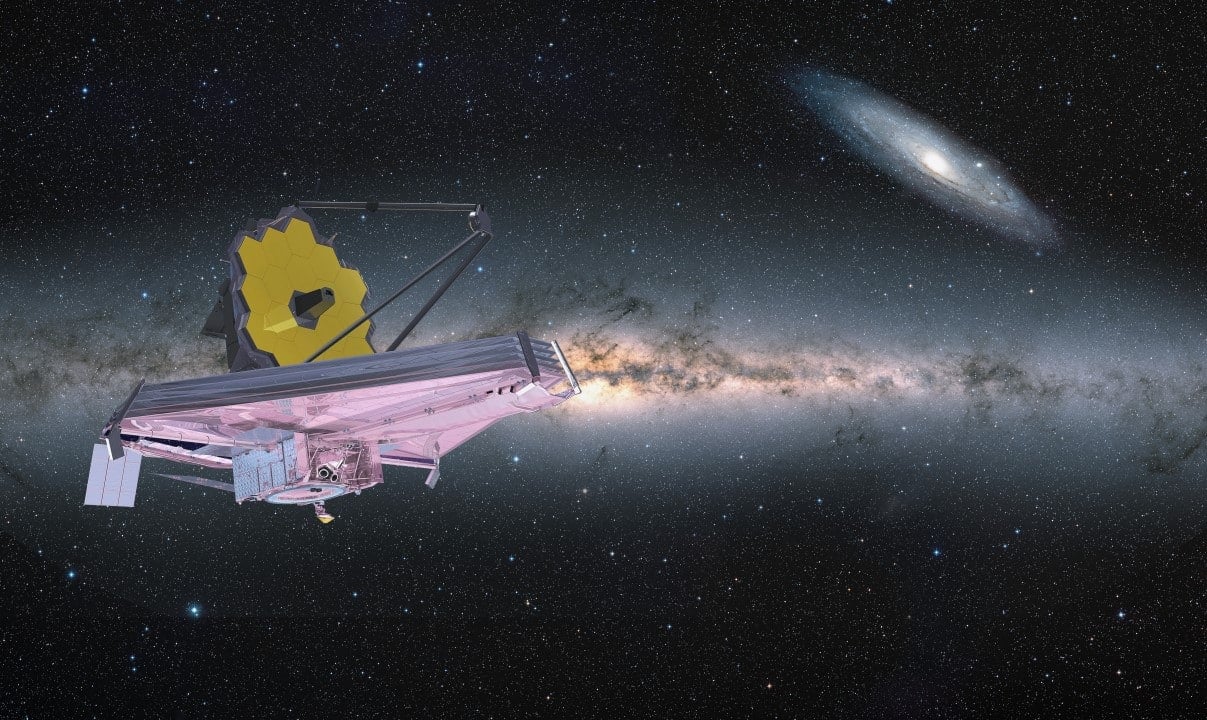
Telescópio Espacial James Webb mapped galaxies at redshifts close to 6.2 and 6.8 around the quasar. NIRCam images showed significantly weaker [O III] emissions in galaxies closer to the central object. Essa decrease indicates less star formation in the last few million years.
Initially, astronomers noticed an apparent paucity of galaxies in certain areas of the observed field. Análises details confirmed the presence of these objects, but with stellar activity inhibited by radiation from the supermassive black hole. The spatial pattern reinforces the hypothesis of radiative feedback at work.
Radiative feedback mechanism acts on a large scale
The radiation emitted by the quasar ionizes and heats the interstellar medium in neighboring galaxies. Molecular hydrogen fragments and loses its ability to condense in cold, dense regions. Sem this reservoir of molecular gas, the star formation process is efficiently stopped.
Galaxies within the radius of influence show reduced star formation rates compared to more distant objects. The measurement of the [O III] λ 5008 line serves as a reliable proxy for this recent activity. The effect demonstrates that active black holes regulate not only their host galaxy but also the surrounding environment.
Quasar J0100+2802 serves as a cosmic laboratory
Quasar J0100+2802 stands out for its extreme luminosity and its position in the young universe, around 900 million years after Big Bang. JWST’s Observações captured foreground and background galaxies affected by radiative emission. The variation in stellar luminosity follows a clear gradient as a function of distance to the quasar.
The team precisely measured distances and correlated the intensity of the emission with the proximity to the central black hole. Galáxias further away maintain normal levels of star formation, while those nearby exhibit marked suppression. Esse spatial pattern validates the feedback model on intergalactic scales.
Interconnection between galaxies changes evolution models
Traditional models treated galaxies as relatively isolated systems due to the large distances between them. The new data shows that active supermassive black holes establish dynamic connections in larger networks. Essa interaction influences collective stellar growth in regions of the early universe.
Central black holes release energy equivalent to billions of suns during phases of high accretion. Essa release affects the thermal and chemical balance of gas in neighboring galaxies. The process contributes to the global regulation of star formation in forming structures.
Effect persists during phases of high quasar activity
Suppression occurs mainly during periods of high quasar luminosity. Quando the black hole consumes matter at extreme rates, radiative emission reaches maximum intensity. Ventos and associated jets amplify the impact on the nearby intergalactic medium.
Future observations of similar quasars may better quantify the spatial extent of this feedback. Next-generation Instrumentos should map more examples and refine affected volume estimates. The discovery reinforces the central role of black holes in large-scale cosmic evolution.




