
Weather forecasts for heavy snowfall in the American Northeast show uncertainty less than two days away


Meteorologists face a considerable challenge in Nordeste of Estados Unidos, with a potential major snowstorm approaching. Faltando less than 48 hours before the predicted start of the phenomenon, the main computer models diverge drastically in their projections, creating a scenario of high uncertainty for the densely populated regions of the Meio-Atlantic and Nova Inglaterra.
The situation is particularly complicated due to the discrepancy in the analyzes of the intensity and trajectory of the winter system. The differences between the forecasts of the American (GFS) and European (ECMWF) models, added to other analyses, represent the distance between a blizzard that could paralyze important highways like I-95 and a light snowfall, easily forgotten.
Inaccuracy in projections of large-scale weather events in the megalopolis stretching from Washington, D.C. to Boston could have significant economic and social consequences. An accurate forecast could save hundreds of millions of dollars in preparedness and response costs, while a lack of preparation for a major storm would lead to even greater expenses and risks to the public.
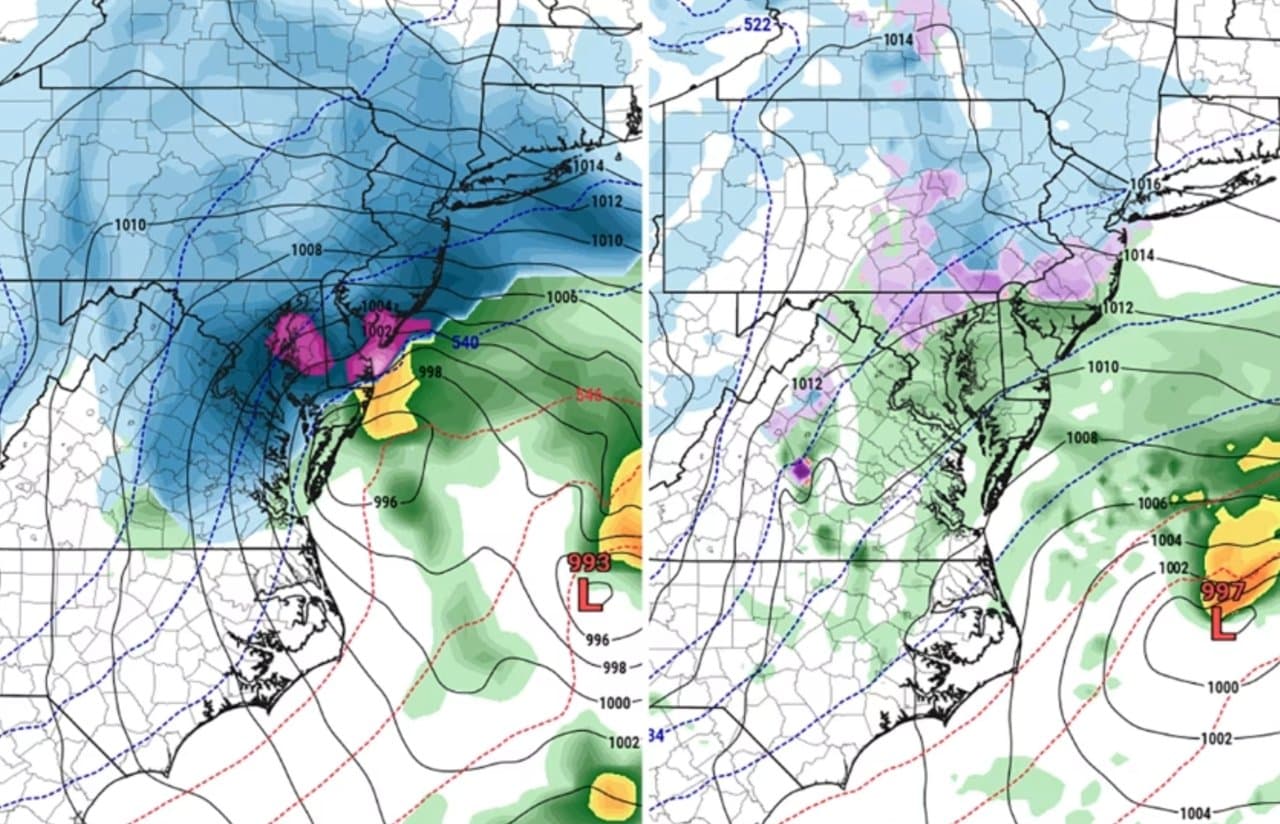
Divergence between global models raises alarm for meteorologists
The divergence between the GFS and European models has been a constant in recent days, with each system indicating radically different outcomes for the imminent storm. The GFS has pointed to a scenario of near-record snowfall in cities like Washington, D.C., with the formation of a “bomb cyclone” that would move close to the coast, intensely impacting Atlântico Médio.
In contrast, the European model has consistently predicted a weaker storm, with a trajectory that would move it away from the coast. Isso would result in considerably lower snowpack for large urban areas, providing relief compared to the more severe GFS projection.
The differences between the forecasts are stark and exemplify the complexity of the atmospheric system. Para Washington, D.C., the European model indicates about 10 centimeters of snow, while the GFS projects a whopping 45 centimeters. The disparity is even greater at Filadélfia, where the European model predicts a mere 4.3 centimeters, in contrast to the frightening 74 centimeters estimated by the GFS model.
Causes of uncertainty: the complexity of the atmosphere
The reasons for such different computational solutions can be attributed to subtle variations in the way each model processes portions of atmospheric energy. Essas portions, which descend from Canadá to the south, propagate along the southern jet stream near the coast of Golfo from
In meteorological terms, minimal changes in the representation of these atmospheric characteristics can define the fate of a blizzard. The exact combination of all the ingredients at the right time and positioning can create a huge storm in Costa Leste. Contudo, if just one or two of these factors are out of alignment, the probability of an extreme event decreases significantly, turning a potential blizzard into a moderate snowfall.
The parameterization of physical processes in the atmosphere, such as cloud formation and precipitation, is one of the main sources of difference between models. Cada model uses different algorithms to simulate these interactions on a small scale, which can lead to divergent results when these processes are amplified in a complex weather system. Além Furthermore, the way observation data is assimilated and the spatial and temporal resolution of each model also contribute to variations in projections.
Economic and social impact of an inaccurate forecast
The difficulty in obtaining an accurate forecast just a few days before a major storm in the US Nordeste entails extremely high costs. Empresas need to decide whether to close or not, public services such as transport and education need to be planned, and the population needs time to prepare, whether by stocking up on food or adjusting work and school routines. A wrong decision, whether by underestimating or overestimating the storm, results in substantial financial losses and can compromise public safety.
Lack of adequate preparation for a major snowfall can lead to the closure of airports, blocked roads and interruption of essential services, such as power supply. Cities between Washington, D.C. and Boston, with their high population density and intense economic activity, are particularly vulnerable to these impacts, making weather forecast accuracy a critical factor for crisis management and urban resilience.
Challenges in decision making: human experience in the face of technology
For meteorologists, forecasting goes far beyond choosing a model and replicating its results. Eles need to understand the reasons behind the projections, combining the raw data with their vast experience and knowledge of atmospheric patterns. Isso involves considering a multiplicity of factors that go beyond direct comparisons between the GFS and the European model.
Cody Snell, NOAA meteorologist for Centro, Good meteorologists often provide a range of snow volume, indicating the uncertainties and level of confidence in their analysis. Technology, including artificial intelligence models, complements but does not replace human expertise in interpreting scenarios.
Communication strategies amid ambiguity
Communicating uncertainty to the public is a delicate task. Quando the models diverge so much, the message to the population can become confusing, especially if experts need to present a wide forecast range, such as between 10 and 45 centimeters of snow. People may fixate on the maximum value, even if meteorologists consider it a low-probability but high-impact outcome.
In these situations, meteorologists generally take a middle-of-the-road approach, estimating light to moderate snowfall but warning of the potential for much larger amounts. Emphasis is placed on preparing for the most severe impacts, even if the likelihood is lower, ensuring that the population is aware of all possibilities and takes necessary precautions.
The historical factor and confidence in projections
Another element that influences meteorologists’ assessment is the models’ performance history. Nos Recent winters, the European model, and its artificial intelligence-enhanced version, has demonstrated greater accuracy compared to the GFS. Essa previous performance leads many analysts to have reservations about extreme scenarios predicted by the American model, questioning the reliability of the most alarming projections.
Historically, in cases of divergence, analysts’ preference falls on the European model, due to its proven track record. Contudo, the magnitude of the current discrepancy is unusual and persists less than 48 hours before the start of the event, making it difficult to choose a single scenario and requiring a more in-depth analysis of all factors involved.
Preparation amid uncertainty
Faced with such uncertainty, individual and community preparation becomes paramount. Residentes of Nordeste Americans should adopt general winter caution measures, regardless of the exact amounts of snow that may fall. Isso inclui garantir suprimentos básicos em casa, como alimentos não perecíveis e água potável, além de kits de emergência com lanternas, pilhas e um rádio a bateria.
It is crucial to keep vehicles with full tanks and charged batteries, as well as having snow removal equipment such as shovels and salt accessible. Local authorities often issue specific guidance, and following updates from trusted sources, such as Serviço Nacional of Meteorologia, is critical to staying informed on the latest conditions.
Protecting pipes and checking heating systems are also important steps. Planejar alternative transportation routes and having a plan for communicating with family members in case of power outages are other precautions that can make a difference. Community resilience is built on individual preparedness and effective risk communication.
Collaboration between emergency agencies, local governments and utility companies is vital to coordinate the response to any scenario, from a moderate snowfall to an extreme event. Multi-scale preparedness allows infrastructure to be better equipped to deal with challenges, minimizing disruptions and ensuring the safety of all citizens.
Future perspectives in meteorology
While artificial intelligence is providing new tools and insights for meteorologists, the challenge of predicting complex events like this storm remains. Integrating new technologies with human expertise will continue to be key to improving forecast accuracy and effectively communicating the risks associated with extreme weather events.



