
Astronomers define interstellar comet rotation after analysis of gas and dust jets in the solar system


An international collaboration of astronomers has achieved a significant milestone in the study of deep celestial objects by determining, with unprecedented precision, the dynamic behavior of comet C/2025 N1. Identificado popularly known as 3I/ATLAS, the interstellar visitor had its rotation cycle calculated at 15 hours and 30 minutes, thanks to the detailed observation of the jets of matter expelled from its surface during its passage through the inner regions of our system.
The discovery was made possible by analyzing periodic oscillations in the object’s dust tail, which became more visible after its closest approach to Terra in December 2025. The intense solar heating, which occurred during perihelion, activated fissures in the comet’s nucleus, generating rhythmic emissions of gas and particles that acted as a cosmic beacon, allowing ground and space telescopes to track the nucleus’s hidden movement.
Jet dynamics and physical stability
The fundamental physical process identified by scientists involves the sublimation of volatile ices which, when reached by sunlight in specific regions of the surface, go directly from a solid to a gaseous state. The expanding gas drags dust particles with it, creating visible jets that change position as the celestial body rotates on its own axis.
The regularity with which these jets appear and disappear in the images served as a mathematical basis for establishing the comet’s rotation speed. The given Esse is a critical indicator of the object’s physical stability, suggesting that 3I/ATLAS has sufficient structural cohesion to resist the centrifugal forces generated by its own rotation, even under thermal stress caused by proximity to the Sol.
Space monitoring and chemical data
The scientific magnitude of the event motivated an observation campaign coordinated by NASA, which integrated resources from multiple missions to eliminate ambiguities caused by perspective effects. Telescópio Espacial Hubble and the Parker Solar Probe probe played central roles in capturing high-resolution images and lateral data of the dust tail, while the Europa Clipper mission adjusted its instruments to observe the object on its journey toward Júpiter.
In addition to the dynamics of movement, spectral analyzes of the light reflected by the comet confirmed the presence of elements crucial for understanding space chemistry:
– Água in solid state (ice);
– Compostos volatile organics;
– Monóxido of carbon;
– Dióxido of carbon.
The similarity in chemical composition between this interstellar visitor and our system’s native comets indicates a universality in star formation processes, suggesting that the basic ingredients for life may be common throughout the galaxy.
Future trajectory and scientific legacy
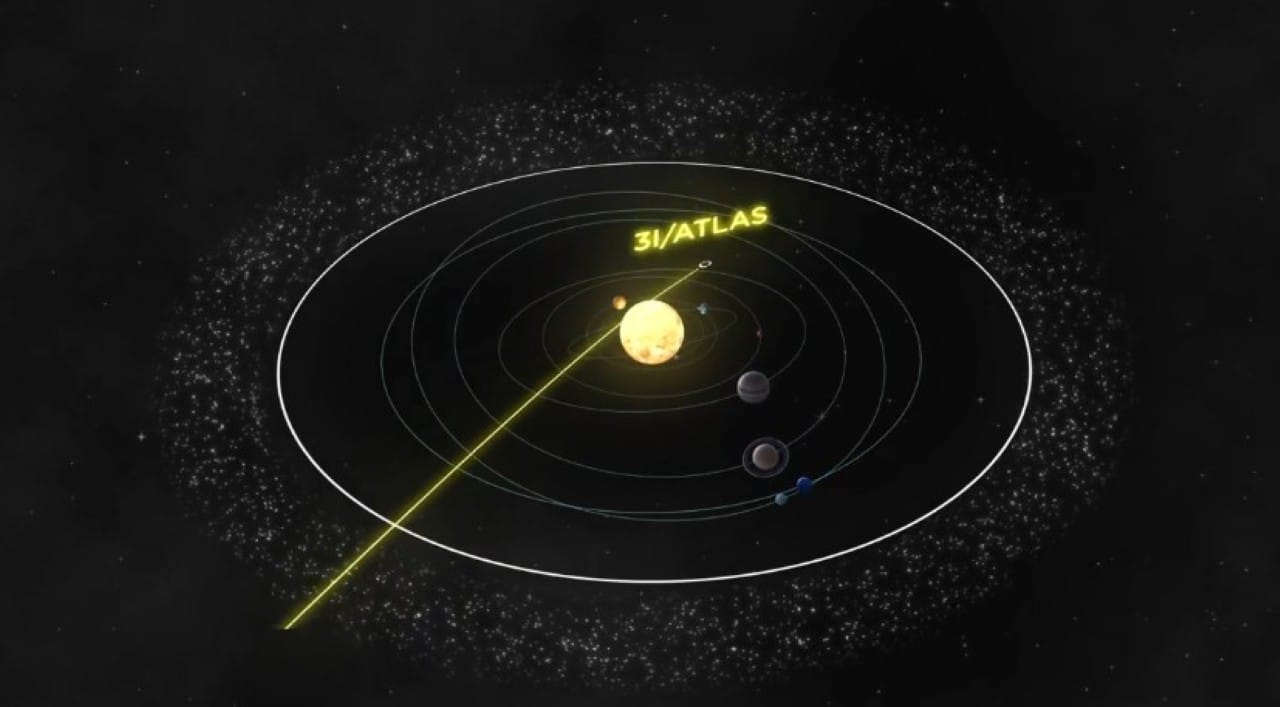
The comet now follows its irremediable trajectory towards interstellar space, progressively moving away from the solar heat. The next significant milestone in its journey will occur in March 2026, when the object will pass in the vicinity of Júpiter, offering a final opportunity for detailed observations under new lighting and gravitational influence conditions.
As the distance increases, 3I/ATLAS’s brightness will dim until it becomes invisible to current instruments, but the legacy of its passage remains in the archived data. The confirmation that visitors from other stars obey the same physical and chemical laws that govern our cosmic backyard represents a step forward in unifying understanding about the formation of worlds beyond the borders of the solar system.



