
Monitoring of jets on interstellar comet fixes core rotation at fifteen and a half hours


Astronomers have consolidated a new understanding of the dynamics of visiting celestial bodies after detailed analysis of comet C/2025 N1, cataloged as 3I/ATLAS. Accurate determination of the nucleus’ rotation period was achieved by monitoring jets of dust emanating from the object’s surface during its passage through the inner solar system. The study confirmed that the nucleus completes one rotation on its own axis every 15 hours and 30 minutes, a crucial piece of data for understanding the physical integrity of the body under heat stress. The observations were possible thanks to the object’s maximum proximity to Terra, which occurred at the end of 2025, when it reached 270 million kilometers away. The stability demonstrated by the comet suggests a structural cohesion capable of withstanding the centrifugal forces generated by the spin, even while releasing volatile materials into space. Esse behavior offers a novel model for the physics of objects formed in other stellar systems. The research used a combination of ground-based and space-based telescopes to track the rhythmic oscillations in the comet’s tail.
The data collected allowed scientists to map fundamental characteristics of the interstellar visitor, establishing parameters that differentiate its activity from that observed in comets native to our system. Key findings include:
– Ciclo of dust jet activity occurring every 7 hours and 45 minutes.
– Confirmação of the presence of water ice and organic compounds in the structure.
– Ausência of artificial technological signals after radio frequency scans.
– Identificação of an “anti-tail” generated by orbital geometric perspective.
Jet mechanics and observation cycles
The key to unraveling the rotation of 3I/ATLAS lay in the regularity with which jets of material were expelled from its surface. Durante the monitoring carried out at Observatório of Teide, in Tenerife, the researchers noticed that the emission of particles followed a strict temporal pattern. The sublimation of volatile ices, activated by sunlight hitting specific fissures in the core, created visible jets that served as precise time markers for astronomers.
The observed cycle of 7 hours and 45 minutes in the jet oscillations corresponds to exactly half of the core’s total rotation period. Essa mathematical relationship is due to the geometry of the object and the way its active regions are illuminated and subsequently shaded during rotation. The consistency of this “cosmic clock” made it possible to eliminate ambiguities in the calculations and provided a robust measure of the comet’s rotational dynamics, validating theoretical models on the behavior of interstellar icy bodies.
In addition to timing, the images captured revealed the complexity of the dust tail, which reached extensions exceeding one million kilometers. The detection of the so-called anti-tail, an optical illusion where part of the debris appears to point toward Sol, helped refine three-dimensional models of the dust cloud surrounding the nucleus. Esses visual details were essential to distinguish the comet’s intrinsic activity from perspective effects caused by the relative position of Terra.
Spatial data and asset integration
The 3I/ATLAS observation campaign mobilized a global network of scientific instruments, coordinated by NASA, to maximize information collection during the brief window of visibility. Telescópio Espacial Hubble was directed to capture high-resolution images of the inner coma, looking for evidence of fragmentation that could occur due to the intense heat of perihelion. The absence of structural breaks reinforced the theory that the object has a solid and resistant composition.
Space probes at different points in the solar system contributed complementary viewing angles, enriching the available data set. The Europa Clipper mission, transiting to Júpiter, adjusted its sensors to observe the comet from a safe distance, while Parker Solar Probe provided lateral images crucial for modeling the tail. Essa triangulation of observations allowed scientists to reconstruct the comet’s morphology in three dimensions, overcoming the limitations of a purely terrestrial view.
Chemical analysis and biological context
The composition of 3I/ATLAS turned out to be surprisingly similar to that of comets found in Nuvem of Oort and Cinturão of Kuiper. Spectral analysis of the light reflected by the coma confirmed the presence of elements essential for prebiotic chemistry:
– Hidroxila, direct indicator of water ice.
– Monóxido of carbon in a volatile state.
– Dióxido of carbon and other simple organic compounds.
The detection of these building blocks in an object from another star system suggests that the ingredients for life may be common in the galaxy. The fact that the comet remained unaffected by stellar heat until its recent approach offers a pure insight into the primordial conditions of planet formation in other regions of the universe. Paralelamente, searches for technosignatures carried out by Instituto SETI in the 1 to 12 GHz band did not detect artificial transmissions, classifying the object as strictly natural.
Current trajectory and passage through Júpiter
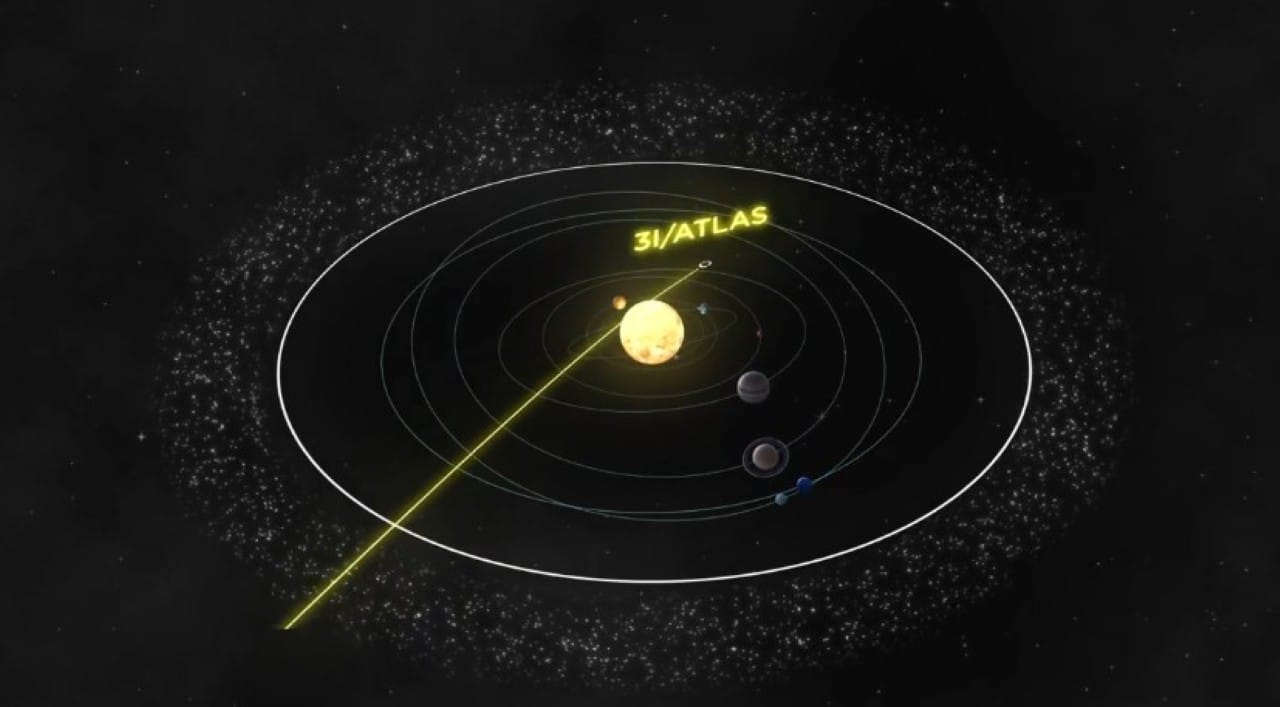
The comet is now on its way out of the solar system, progressively moving away from the thermal influence of Sol. In March 2026, the object makes a significant pass close to the orbit of Júpiter, an event that marks the last practical opportunity for detailed observations before it becomes invisible to most instruments. The gravitational interaction with the gas giant, although insufficient to capture the visitor, may slightly alter its escape trajectory.
The legacy left by the passage of 3I/ATLAS lies in the vast archive of data that will continue to be processed in the coming years. Confirming that locally observed physical and chemical laws apply to interstellar visitors strengthens astronomical understanding of the formation of distant planetary systems. The detailed study of this cosmic traveler establishes a solid comparative basis for the identification and analysis of future interstellar objects that cross our system.



