
New Hubble images show rhythmic oscillations in the jets of interstellar comet 3I/ATLAS

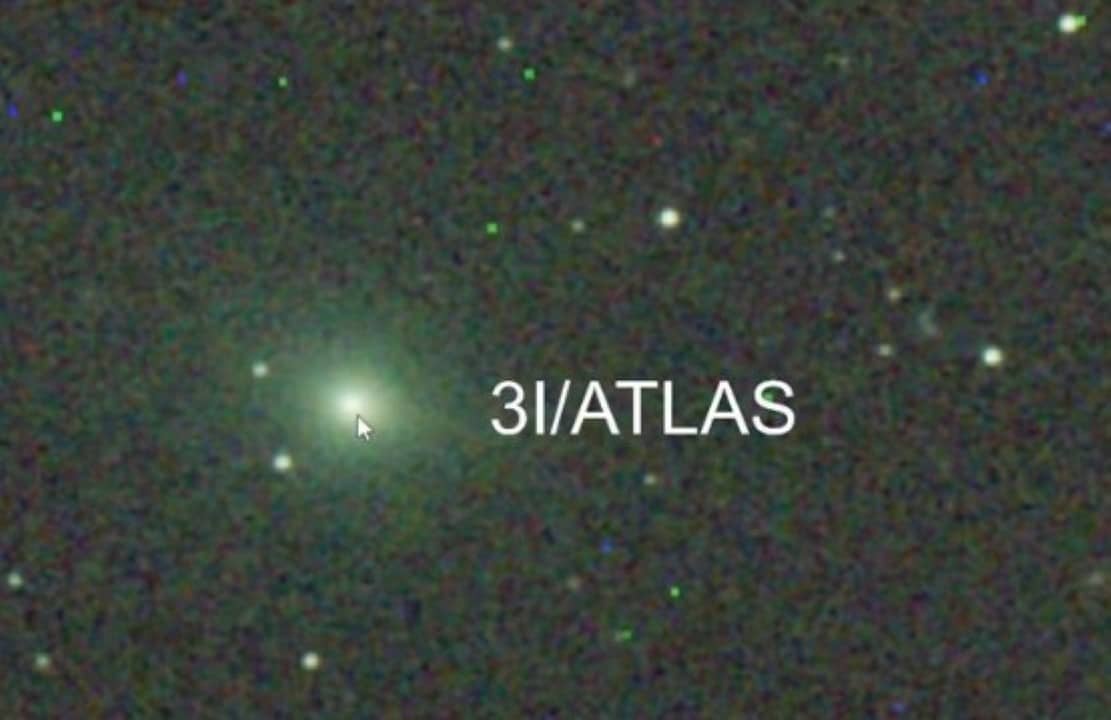
Telescópio Espacial Hubble captured detailed images that reveal complex, dynamic behavior in the interstellar object 3I/ATLAS, specifically its gas emission structure. Observations carried out between the end of November and the end of December 2025, the period after the object passed through perihelion, show the existence of three distinct jets that present periodic oscillations. Data analysis indicates that these variations are not random, but follow a synchronized rhythmic pattern, suggesting intense physical processes in the celestial body’s core as it travels through the solar system.
Astronomers identified that the most prominent jet, oriented in the opposite direction to Sol, exhibits an oscillating movement, known technically as a “wobble”, with a cycle of approximately 7.20 hours. Esse angular movement covers a variation of around 20 degrees, which directly influences the total luminosity observed in the object. The brightness variability recorded follows this cycle of movement, presenting a period of 7.136 hours and an amplitude of change of around 30%, which reinforces the connection between the activity of the jets and the rotation of the nucleus.

Spin dynamics and nucleus structure
The scientific interpretation for these movement patterns points to precession or nutation phenomena in the attitude of the comet nucleus. Isso occurs due to a fundamental misalignment between the object’s axis of rotation and its main axes of symmetry. The axis of rotation remains aligned close to the solar direction, with a margin of 20 degrees, which favors the stability observed in the formation of gas and dust structures that emanate from the surface.
Studies on the physical dimensions of 3I/ATLAS estimate that its core has a diameter of approximately 2.6 kilometers. A relevant discovery is that most of the light captured by telescopes does not come from the solid surface of the object, but rather from intense cometary activity. Apenas About 1% of the total brightness is the result of reflection of sunlight by the nucleus, while the remainder derives from scattering of light in jets of ejecta.
Geometric configuration of the jets
Detailed morphological analysis allowed mapping the position and specific behavior of each of the three identified jets. The first jet exhibits a position angle of 55 degrees with an oscillation amplitude of 12.8 degrees, while the third jet exhibits an angle of 170 degrees and a similar amplitude of 12.6 degrees. The second jet, which projects towards the sun at an angle of 290 degrees, is the one that demonstrates the greatest range of movement, reaching 20 degrees.
The anti-solar jet, positioned at 290 degrees, concentrates the clearest evidence of the “wobble”, serving as an accurate indicator of the comet’s rotational dynamics. The measurements were made possible by advanced image processing that highlighted the symmetry and shape evolution of these emissions over time. The observed variations alternate between narrower, collimated shapes and fan shapes, explaining the non-sinusoidal fluctuations in the object’s total light curve.
Persistence of post-perihelion phenomena
The periodicity of approximately 7.1 hours is intrinsically linked to the rotation of the misaligned nucleus. Esse precession movement generates quasi-periodic oscillations that affect the phases and amplitudes of the jets as their morphology evolves in space. The alignment of the rotation axis with the direction of Sol facilitates the creation of stable structures, such as an extensive anti-tail jet, while multiple emission points appear to contribute to the rotational balance of the system.
Comparative research indicates that similar modulations had already been detected in phases prior to the maximum approach to Sol, with periods very close to the current ones. Confirmation of these behaviors in the post-perihelion phase suggests that the internal dynamics of 3I/ATLAS are consistent and persistent. The three-jet system maintains a projected sky separation of approximately 120 degrees, a geometry that becomes evident when processing filters remove the diffuse glow of the coma, revealing the complexity of this interstellar visitor.



