
New NASA simulations project deadline for life on Earth due to solar expansion


Researchers from the US space agency used advanced supercomputers to accurately map the final stages of Sol’s life cycle. The new computational models allowed scientists to establish a more assertive timeline about the drastic transformations that the central star of the solar system will face in the future. Atualmente, the star is in the middle of its useful life, maintaining hydrogen fusion in its core in a stable way for billions of years.
Current energy stability has been fundamental for the maintenance of the Earth’s atmosphere and the development of the biosphere since the formation of the planet. However, astronomical data indicates that the process of nuclear fuel depletion will occur gradually and predictably on a cosmic scale. The stable period of Sol should last approximately five billion years, a phase in which luminosity remains suitable for complex life.
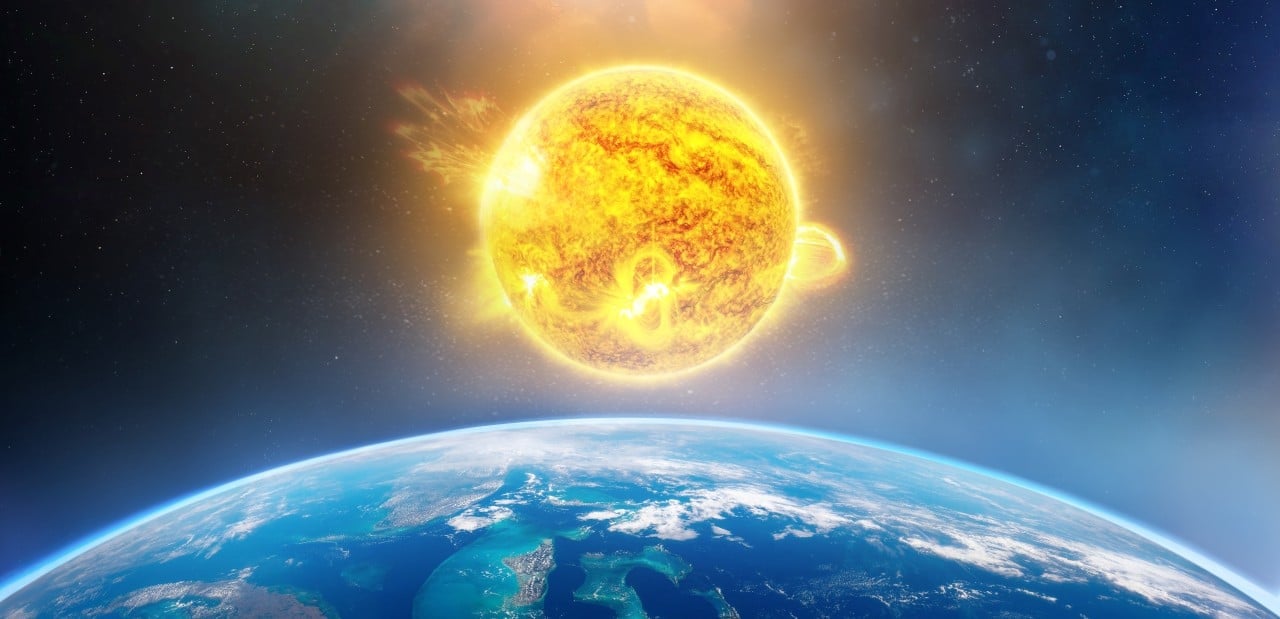
Comparative studies with similar stars present in Via Láctea corroborate these calculations and reinforce the reliability of the hypotheses generated by the algorithms. Apesar of apparent stability, subtle changes have already begun to slowly manifest themselves in the stellar structure. Solar brightness tends to increase progressively over the next billion years, a phenomenon that experts monitor to understand future climate impacts on our planet.
Current evolution on the main sequence
Sol remains positioned on the main sequence of its stellar life, where the fusion of hydrogen into helium occurs steadily in the core. Essa nuclear reaction releases energy that reaches the surface of Terra, regulating the water cycle and maintaining temperatures compatible with biological existence. Astrônomos monitor the behavior of analogous stars at different ages to calibrate the projection models.
Simulations carried out on supercomputers integrated data from recent space missions and adjusted estimates of the star’s fuel reserves. The star has already consumed around half of the hydrogen available in its core and continues to operate within the parameters expected for its mass.
Gradual increase in solar luminosity
As the core evolves internally and fusion adjusts to new pressure and temperature conditions, the star releases increasing amounts of radiation. Essa additional energy alters the thermal balance of the planets that orbit it and should raise average Earth temperatures over time. Pesquisadores uses satellite data to measure subtle variations in solar irradiance and project future climate scenarios.
Models indicate that, in approximately one billion years, increased radiation will already make the climate of Terra excessively hot and hostile to current life forms. The environment may undergo irreversible changes that include:
– Aceleração of the loss of ocean water due to intense evaporation;
– Modificações drastic changes in atmospheric chemistry and the carbon cycle;
– Extinção of the biosphere as it is known today due to extreme heat.
Comparative studies with other planetary systems provide additional evidence about these progressive stellar heating processes. The increase in luminosity forces adaptations in the cycle of fundamental chemical elements and experts analyze ancient geological records to identify similar patterns in the planet’s past eras.
Red giant phase and expansion
The solar core will exhaust its hydrogen reserves in about five billion years, at which point nuclear fusion will begin to occur in the outer layers. The star will expand its surface dramatically, growing to hundreds of times its current diameter. Durante this massive expansion, the closest planets, Mercúrio and Vênus, will be swallowed by the growing solar atmosphere.
Terra’s orbit will face severe disruptions, even if the planet is not completely consumed at this early stage. The oceans will completely evaporate and the atmosphere will dissipate into space, transforming the surface into a desert of barren rock and magma, incapable of supporting any known life.
Mars and the outer planets will receive an energetic charge much greater than the current one and may experience temporary changes in their surface conditions. Sol will gradually lose mass during this phase, which will alter the orbital distances of all remaining celestial bodies in the solar system.
Impacts on gas giants and final transition
Jupiter and Saturno are expected to maintain their main gaseous structures, but will face intense solar winds that could sweep away part of their upper atmospheres. The rings of Saturno, composed mainly of ice and rock, can disperse or undergo significant changes with the increase in incident radiation.
Unlike more massive stars, Sol does not have enough mass to explode as a supernova. The star’s death process will involve thermal pulsations that will eject the outer layers in a controlled manner, creating a planetary nebula around the remaining core. Essa mass loss occurs over tens of thousands of years, leaving behind a compact, extremely hot object.
Astronomers observe similar nebulae in the galaxy to understand the details of this matter ejection mechanism. Modelos statistics reproduce the mass loss rates and temperatures involved in the transition. The red giant phase lasts about a billion years before the final detachment of the outer layers.
Observation of white dwarfs and the distant future
After the ejection of the outer layers, the contracted core transforms into a white dwarf, a dense object with a size comparable to that of Terra, but with a mass equivalent to that of the current Sol. Esse stellar remnant cools slowly over trillions of years, emitting residual radiation until it becomes a dark, inert body in space.
Sol will continue to exert gravitational influence on the remaining planets even after it becomes a white dwarf. Orbits will adjust to new distances due to the loss of mass from the central star. Outer Planetas such as Urano and Netuno will undergo changes in their atmospheres and compositions, and the solar system as a whole will adapt to a new gravitational balance established by the remains of the star.
The scientific community uses ground-based and space telescopes, such as the James Webb and the Gaia missions, to observe stars that are in advanced stages of evolution and have a mass and chemical composition close to those of Sol. Esses objects function as natural laboratories that directly reveal the future of our system. Spectroscopic observations detect chemical signatures left by the fusion of helium and heavy elements, confirming theoretical predictions about the final fate of white dwarfs.




