
Gravity shapes cosmic web in the Tarantula Nebula and drives birth of massive stars


Astronomers have managed to capture unprecedented, detailed images of Nebulosa Tarântula, revealing a complex structure that resembles a gigantic spider web in deep space. The region, located at Grande Nuvem of Magalhães, is one of the most active and bright stellar nurseries in the galactic neighborhood of Via Láctea, located approximately 160 thousand light years from Terra. The new observations were made possible by combining data collected by cutting-edge instruments, allowing scientists to analyze gas dynamics and new star formation with unprecedented clarity.
The research used the Very Large Telescope (VLT) and the Atacama Large Millimeter/submillimeter Array (ALMA), both located on Chile and operated by Observatório Europeu of Sul (ESO) and international partners. By superimposing images at different wavelengths, researchers identified how gravity interacts with the energy released by massive stars. The study focuses specifically on the constellation Dorado, where the nebula resides, and offers new insights into the physical processes that govern the birth of stars in extreme environments.
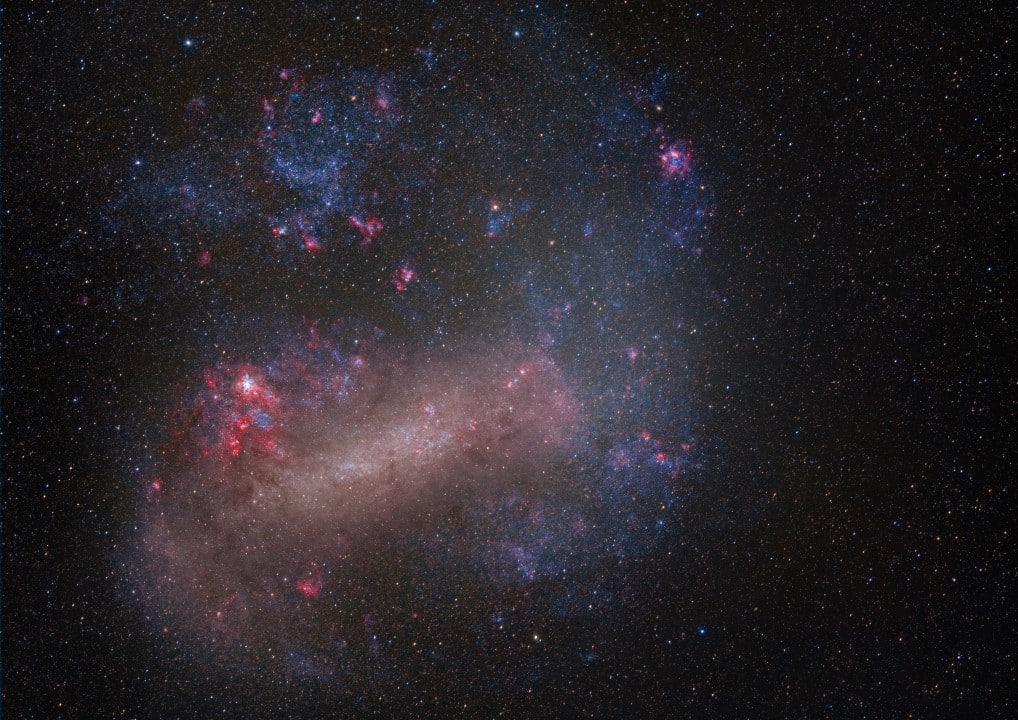
The data obtained indicate that gravity continues to play a dominant role in the formation of new stars, even in regions saturated by violent stellar winds. Nebulosa Tarântula is home to some of the most massive stars known to science, with masses that can exceed 150 times that of Sol. Understanding this balance of forces is fundamental to understanding the evolution of distant galaxies that existed at the beginning of the universe.
The findings challenge previous models that suggested the energy expelled by young stars would quickly disperse the gas needed for the formation of new celestial bodies. Instead, the nebula’s filamentary structure demonstrates surprising resilience, maintaining reservoirs of cold, dense gas ready to collapse and give rise to new stellar generations.
Spectral mapping and advanced technology
The key to these discoveries lies in the ability to observe the cosmos in multiple spectrums of light, which reveals components invisible to traditional optical telescopes. The VISTA instrument, coupled to the VLT, captured the nebula in infrared, highlighting the hot, ionized gas in pink tones that permeate the region. Essa band of the spectrum is crucial for penetrating the dense dust clouds that often obscure stellar nurseries.
Simultaneously, ALMA provided data in the radio band, mapping the cold, dense gas, represented in shades of red and yellow in the visual composites. It is in these cold regions that the gravitational collapse necessary for the ignition of new stars occurs. Overlapping these maps allowed astronomers to visualize the “web” of gas filaments that connect different parts of the nebula, showing the distribution of matter with millimeter precision.
ALMA’s interferometry technology was essential for detecting carbon monoxide emission, a reliable marker for molecular gas clouds. By tracking these molecules, the team was able to outline the three-dimensional structure of the nebula and identify zones where the gas density is sufficient to overcome the internal pressure and initiate the star formation process. The use of adaptive optics on the VLT also ensured that infrared images maintained exceptional sharpness, correcting distortions caused by the Earth’s atmosphere.
Dynamics between gravity and stellar feedback
One of the central points of the investigation is the interaction between gravitational attraction and the so-called “stellar feedback”. Massive Estrelas emit colossal amounts of ultraviolet radiation and powerful stellar winds, which tend to push and heat the surrounding gas. Teoricamente, this process should slow the formation of new stars by dispersing the necessary raw material. However, observations at Tarântula show a different, more complex picture.
Detailed analysis revealed that in many areas of the nebula, gravity is still the predominant force. The gas filaments, although disturbed by intense radiation, maintain enough cohesion to allow the continued collapse of molecular clouds. Isso suggests that stellar feedback, although it shapes the nebula’s architecture by creating cavities and bubbles, is not strong enough to interrupt the stellar birth cycle in the region as a whole.
Scientists have observed that the nebula’s fragmented structure may actually aid in the process. As stellar winds compress the gas in certain directions, they can increase the density locally, easing the action of gravity. The Esse “trigger” mechanism may explain why Nebulosa Tarântula maintains such a high star formation rate, vastly outperforming other known regions, such as Nebulosa and Órion.
Natural laboratory of the primordial universe
Nebulosa Tarântula has unique chemical characteristics that make it a perfect laboratory for studying the past of the cosmos. Sua composition has a low metallicity, that is, a scarcity of elements heavier than helium and hydrogen. The Essa condition is analogous to that found in galaxies in the young universe, about 10 billion years ago, during a period known as “Noon Cósmico”, when star formation reached its peak.
Studying Tarântula allows astronomers to infer how stars formed in these remote times, without the need to observe extremely distant and diffuse galaxies. Grande Nuvem’s proximity to Magalhães offers a detailed view of processes that shaped early galactic evolution. Low metallicity influences gas temperature and cloud transparency, altering the efficiency with which material coalesces into new stars.
Furthermore, the region serves as a testbed for theories about the evolution of irregular galaxies. Grande Nuvem of Magalhães is undergoing dynamic interactions with Via Láctea and Pequena Nuvem of Magalhães, which generate turbulence that can accelerate the collapse of gas clouds. Entender How these external factors influence the stellar birth rate is crucial to refining current cosmological models.
Impact of supermassive stars
The presence of exceptionally large stars in the central region of the nebula is another focus of intense interest. Estima It is believed that some of these stars have masses up to 200 times greater than that of Sol. The lives of these stars are brief and violent, ending in supernova explosions that inject energy and chemical elements into the interstellar medium. The current study helps quantify how these explosions affect the nebula’s long-term structure.
The data suggests that Nebulosa Tarântula acts as a kind of galactic engine, ejecting gas out of Grande Nuvem from Magalhães. Esse flow of material could enrich intergalactic space or eventually fall back onto the galaxy, fueling future cycles of star formation. ALMA’s mapping of the cold gas provides clues about the speed and direction of these matter flows.
- Observations confirm the existence of dense filaments that resist erosion caused by intense radiation.
- Gravity overcomes radiative pressure in critical areas, ensuring continued stellar birth.
- The web-shaped structure facilitates the transport of gas to centers of greatest gravitational activity.
- The low metallicity environment favors the formation of more massive stars than in metal-rich environments.
Future perspectives and data integration
The scientific community anticipates that integrating this data with observations from other space telescopes, such as the James Webb and Hubble, will bring even more details to light. James Webb, with its ability to observe in the near and mid-infrared, can penetrate even deeper into the dust clouds, revealing protostars that are still in the process of accreting mass. Essa data complementarity covers a wide range of the electromagnetic spectrum, from ultraviolet to radio waves.
Computational models are being updated with the new density and temperature metrics obtained. Essas simulations aim to predict the future evolution of Nebulosa Tarântula, estimating how long it will remain active before exhausting its gas supply or being dispersed by the cumulative energy of its giant stars. The accuracy of the new three-dimensional maps is essential to validate these theoretical projections.
The ongoing study of the region also seeks to identify transient events, such as the birth of new stars or the early stages of supernovae. Regular monitoring allows astronomers to capture changes in real time, something rare on the astronomical timescale. Tarântula therefore remains one of the priority targets for modern astrophysics, offering answers about the origins of the structures we see in the universe today.
The international collaboration between institutions at Europa, América, Norte and Ásia demonstrates the global importance of this astronomical object. As observational technology advances, image resolution improves, transforming diffuse patches of light into complex, dynamic cosmic landscapes. Understanding the cosmic web of Tarântula is a significant step towards deciphering the history of star formation across the universe.




