
Hubble data confirms misaligned rotation and pulsating jets in interstellar object 3I/ATLAS

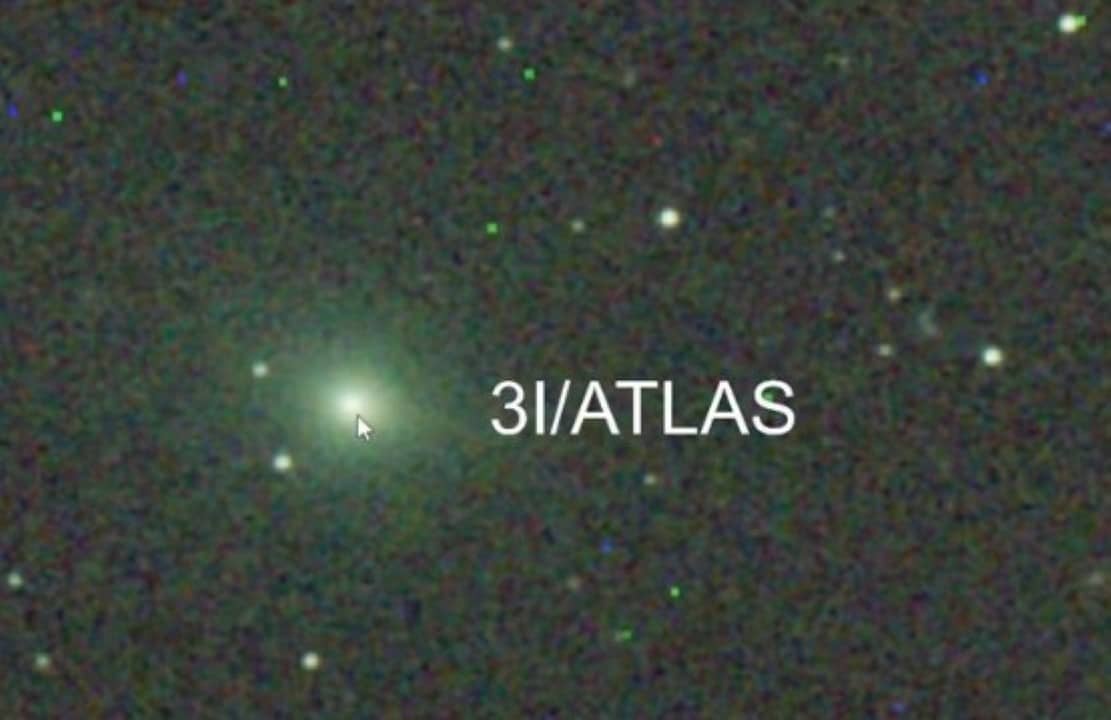
Telescópio Espacial Hubble has provided new evidence about the complex dynamics of the interstellar object 3I/ATLAS, revealing a peculiar behavior in its outgassing structure. Análises carried out using data captured between the end of November and December 2025 shows that the celestial body not only releases material into space, but does so through a rhythmic and synchronized pattern.
Detailed observations, processed after the object passed through perihelion, identified the presence of three distinct jets that operate in conjunction with the rotation of the nucleus. Diferente of comets that exhibit random or chaotic emissions, 3I/ATLAS exhibits a physical choreography that suggests intense internal processes and an active nuclear structure.

Astronomers focused their attention on the most prominent jet, positioned in the opposite direction to Sol, which demonstrates a technical angular motion called a “wobble.” Este phenomenon is not static; it follows a precise time cycle, indicating that surface activity is intrinsically linked to the rotation mechanics of the interstellar visitor.
Among the main discoveries quantified by the Hubble instruments, the following stand out:
– A jet oscillation cycle lasting approximately 7.20 hours.
– An angular variation that covers approximately 20 degrees during movement.
– Alterações in the total luminosity of the object in the order of 30%.
– A brightness rotation period calculated at 7.136 hours.
Spin dynamics and core characteristics
The consistency between the period of oscillation of the jets and the variation in brightness reinforces the hypothesis of a direct connection with the comet nucleus. The physical explanation for this behavior lies in precession or nutation phenomena, which occur when there is a fundamental misalignment between the object’s axis of rotation and its main axes of symmetry.
Experts point out that the rotation axis of 3I/ATLAS remains aligned close to the solar direction, with a stability margin of 20 degrees. Essa configuration favors the maintenance of the gas and dust structures that are emanated, allowing telescopes to capture the morphology of the jets clearly.
In terms of physical dimensions, current estimates suggest that the object’s core has a diameter of approximately 2.6 kilometers. However, direct visualization of this solid surface is made difficult by the comet’s own activity. Apenas cerca de 1% da luz captada pelos equipamentos resulta da reflexão solar no núcleo, enquanto a vasta maioria do brilho provém da dispersão de luz nos materiais ejetados.
Geometric mapping of emissions
The morphological mapping carried out allowed us to determine the exact position and individual behavior of each of the three identified jets. The first jet has a position angle of 55 degrees, while the third has an angle of 170 degrees, creating a specific spatial configuration around the nucleus.
The second jet, projected towards the sun at 290 degrees, stands out for demonstrating the greatest amplitude of movement among the observed emissions. Já the antisolar jet acts as an accurate indicator of rotational dynamics, alternating its shape between collimated structures and fan configurations as the nucleus rotates.
The 7.1-hour periodicity observed in the variations in brightness and movement is linked to the rotation of this misaligned nucleus. Pesquisas comparisons indicate that similar modulations had already been detected in phases prior to the maximum approach of Sol, suggesting that this dynamic is a persistent characteristic of the object.
The three-jet system maintains a designed separation of 120 degrees from each other. Essa symmetry, combined with rhythmic oscillation, highlights the physical complexity of this celestial body and provides crucial data for understanding the formation and behavior of objects from outside our solar system.



