
New radio signal reveals extreme object at the center of the galaxy and could prove Einstein’s theory

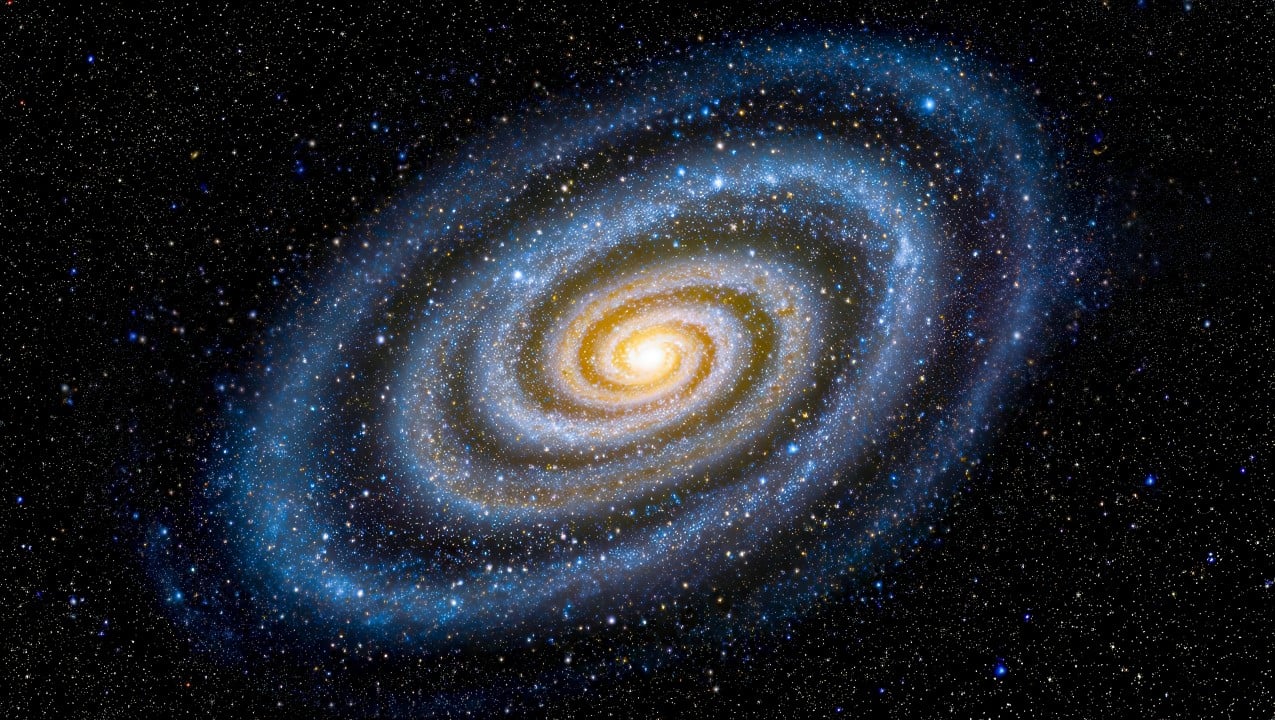
Astronomers linked to the Breakthrough Listen project have identified a peculiar radio signal coming from the depths of Via Láctea, indicating the presence of a rare cosmic object in the vicinity of the supermassive black hole Sagitário A*. The detection points to a candidate millisecond pulsar, a type of neutron star that spins at breakneck speeds. Analysis of the data suggests that the celestial body completes a rotation on its own axis every 8.19 milliseconds, which corresponds to an impressive frequency of 122 revolutions per second.
The observations that led to this discovery were carried out using the radio telescope Caso the existence of this object is confirmed by subsequent studies, it will become a crucial tool for modern physics, allowing tests of unprecedented precision in extreme gravity environments.

Challenges of observation at the galactic center
The core of Via Láctea is a chaotic, overcrowded environment filled with massive stars, molecular clouds and stellar remnants orbiting the central black hole. Essa configuration creates a natural barrier to conventional astronomical observation, as interstellar dust almost completely blocks visible light. To get around this obstacle, scientists rely on radio waves, which have wavelengths long enough to pass through dust clouds without being absorbed, revealing what hides at the heart of the galaxy.
Despite the penetration capacity of radio waves, the search for pulsars in this region has proven to be more complex than theoretical models predicted. The expectation of the scientific community was to find a large population of these objects orbiting Sagitário A*, but detections have been scarce. The newly discovered candidate, tentatively named BLPSR, was the only one found after an exhaustive analysis of the data, raising questions about the actual density of active neutron stars in this area or the efficiency of current detection methods amid the galactic background noise.
Physical characteristics of the detected object
The captured signal presents a dispersion measurement that is consistent with a distance of approximately 26 thousand light years from Terra, positioning the object exactly in the central region of the galaxy. The research team dedicated more than 20 hours of observation focused specifically on this internal area, managing to identify regular pulses that remained constant throughout multiple scanning sessions. Essa regularity is the classic signature of a pulsar, which functions as a high-precision cosmic beacon.
For an object to emit signals with this frequency and stability, it must possess extreme physical properties that defy the imagination. Preliminary analysis of BLPSR data indicates characteristics that classify it as a natural high-energy physics laboratory. The main properties expected for this celestial body include:
– A mass equivalent to up to twice that of Sol, compressed into a sphere just 20 kilometers in diameter, resulting in an unimaginable density.
– A magnetic field billions of times more intense than that of Terra, capable of accelerating particles to speeds close to that of light.
– The continuous emission of radio beams from the magnetic poles, which sweep across space as the star rotates, creating the observed pulse effect.
– A stable rotation of 122 times per second, typical of pulsars that have been “recycled” by absorbing matter from a companion star over millions of years.
Laboratory for the theory of relativity
The strategic location of this candidate pulsar offers a unique opportunity to test the limits of Teoria, Relatividade Geral, and Albert Einstein. Sagitário A* has a mass estimated at four million times that of Sol, exerting a dominant gravitational influence on its surroundings. An object orbiting so close to this gravitational giant would be subject to severe relativistic effects, which could be measured with the precision of atomic clocks through the timing of radio pulses.
Among the expected phenomena, scientists seek to measure the temporal delay in pulses caused by the passage of radio waves through the black hole’s intense gravitational field, in addition to the precession of the pulsar’s orbit and the deflection of the light’s trajectory. Qualquer deviation, however small, in the predictions of general relativity could open doors to new physics, or, as is more likely, provide the most robust confirmation of the theory ever obtained in a strong field regime, something impossible to replicate in terrestrial laboratories.
Future prospects and confirmation
Science demands rigor and definitive confirmation of the BLPSR still depends on new verification steps. The team responsible for the discovery is planning follow-up observations to refine the orbital parameters and exclude any possibility of terrestrial interference or artifacts in the processed data. Releasing the raw data to the international community allows other independent groups to carry out their own analyses, strengthening the validity of the finding.
The future of radio astronomy promises to revolutionize this field of study with the entry into full operation of projects such as Square Kilometre Array (SKA). With antennas distributed across África of Sul and Austrália, the SKA will dramatically increase the sensitivity and resolution of observations of the galactic center. Espera This new generation of instruments is expected to not only confirm the nature of the BLPSR, but also reveal a hidden population of pulsars, enabling detailed mapping of stellar dynamics and the distribution of dark matter at the heart of Via Láctea.




