
Thousands venerate bones of Saint Francis of Assisi in unique exhibition in central Italy

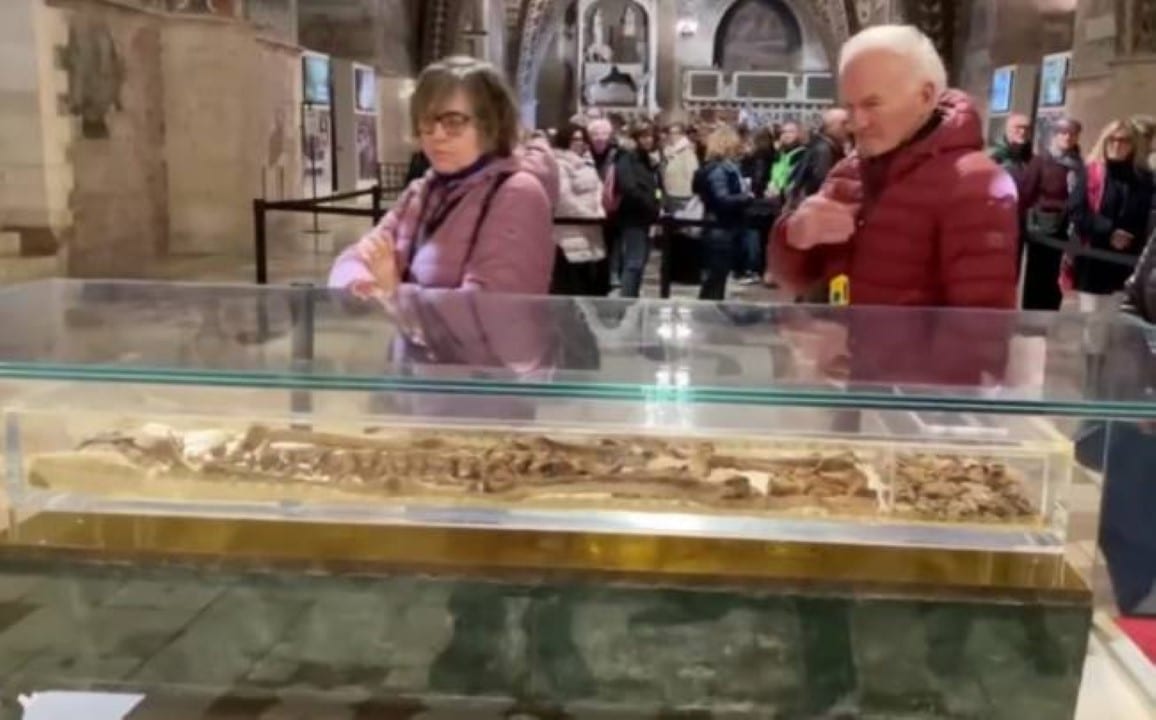
The remains of São Francisco of Assis were put on public display for the first time in history, at Basílica of The exhibition began on Sunday, February 22, 2026, and continues until March 22, 2026, marking 800 years since the saint’s death, which occurred in 1226. Milhares of pilgrims have already visited the site on the first day, with around 400,000 people expected to attend during the period. The bones are arranged in a transparent, bulletproof acrylic reliquary, positioned in front of the altar of the basilica’s lower church, allowing direct veneration.
The skeleton was exhumed from the sarcophagus in the crypt on the morning of Saturday, February 21, 2026, in a ceremony reserved for the Franciscan friars. Após the ceremonial transfer to the lower church, around 300 friars participated in a solemnity of Vésperas on the same day. The initiative offers an unprecedented opportunity for believers and visitors to pray in front of the relics, in an environment of silence and prayer. The Latin inscription “Corpus Sancti Francisci” identifies the contents of the showcase.
Exhumation and transfer of relics
The remains remained hidden for centuries inside the stone sarcophagus in the basilica’s crypt. Frades Franciscans carried out the exhumation with care to preserve the integrity of the bones. The remains were then arranged on a special table in the crypt before moving.
The transfer took place solemnly, with the exclusive participation of the Franciscan community. The reliquary was filled with nitrogen for proper conservation. The basilica’s lower church was prepared to receive the public from the following day.
Historical significance of the exhibition
They are Francisco of Assis, born around 1181 or 1182 in Assis, renounced family wealth to adopt a life of poverty and service. Ele founded Ordem of Frades Menores and is recognized as patron saint of Itália, ecology, animals and peace. Seu meeting with Sultan al-Kamil during the Cruzadas, in 1219, exemplifies his search for dialogue and fraternity.
The relics were discovered in 1818, after excavations, as the body had been protected in an iron cage to prevent theft. A brief, limited exhibition took place in 1978, but there has never been a prolonged public exhibition like the current one. The exhibition reinforces the saint’s legacy of peace and collaboration.
Open house details
Pilgrims need to make an appointment in advance to access the veneration, according to official guidelines from the basilica. The reliquary is positioned in an easy-to-view location, ensuring security and order. Milhares attended the opening day, with organized queues and a respectful atmosphere.
The exhibition takes place amidst the VIII Centenário celebrations of the death of São Francisco. Missas international highlights the diversity of visitors. The focus remains on prayer and reflection on the saint’s message.
Contemporary legacy of the saint
The figure of São Francisco continues to inspire believers and non-believers alike through its emphasis on simplicity and mutual service. Seu example of a life based on collaboration, rather than competition, remains current. Papa Francisco adopted the name in reference to the saint and cited his teachings in documents about the environment.
The initiative allows us to rediscover aspects of the Poverello trajectory, such as love for nature and the promotion of peace. The basilica receives visitors from different backgrounds during the period.
Preparations and public expectations
The Franciscan community organized the logistics to accommodate the expected large influx. Medidas security features include secured reliquary and access control. The city of Assis is preparing for an increase in pilgrims over the course of a month.
The event represents a milestone for Igreja and the Umbria region. Visitantes can participate in moments of collective prayer in front of the relics.
Access and practical guidance
Visitors pass through metal detectors before entering the worship area. The basilica maintains regular opening hours, adapted to the flow. Agendamentos help to avoid excessive crowding.
The exhibition invites personal reflection in a sacred space. Peregrinos report experiences of spiritual renewal when witnessing the relics.



