
Detection of millisecond pulsar at the center of the Milky Way opens the way for unprecedented tests of relativity

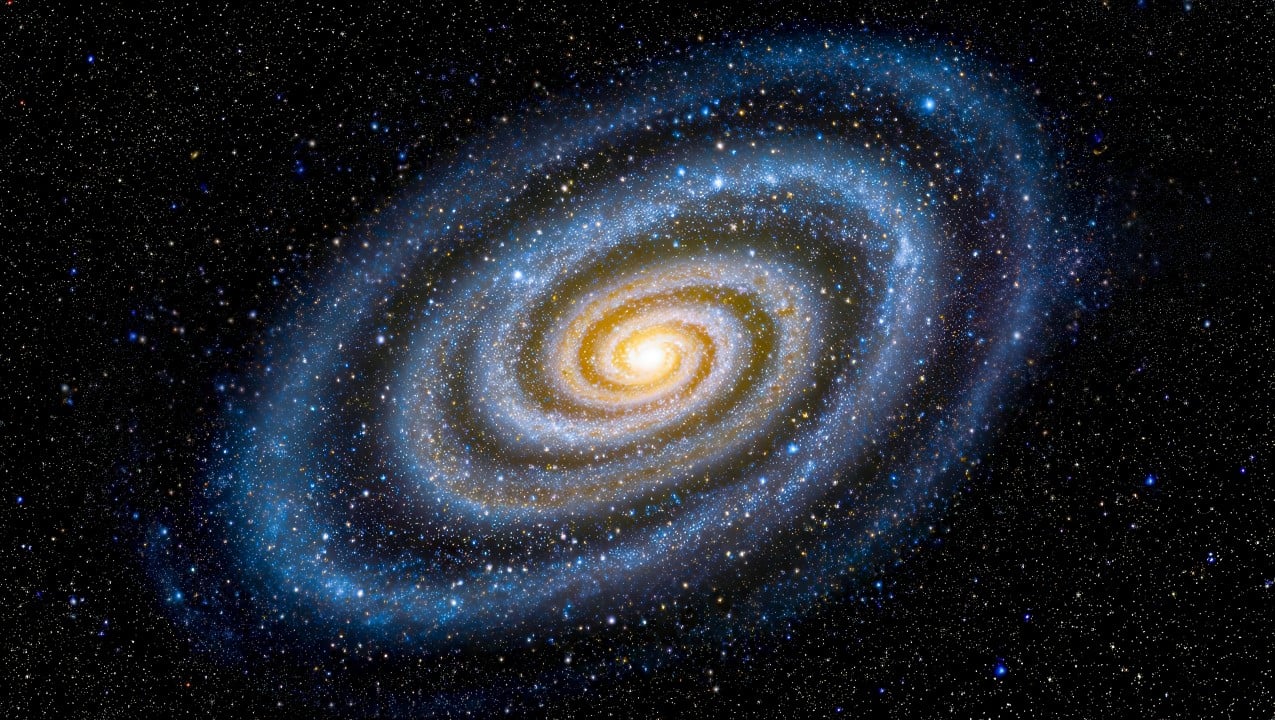
Researchers linked to the Breakthrough Listen project have identified a unique radio signal originating in the depths of the galaxy, suggesting the existence of a rare cosmic object in the vicinity of Sagitário A*. The discovery points to a candidate millisecond pulsar, an extremely fast-rotating neutron star. Dados Preliminaries indicate that the celestial body completes a rotation on its axis every 8.19 milliseconds, generating a frequency of 122 revolutions per second.
The analyzes were conducted using the radio telescope Caso confirmed, this celestial body will serve as an essential tool for precision testing in intense gravity environments.

Natural barriers to astronomical observation
The galactic core acts as a hostile, overcrowded environment where molecular clouds, massive stars, and stellar remnants orbit the gravitational center. Interstellar dust almost completely blocks visible light, forcing scientists to use radio waves that can cross these physical barriers and reveal what is hidden. Mesmo With this technology, locating pulsars in the region remains a significant technical challenge.
Theoretical models have suggested a vast population of these objects around Sagitário A*, but actual detections have been scarce. The current candidate, tentatively named BLPSR, appears as an exception amid the background noise, raising debates about the actual density of active neutron stars in this area and the efficiency of current search methods.
Extreme object properties
The consistency of the captured signal suggests a distance of approximately 26 thousand light years from Terra, positioning the object exactly in the central zone of the galaxy. Observações focused for more than 20 hours confirmed the regularity of the pulses, an essential characteristic of a “cosmic clock”. The estimated physical properties for the BLPSR describe an extreme energy scenario, as indicated by preliminary data:
– Massa equivalent to up to twice that of Sol, compressed into a sphere just 20 kilometers in diameter.
– Magnetic Campo billions of times superior to terrestrial, capable of accelerating particles to speeds close to that of light.
– Emissão continuous radio beams from the magnetic poles, creating the pulse effect observed during rotation.
– Rotational Estabilidade typical of “recycled” pulsars, which have absorbed matter from a companion star for long periods.
Laboratory for modern physics
The strategic location of this candidate offers a unique opportunity to test the limits of Teoria and Relatividade Geral. The proximity to Sagitário A*, which has four million times the solar mass, subjects the object to severe gravitational effects. Cientistas hope to use the precision of radio pulses to measure phenomena predicted by Einstein, such as the temporal delay and deflection of light caused by the black hole’s gravity.
Any deviation from theoretical predictions could indicate new paths for physics, although the most likely scenario is robust confirmation of relativity in a strong field regime. Esse type of verification is impossible to replicate in terrestrial laboratories, making the BLPSR discovery a potential milestone for astrophysics.
Validation and future of research
Official confirmation of the nature of the object awaits further verification steps to eliminate any possibility of terrestrial interference or data processing failures. The responsible team plans follow-up observations and the release of raw data for independent analysis by the international community, ensuring the necessary scientific rigor.
The advancement of projects such as Square Kilometre Array (SKA), with antennas distributed across África of Sul and Austrália, promises to revolutionize the sensitivity of observations of the galactic center. The coming into full operation of these instruments should not only confirm BLPSR, but also reveal a hidden population of pulsars, allowing detailed mapping of stellar dynamics and dark matter distribution in Via Láctea.




