
Recent images of the Tarantula Nebula reveal gravitational web and formation of giant stars


Astronomers have presented a detailed mapping of Nebulosa Tarântula, located in Grande Nuvem of Magalhães, which reveals a complex structure of gas filaments that resembles a gigantic spider web. The new observations indicate that gravity plays a fundamental role in the organization of this matter, directly influencing the birth of massive stars in the region. The study used combined data from different light spectrums to understand the internal dynamics of this neighboring stellar nursery.
Located approximately 160,000 light-years from Terra, in the constellation of Dorado, the nebula is one of the most active and bright star-forming regions of the Grupo Local of galaxies. Recent research has managed to penetrate the dense clouds of dust and gas that make up the astronomical object, allowing scientists to visualize how the cold gas collapses under its own gravity. Esse process is essential for the creation of new celestial bodies, even in an environment dominated by intense radiation from already formed stars.
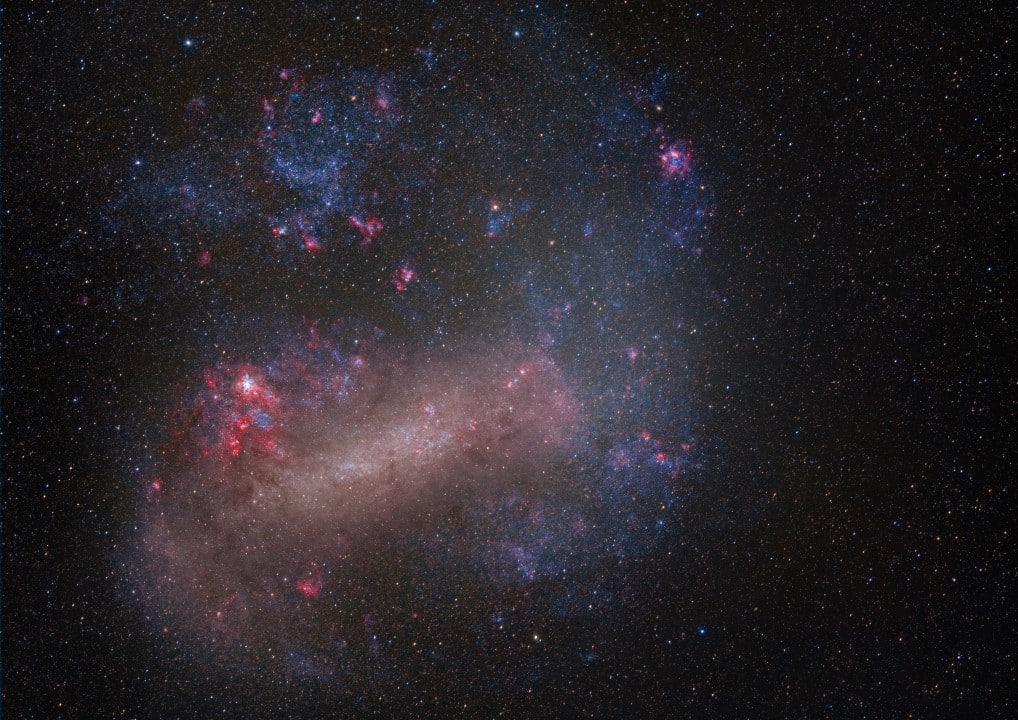
The results indicate that the nebula’s filamentary structure is not random, but rather the result of gravitational forces that shape interstellar gas into defined patterns. The areas of greatest density in these filaments become the places where gravitational collapse is inevitable, giving rise to protostars that will eventually become giant stars. The discovery offers a new perspective on how irregular galaxies manage to maintain high rates of stellar production.
Combination of observation technologies
To achieve this level of detail, researchers integrated data from cutting-edge instruments operated by Observatório Europeu from Sul (ESO) and international partners. The superimposition of images captured at different wavelengths made it possible to differentiate the temperatures and compositions of the gases present in the nebula. The simultaneous use of these technologies was crucial to identifying the cosmic “web” that connects star-forming regions.
Observations were mainly based on the following technical capabilities:
– The Atacama Large Millimeter/submillimeter Array (ALMA) has mapped carbon monoxide emissions, revealing the cold, dense gas that fuels new stars.
– The Very Large Telescope (VLT) and the VISTA survey telescope captured infrared images, showing hot gas and young stars that would be hidden in visible light.
– The combination of data generated a three-dimensional map of the distribution of matter, highlighting the interaction between stellar winds and local gravity.
This multispectral approach eliminated the visual barriers imposed by cosmic dust, providing a clear view of the nebula’s interior. The precision of the data allowed astronomers to measure the speed of the gas in the filaments, confirming that matter flows toward the central clusters under the influence of gravity.
Natural laboratory of the primitive universe
Nebulosa Tarântula has unique chemical characteristics that make it an excellent laboratory for studying conditions in the early universe. Sua composition has a low concentration of heavy elements, known in astronomy as metals, which resembles the environment of galaxies that existed around 10 billion years ago. Esse period, known as “cosmic noon”, was the era of greatest star production in the history of the universe.
Studying the physical processes in Tarântula allows scientists to infer how the first generations of stars formed and evolved. The proximity of Grande Nuvem to Magalhães offers a rare opportunity to observe these phenomena in high resolution, something impossible to do in distant galaxies that actually belong to the young universe. The current findings suggest that gravity shaped ancient galactic structures in a similar way to what is observed today in the vicinity of Via Láctea.
The role of gravity versus stellar feedback
One of the central points of the study was to analyze the competition between gravity, which attracts matter, and stellar feedback, which tends to disperse it. Massive Estrelas, which can be more than 150 times the mass of Sol, emit powerful winds and intense ultraviolet radiation, creating bubbles of hot gas and pushing surrounding material. Havia a doubt as to whether this energy would be enough to stop the formation of new stars by fragmenting gas clouds.
The new images show that, despite the energetic violence of massive stars, gravity continues to dominate in many parts of the nebula. The filaments of dense gas resist the pressure of stellar winds, maintaining their integrity and allowing the cycle of stellar birth to proceed. Isso indicates that the formation process is robust and self-sustaining, even in extreme and chaotic environments.
This resistance of gravitational structures explains why Nebulosa Tarântula maintains an exceptionally high star formation rate, surpassing other known regions, such as Nebulosa and Órion. Gravity’s ability to overcome energetic feedback ensures a continuous supply of gas to stellar nurseries, perpetuating activity in the region for millions of years.
Impact on the evolution of galaxies
The dynamics observed in Tarântula have direct implications for understanding the evolution of entire galaxies. The movement of gas and the formation of star clusters influence the global structure of Grande Nuvem and Magalhães and, possibly, its interaction with Via Láctea. Material ejected by supernovae and stellar winds enriches the interstellar medium, but local gravity determines where this material will be recycled into new stars.
Computational models, fed by new observational data, are being updated to reflect this predominance of gravity in the filaments. Essas simulations help predict how dwarf and irregular galaxies evolve over eons, transforming their reservoir gas into complex stellar populations.




