
Study finds excess carbon in rocks on Mars and scientists investigate traces of ancient life


A recent investigation conducted by scientists associated with the North American space agency has brought to light revealing data about the chemical composition of Planeta Vermelho, challenging currently accepted geological models. The information, published in the scientific journal Astrobiology in February 2026, indicates that known inorganic processes are insufficient to justify the high concentration of certain organic materials found in Martian soil. The focus of the study is on samples collected at Cratera Gale, highlighting a significant discrepancy between the amount of molecules detected and what would be expected from non-biological sources, such as meteorites or atmospheric reactions.
The data was obtained through the mobile laboratory of the Curiosity rover, which continues to operate on the planet’s surface. The analyzes showed the presence of long carbon chains, specifically decane, undecane and dodecane. The integrity and abundance of these compounds have raised the hypothesis that ancient biological sources may be a plausible explanation for the origin of these materials, since known geological mechanisms produce quantities much lower than those observed.
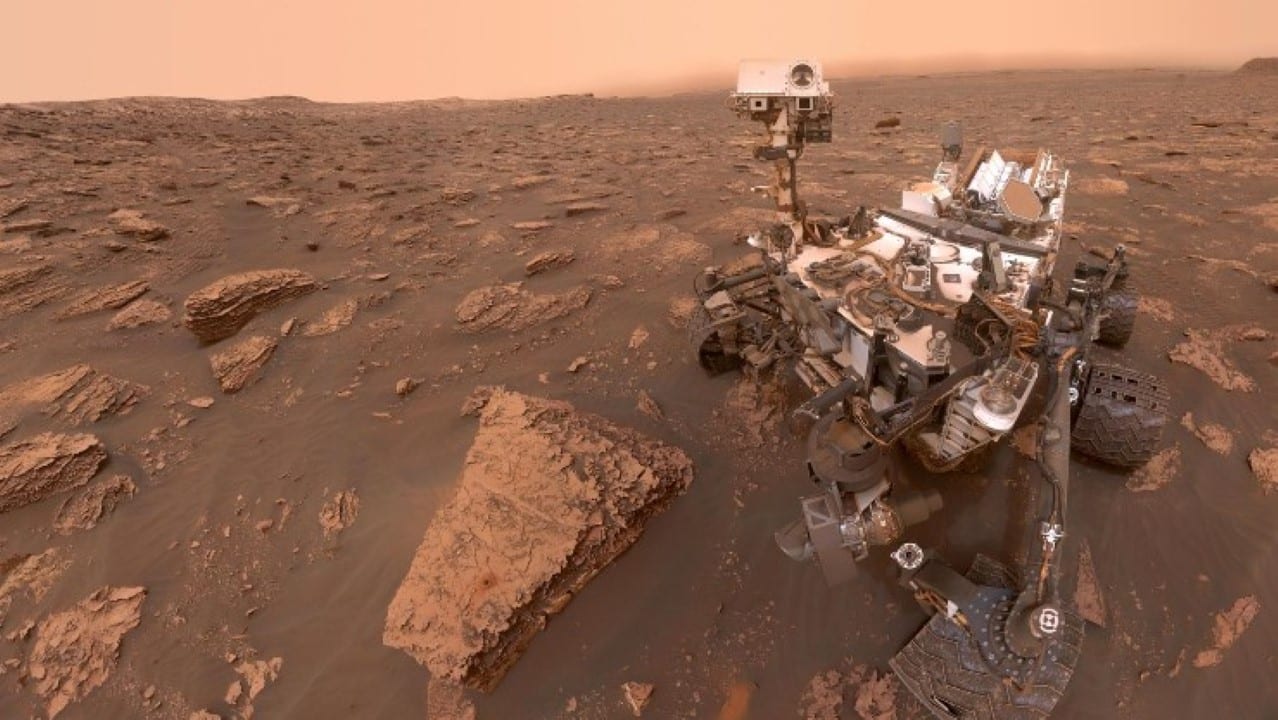
The physical detection of these molecules originally occurred in March 2025, but complex mathematical modeling and laboratory radiation testing were required to understand the context of their preservation. The researchers estimate that the rock analyzed was exposed to cosmic radiation for around 80 million years, a factor that normally degrades organic matter, making the remaining amount a surprise to the scientific community.
To validate the findings, the team performed comparative simulations of the environment of Marte, applying radiation doses equivalent to millions of years of surface exposure. The goal was to go back in geological time and calculate the original composition before environmental degradation. The results demonstrated that the “starting material” was far more abundant than any standard solar system process could deposit or create.
Details about chemical detection
The molecules that star in this study belong to the class of long-chain alkanes. Na Terra, similar chemical structures are often associated with biological processes, being fundamental components of cell membranes and other vital structures. The identification of these elements in Marte, even in parts per billion, represents a breakthrough in planetary astrobiology.
It is believed that these molecules may be fragments of ancient fatty acids that were preserved in clay minerals. The rover’s analysis process, which involves heating samples to release volatiles, may have broken down even larger structures, resulting in the alkanes detected by the sensors. Essa possibility reinforces the theory that the chemical complexity of Marte may have been much higher in the remote past.
Limitations of traditional geological explanations
Before suggesting any biological origin, scientists exhausted the possibilities of abiotic sources. The first hypothesis evaluated was the contribution of organic material via meteorite impacts, which occur frequently on the geological time scale. However, calculations showed that the contribution of these celestial bodies would be insufficient to explain the presence of such a high amount of these long chains in the specific sample.
Another route investigated was spontaneous chemical reactions in the atmosphere or on the surface of Marte. While these processes are capable of generating simple organic molecules, they rarely produce complex and long structures such as dodecane in abundance. Além Furthermore, the rarefied atmosphere of Marte allows a lot of radiation to pass through, which tends to destroy these molecules quickly, not preserve them.
Hydrothermal processes, which occur in underground hot water sources, were also considered. Embora are environments conducive to prebiotic chemistry, current models still cannot fully explain the high levels found in Cratera Gale through this route alone. Isso leaves a gap in understanding that the biological hypothesis attempts to fill.
The role of Cratera Gale in preservation
The collection site, Cratera Gale, is fundamental to the context of this discovery. The region is recognized by scientists as an ancient lake that existed billions of years ago, offering an environment that could have supported microbial life. The presence of sedimentary layers indicates that the place has undergone several climatic changes over the ages.
The sample in question was extracted from an ancient mudstone rock. Esse type of sedimentary rock is known, including in Terra, for its ability to preserve organic matter. The clay and sediment compaction act as a physical barrier, protecting the molecules from ultraviolet degradation and the harsh cosmic radiation of Marte, allowing them to survive for long geological periods.
This natural “shield” is what allowed the Curiosity rover, which has been operating in the region since 2012, to detect these chemical signatures in 2025. The rover’s ability to drill and analyze material in situ reduces reliance on guesswork, providing direct data on the subsurface’s composition and history.
Future exploration prospects
The discovery of these long-chain alkanes is considered the most robust advance in terms of complex organic molecules ever recorded on the neighboring planet. Contudo, the scientific community maintains a cautious stance. Embora Although biological origin is a valid hypothesis given the lack of geological explanation, it still does not constitute definitive proof of past life.
The implications of this study guide the next steps in space exploration. Há a growing consensus that the search for signs of life should focus on protected environments, such as the deep underground or specific sedimentary rocks that have escaped radiation degradation. Novas drillings are being planned for locations with characteristics similar to those of the sample analyzed.
Future missions, like Mars Sample Return, aim to bring physical samples from Marte to Terra. Somente with the advanced equipment of terrestrial laboratories it will be possible to carry out isotopic and molecular analyzes that will be able to confirm, beyond doubt, whether these carbon chains are in fact “molecular fossils” of ancient organisms or the result of an as yet unknown geochemical process.



