
Study indicates merger of ancient moons as key to understanding Titan and Saturnian ring system

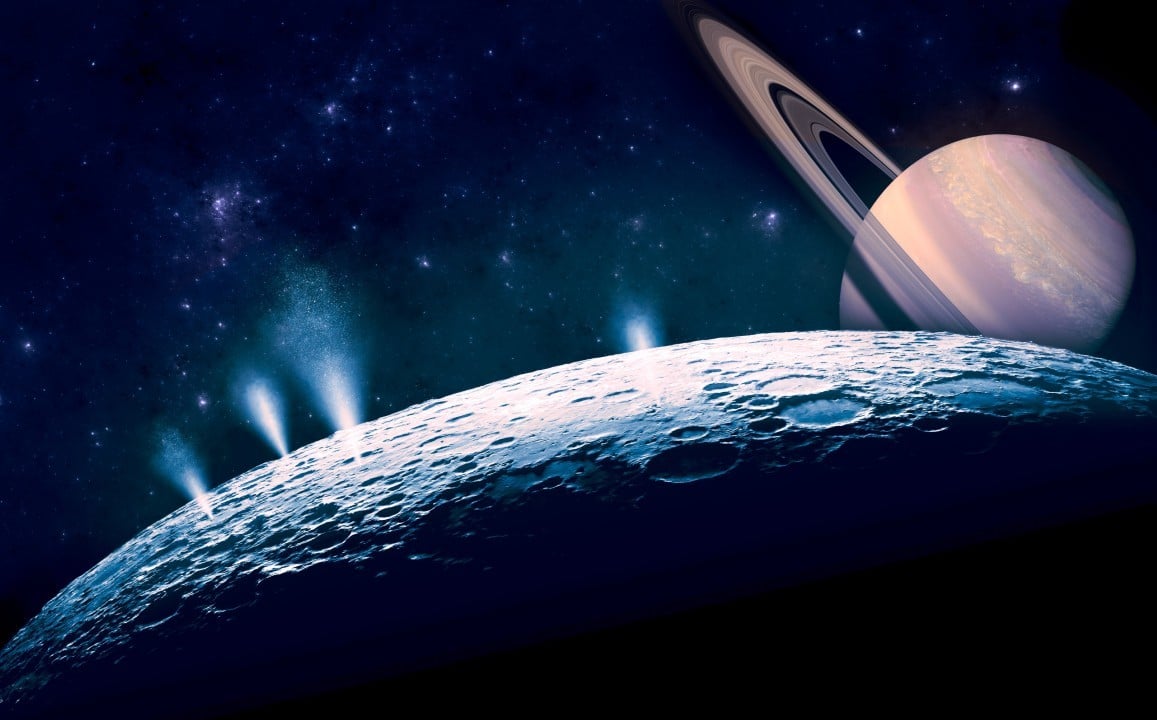
New scientific research suggests that Titã, the largest moon in Saturno, may have formed from the merger of two ancient moons. The study, led by experts in planetary dynamics, combines data from the Cassini mission with computer simulations to explain not only the origin of Titã, but also the formation of the planet’s famous rings and its orbital inclination.
The researchers indicate that the event occurred about 100 to 160 million years ago, involving a collision between a precursor to Titã and another moon, possibly related to Hiperião. Essa cosmic interaction altered the orbits and contributed to the current system of Saturno, solving long-standing mysteries about its evolution.
The theory refines previous ideas, such as the existence of a hypothetical moon called Crisálida, and proposes that the merger released debris that organized itself into the rings observed today. Based on precise observations, the model explains discrepancies in resonance between Saturno and Netuno, highlighting the role of lunar gravity in planetary balance.
Cosmic origin of Titã
The formation of Titã through a collision between two ancient moons represents a breakthrough in understanding the Saturnian system. Scientists use evidence from the Cassini probe, which operated between 2004 and 2017, to support this hypothesis.
Data collected reveals that the orbit of Titã moves away from Saturno at a rate of about 11 centimeters per year. Essa orbital migration suggests past impacts that influenced its current position.
Orbital inclination and planetary resonance
The 26.7-degree tilt in the Saturno axis has intrigued astronomers for decades. The new theory attributes this characteristic to the gravitational interaction with Netuno, amplified by the presence of extinct moons.

Simulations show that, without the collision, the resonance between the planets would not be maintained. The event adjusted the oscillation period of Saturno, temporarily aligning it with that of Netuno.
The absence of perfect resonance today is explained by the disappearance of the additional moon after the merger. Esse fine-tuning resolves inconsistencies observed in telescopic data.
Hypothetical collision details
The precursor of Hiperião was estimated to be a thousand times larger than its current form, according to researchers’ calculations. Essa moon collided with a proto-Titan, resulting in merger and significant mass loss.
Fragments from the collision scattered, contributing to the formation of rings and possibly other smaller moons. The energy released altered orbital trajectories in the system.
Computer models indicate that the impact occurred in an unstable orbit, leading to partial disintegration. Essa dynamics explains the irregularity of Hiperião and its orbital relationship with Titã.
The resulting debris, composed of ice and rock, accumulated on the equatorial plane of Saturno. Over time, gravitational forces shaped these materials into the distinct rings observed.
Mission Dragonfly and future checks
NASA’s Dragonfly mission, scheduled for launch in 2028, promises crucial data about the surface of Titã. The nuclear aerial vehicle will analyze samples to detect signs of ancient impacts.
Experts hope that the analyzes will reveal chemical compositions compatible with a lunar merger. The absence of ancient craters on the surface of Titã, estimated to be 300 million years old, supports the collisional renewal scenario.
Evolution of the Saturnian system
The theory integrates observations on the more than 80 moons of Saturno, many of them irregular and possibly captured. The merger of ancient moons may have triggered a chain of events, including the destabilization of inner satellites.
These interactions resulted in the current configuration, with Titã dominating as the second largest moon to Sistema Solar. Sua dense, nitrogen-rich atmosphere may have been preserved or evolved post-collision, influencing conditions for organic compounds.
Additional research examines how the tilt of Saturno affects its internal climate and magnetosphere. Past resonance with Netuno suggests dynamic cycles that shape gas giant planets.
The hypothesis also considers the migration of Titã, which continues to move away, potentially affecting neighboring moons in the distant future. Modelos predict stability in the system for billions of years, but continuous monitoring is essential.
Impacts on planetary science
This new perspective on Titã and the rings of Saturno challenges traditional models of lunar formation. Astrônomos now reconsider similar scenarios in other planetary systems, such as Júpiter and its Galilean moons.
Comparative studies with exoplanets reveal patterns of cosmic collisions common in early evolution. Merging moons may explain anomalies in axial tilts observed on distant worlds.
The research highlights the importance of space missions to validate theories. Dados of Cassini continue to generate insights, years after the end of the mission.
Composition and characteristics of Titã
Titan has a diameter of about 5,150 kilometers, larger than Mercúrio. Sua surface features lakes of methane and ethane, revealed by Cassini radars.
The thick atmosphere hides optical details, but probes detect dunes and mountains. Esses geological features suggest recent activity, compatible with past impacts.
Rings of Saturno in focus
The rings of Saturno stretch hundreds of thousands of kilometers, composed mainly of ice particles. Observações indicate that they are relatively young, estimated to be less than 100 million years old.
The collision theory explains its recent formation, contrasting with the planet’s age of 4.5 billion years. Detritos from the merger would have gradually clumped together.
Particles in the rings range from micrometers to meters, orbiting in distinct bands. Forças how the gravity of shepherd moons maintains their structure.
Spectroscopic studies reveal the purity of the ice, suggesting its origins in destroyed lunar materials. Essa composition reinforces the connection with the proposed collision.
Contributions from mission Cassini
The Cassini probe provided detailed images of Saturno’s rings and moons during its orbit. Medições accurate gravitational fields helped model past interactions.
Data on the density of Titã indicate a differentiated interior, possibly altered by mergers. The mission also mapped variations in axial tilt.
Prospects for future exploration
In addition to Dragonfly, telescopes such as James Webb observe Titã in infrared. Essas observations complement in situ data, refining formation models.
Proposals for additional robotic missions target return samples from the rings. Tais efforts could confirm the collisional origin directly.
International collaboration in astronomy accelerates advances, with agencies such as ESA contributing to analysis. Futuros studies integrate artificial intelligence for more complex simulations.
Detailed orbital dynamics
The resonance between Saturno and Netuno involves orbital periods that align periodically. The theory adjusts this model by including the mass of extinct moons for past equilibrium.
Back calculations show that, 160 million years ago, the configuration allowed perfect resonance. The current misalignment results from post-collision lunar mass loss.
Hyperion, with its irregular shape, exhibits evidence of fragmentation. Sua orbit synchronized with Titã suggests residue from the original merger.
Hydrodynamic models simulate the impact, predicting ejection of material that forms rings. Essas simulations consider relative velocities and chemical compositions.
Young surface of Titã
The scarcity of craters on Titã indicates recent resurfacing. Processos such as methane erosion and cryovolcanism mask ancient impacts.
Studies estimate surface age at 300 million years, in line with the proposed collision. Essa renewal explains the presence of complex organic molecules.
Implications for astrobiology
Titan harbors prebiotic conditions, with hydrocarbons forming liquid “seas.” Lunar fusion may have introduced elements that fostered organic chemistry.
Research is exploring whether impacts warmed the interior, creating underground habitats. Dragonfly will look for signs of primitive life in samples.
Evolution of rings
Os anéis de Saturno evoluem sob influência de micrometeoritos e radiação solar. Sua juventude relativa sugere formação dinâmica, não primordial.
Alternative theories proposed origin from captured comets, but the lunar collision offers an integrated explanation. Observações continuous monitors its gradual dissipation.



